
TaxoSoft: Bridging the Semantic Gap in Soft Skill Extraction
Building a soft skill taxonomy from job openings
This paper introduces TaxoSoft, a multi-source methodology for building a comprehensive soft skill taxonomy from job advertisements. By combining structured knowledge from DBpedia with semantic embeddings from Word2Vec, the authors successfully extract diverse terminologies and inflections used to denote soft skills, achieving a state-of-the-art F-score of 0.84.
TL;DR
Soft skills are the "silent power" of the job market, yet they are notoriously difficult to track automatically. TaxoSoft is a new methodology that combines the structured "wisdom of the crowd" from DBpedia with the contextual intelligence of Word2Vec. It boosts the accuracy of identifying soft skills like "Active Listening" or "Conflict Resolution" by over 50% compared to existing industry standards.
Background & Positioning
In the academic coordinate system, this work resides at the intersection of Information Extraction (IE) and Labor Market Economics. While previous SOTA (State of the Art) systems like ESCO or LinkedIn's folksonomy excelled at identifying "Python" or "Accounting" (hard skills), they struggled with the linguistic fluidity of soft skills. TaxoSoft moves beyond simple keyword matching to grasp the underlying intent of recruiters.
The "Soft Skill" Problem: More than Synonyms
Why is extracting "Teamwork" harder than "Java"?
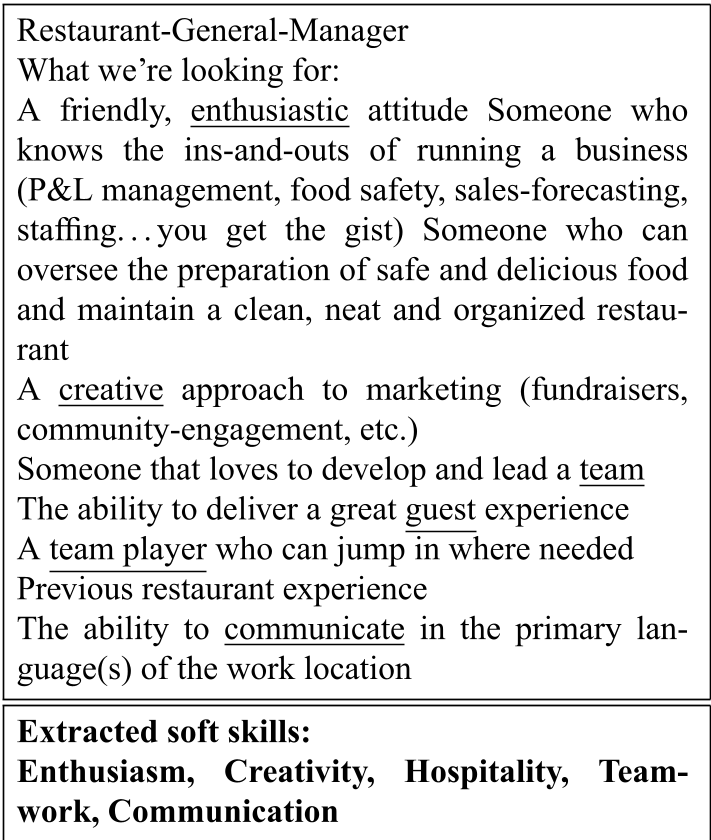
- Iterative Forms: It can be a noun (Teamwork), an adjective (Team-player), an adverb (Collaboratively), or a verb (Collaborate with others).
- Semantic Overlap: "Active listening" is a subset of "Communication," but how does a machine learn that hierarchy?
- Terminology Variety: Recruiters use colorful language that standard thesauruses (like WordNet) often lack.
Methodology: The Hybrid Intelligence of TaxoSoft
The authors' core insight is that Structured Data (DBpedia) provides "what is related," while Unstructured Data (Word2Vec) provides "what is relevant."
1. The Dual-Pass Pipeline
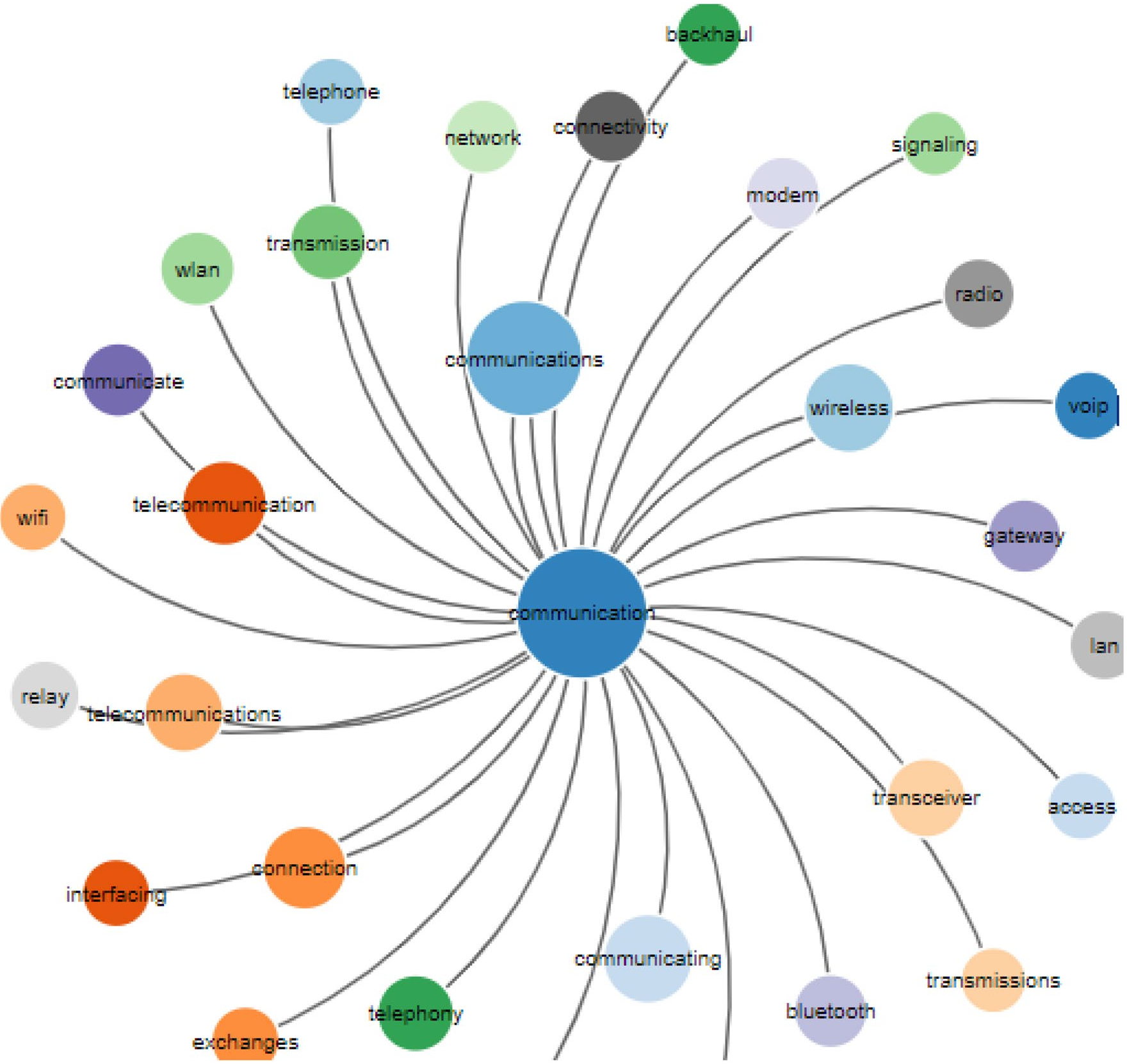
The system queries DBpedia for "wikilinks" (internal hyperlinks) to find broad relations. It then subjects these terms to a Word2Vec filter trained specifically on a corpus of 380,000 job ads. This ensures that while DBpedia might suggest "Coaxial Cable" for "Communication" (technically related), the Word2Vec filter will discard it in favor of "Interpersonal Skills."
2. Building the Hierarchy
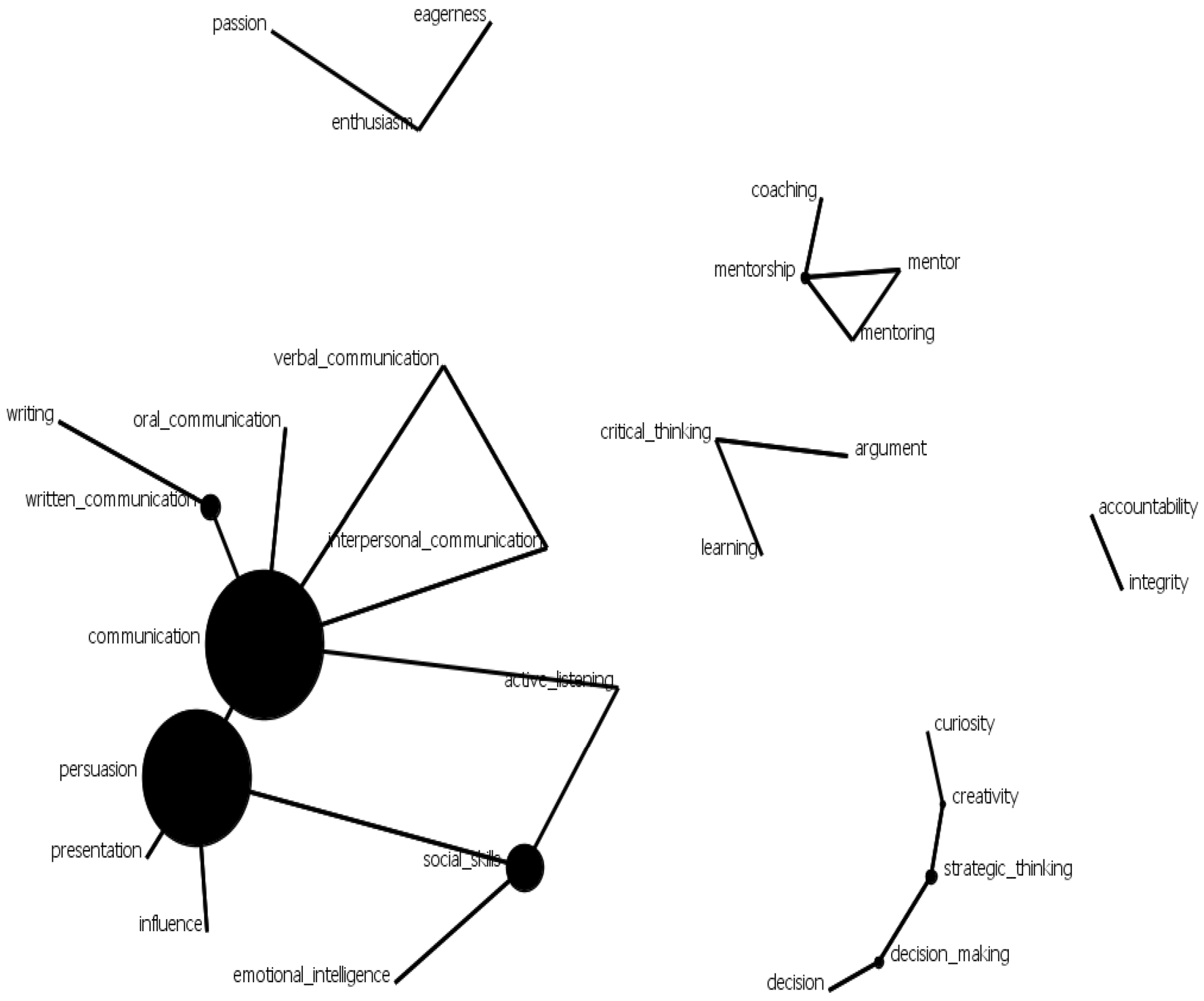
To turn a list of words into a structured taxonomy, the authors represented terms as nodes in a network. By calculating Betweenness Centrality, they identified "hub" skills. A node with high centrality is likely a parent skill (e.g., Communication) connected to specialized sub-skills (e.g., Oral Communication).
Experiments and Market Insights
TaxoSoft was tested on both English and French datasets. The performance leap is substantial:
| Method | English F-score | French F-score |
|---|---|---|
| ESCO (Industry Standard) | 17% | 2% |
| General Knowledge Base | 54% | 57% |
| TaxoSoft | 84% | 80% |
Key Market Takeaways:
- Education Correlation: The higher the required degree (Master's vs. Associate), the more soft skills are explicitly requested.
- Sector Specificity: In Banking, "Analytical Skills" dominate; in Medicine, "Accountability" is the priority.
- Skill Clusters: "Critical Thinking" rarely appears alone—it co-occurs in clusters with "Problem Resolution" and "Curiosity."
Critical Analysis & Future Outlook
The beauty of TaxoSoft lies in its Inductive Bias—it assumes that the context of job ads is the ultimate arbiter of meaning. However, its reliance on Word2Vec is a limitation in 2024+ (given the rise of Large Language Models and context-aware embeddings like BERT/GPT).
Future Work: The methodology could be significantly enhanced by replacing Word2Vec with Sentence Transformers to better capture the nuance of phrases like "thinking outside the box" which are currently handled by N-gram splitting.
Conclusion
TaxoSoft provides a robust blueprint for universities and recruitment platforms. By moving from "Keywords" to "Taxonomies," we can finally map the soft skills gap with mathematical precision, helping graduates understand exactly what "Accountability" and "Integrity" look like in the eyes of an employer.