
Building a Task Blacklist: Shielding the Web from Crowdsourced Manipulation
Building a task blacklist for online social platforms
The paper introduces a framework to detect and catalog malicious "crowdturfing" campaigns on crowdsourcing platforms. By training a Random Forest classifier on a manually labeled dataset, the authors identified over 51,000 new malicious campaigns from a massive 446K-campaign dataset and deployed a public "Task Blacklist" web service.
TL;DR
As crowdsourcing platforms like Amazon Mechanical Turk grow, so does their misuse for "crowdturfing"—hiring humans to manipulate search rankings and leave fake reviews. This paper presents a high-accuracy classification framework (99.4% accuracy) that detected over 51,000 malicious campaigns and hosted them in a searchable Task Blacklist web service to help platforms and workers identify fraudulent activity.
Background: The Dark Side of Micro-tasks
While most crowdsourcing is legitimate (e.g., image labeling), a subset of "requesters" uses these platforms to attack the integrity of the digital ecosystem. These campaigns target e-commerce via "Add to Favorites" manipulation, search engines via SEO spam, and social media via fake accounts. Prior work proved these tasks often have distinct signatures—higher pay for shorter durations—but lacked a scalable, public mechanism to track them.
Methodology: Beyond Simple Keyword Matching
The authors’ approach transforms raw campaign data into a structured feature space, treating malicious detection as a binary classification problem.
The Feature Engineering Pipeline
The system extracts several categories of features:
- Financial & Effort Metrics: Reward rate, hourly wage (often higher for unethical tasks), and Estimated Time to Complete (ETC).
- Structural Metadata: Number of URLs, words in titles, and word count of instructions.
- Textual Nuance: Utilizing TF-IDF vectors for unigrams/bigrams/trigrams. Interestingly, the authors found that the sequence of concatenation (Title + Instruction vs. Instruction + Title) affects n-gram generation and subsequent model performance.
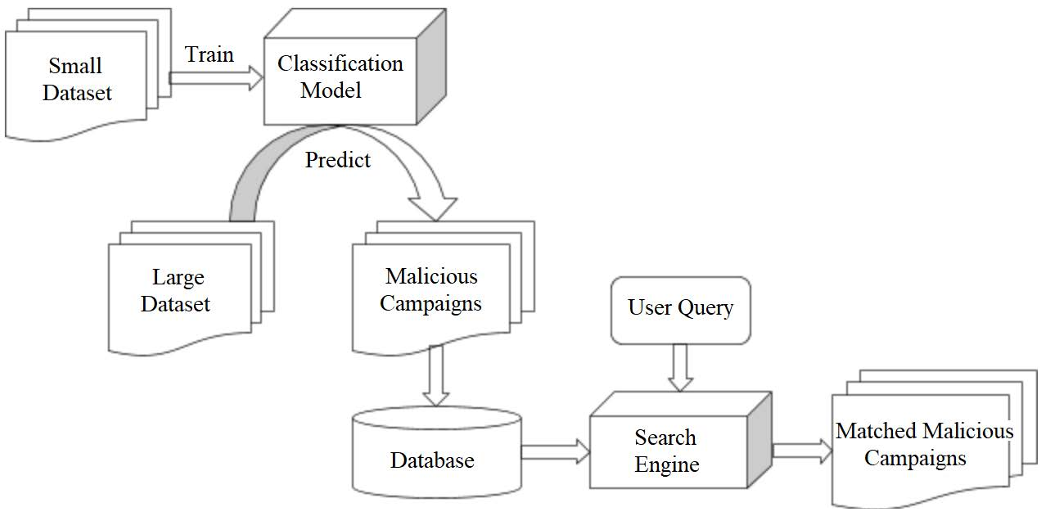 Figure 1: The high-level workflow from data crawling to the deployment of the Task Blacklist.
Experiments: Random Forest Takes the Lead
The study compared five algorithms: SVM (the previous baseline), Decision Trees (CART), Random Forest, Gradient Boosting, and XGBoost.
The Random Forest model emerged as the clear winner. By leveraging an ensemble of trees, it better captured the non-linear relationships between "too-good-to-be-true" pay rates and the textual patterns of unethical requests.
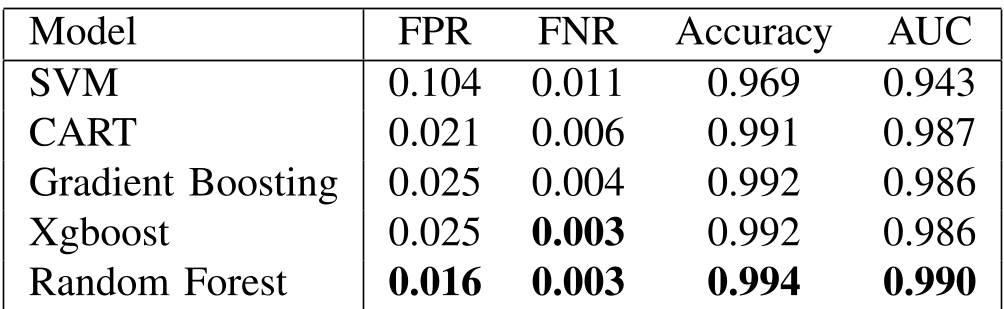 Table 1: Performance comparison showing Random Forest achieving the highest AUC (0.990) and lowest False Positive Rate (0.016).
The "Task Blacklist" Web Service
The most practical contribution of this work is the Task Blacklist. Built on the Django framework with a MySQL backend, it allows potential victims (like Amazon or Google) to search for their URLs or product names to see if they are currently being targeted by paid manipulation campaigns.
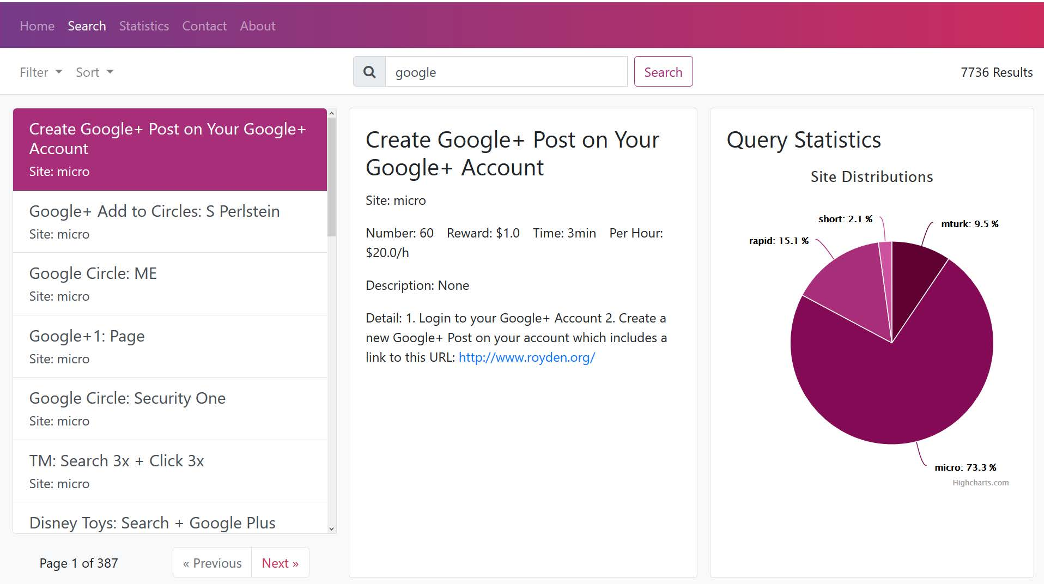 Figure 2: The search interface allows users to filter malicious tasks by targeted site or requester.
Critical Insight & Future Outlook
While the 99.4% accuracy is impressive, the "arms race" continues. As requesters become aware of these filters, they may begin to mask their language or normalize their pay rates to blend in with legitimate academic or business tasks.
Future Work will likely need to move toward:
- Multi-Platform Correlation: Tracking requesters who jump from MTurk to Microworkers when banned.
- Real-time Indexing: Moving from batch processing of 20 months of data to live stream processing to catch campaigns before they are completed.
This research serves as a vital blueprint for building a "neighborhood watch" for the crowdsourcing industry, ensuring that collective human intelligence remains a tool for progress rather than a weapon for manipulation.