
Bumps and Bruises: Why Twitter Campaign Announcements are a Double-Edged Sword
Bumps and Bruises: Mining Presidential Campaign Announcements on Twitter
The paper introduces a framework based on "The American Voter" to analyze public discourse on Twitter following the 2016 U.S. Presidential campaign announcements. Using large-scale data mining, it evaluates six major candidates across three pillars: Party Affiliation, Personality Perception, and Policy Issues, revealing how digital "bumps" in attention often lead to "bruises" of negative sentiment.
TL;DR
In the high-stakes arena of the 2016 U.S. Presidential election, a "Candidacy Announcement" was no longer just a televised speech—it was a strategic digital launch. This paper analyzes the Twitter fallout of six major candidates, revealing a brutal reality: while announcements generate massive spikes in attention ("Bumps"), they primarily provoke "Bruises" in the form of overwhelming negative criticism driven by opposing party supporters.
Context: This work moves beyond simple tweet counts to apply the "The American Voter" framework—Party, Personality, and Policy—to social media data, providing a specialized look at the beginning of the campaign lifecycle.
The "American Voter" Goes Digital
Historically, political scientists understood voter behavior through three lenses: Party Affiliations, Perceptions of Personality, and Policy Positions. Traditionally measured by surveys, this paper shifts the lens to Twitter. The researchers argue that Twitter isn't just a broadcast tool; it is a space for "crosstalk," where Republicans and Democrats engage in a digital tug-of-war over a candidate's image the moment they enter the race.
Methodology: Reading the Digital Mind
The study used a rigorous three-pronged approach:
- Party Inference: By looking at whether a user followed "landmark" accounts (e.g., Sean Hannity for Republicans vs. Rachel Maddow for Democrats), the authors could guess the user's political leaning.
- Trait Templates: Instead of just tagging a tweet as "bad," they used 40 high-precision templates to see if a candidate was perceived as "deceitful," "intelligent," or "easy-going."
- Policy Tracking: Keywords related to healthcare (Obamacare), foreign policy, and immigration were tracked to see which candidates "owned" which issues during their launch week.
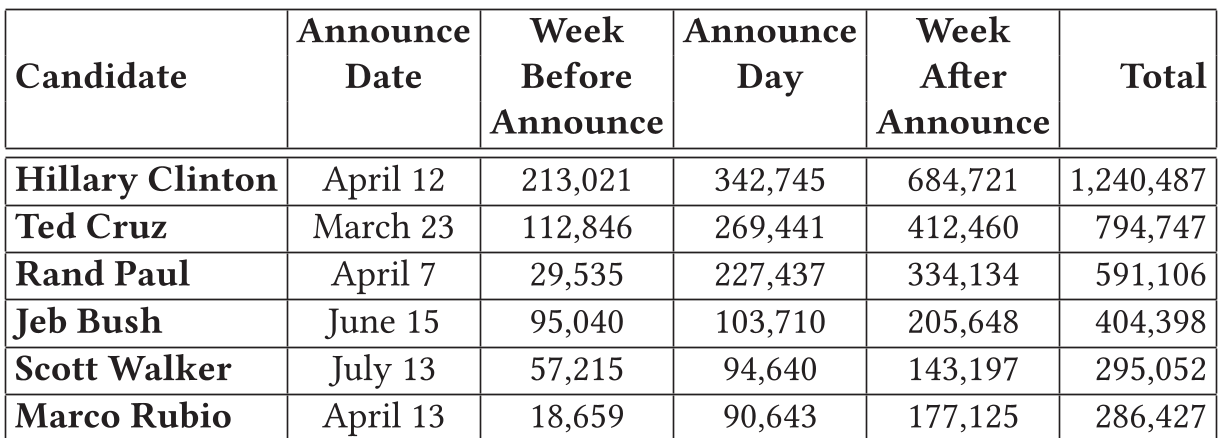
Key Findings: The Anatomy of a "Bruise"
1. The Negativity Bias
The most striking result is the sheer volume of "bruises." Jeb Bush’s announcement, for example, saw 19 times more negative tweets than positive ones. This was often organized via hostile hashtags:
- #NoMoreBushes (Jeb Bush)
- #WhyImNotVotingForHillary (Hillary Clinton)
- #YouCruzYouLose (Ted Cruz)
2. The Power of Crosstalk
The data suggests that your "mention" feed isn't your own. For almost every candidate, users from the opposite party dominated the conversation. In Scott Walker's case, 31.4% of those tweeting about him were Democrats, while only 16.2% were Republicans. This "outside-in" criticism defines the narrative of a campaign launch more than the candidate’s own messaging.
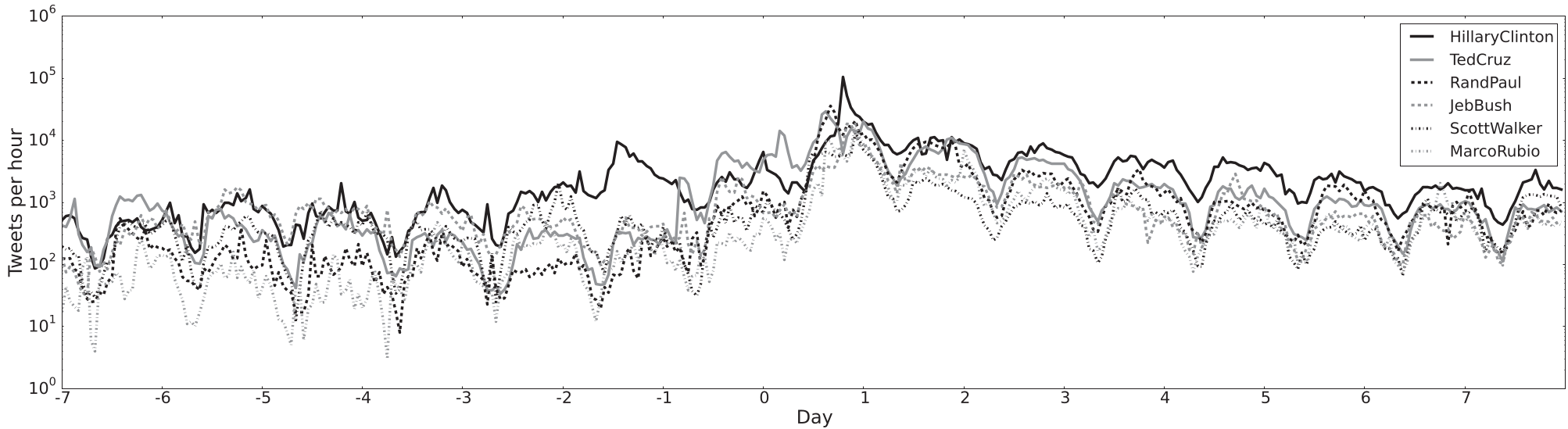
3. Personality as a Weapon
Character perceptions are highly specific. Hillary Clinton was uniquely targeted as "deceitful" (12.4% of trait-relevant tweets), a trait almost non-existent for others. Conversely, Marco Rubio and Scott Walker were hit with "bruises" regarding their "Intellectual Brilliance" (or lack thereof), often being described as "not shrewd" or "not intelligent" by opposing users.
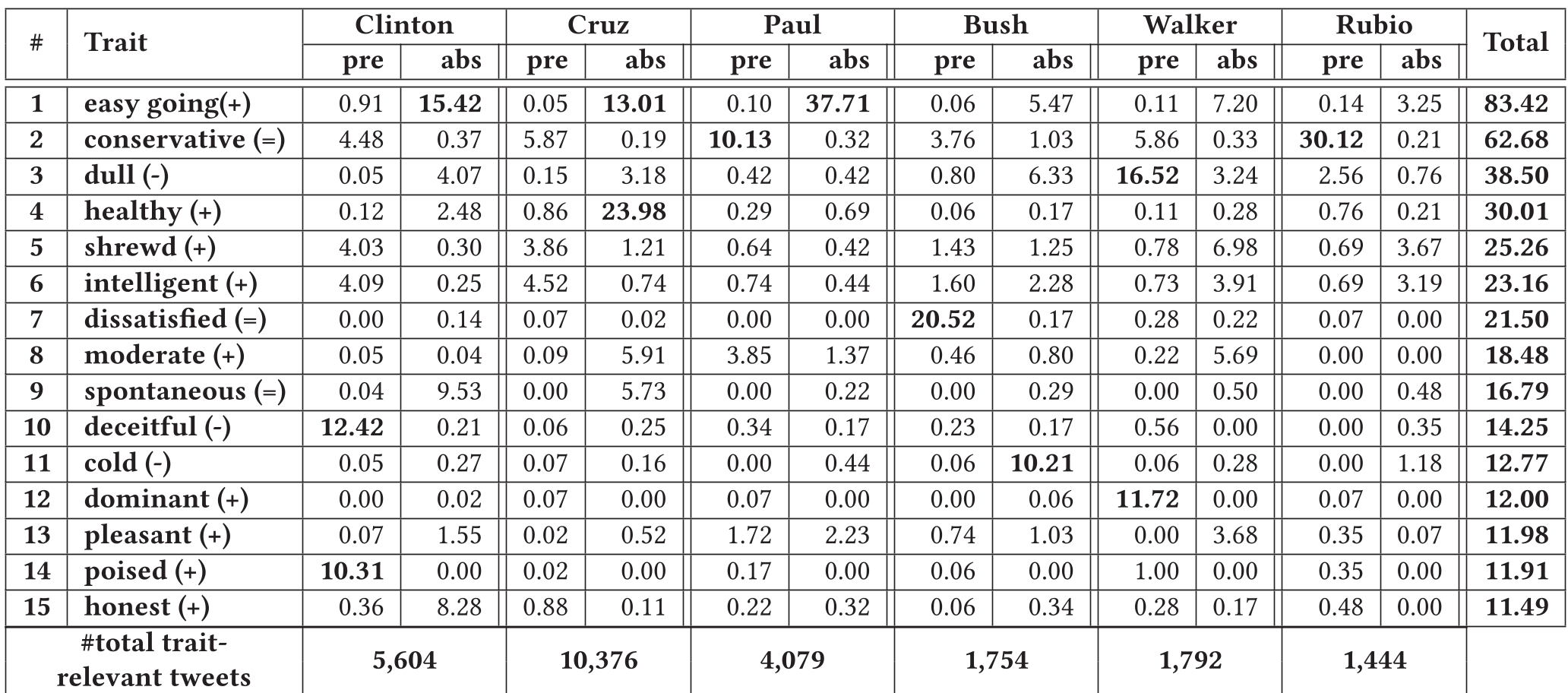
Deep Insight: Policy Ownership
The study highlights how specific events can hijack a policy narrative. Ted Cruz, despite being a staunch opponent of the Affordable Care Act, saw a massive spike in "Healthcare" mentions when it was revealed he signed up for Obamacare for his family. This irony-fueled engagement is a classic "bruise" that traditional media might treat differently than the fast-moving Twitter crowd.
Critical Analysis & Conclusion
This paper provides a sobering look for political strategists. The "Announcement Bump" is often a mirage of engagement that hides a sea of organized opposition.
Limitations: The study notes that the "Other/Independent" category remains a black box (64% of users), and the presence of bots (common in 2016) was not fully filtered.
Takeaway: To succeed in the modern era, a candidate must do more than just announce; they must prepare for a coordinated "bruising" from the other side. This baseline study reminds us that on social platforms, your enemies often speak louder than your friends.