
Crowdsourcing the Campus Shuttle: Transforming Transit into a Value-Added Logistics Network
Implementation of Bus Value-Added Service Platform via Crowdsourcing Incentive
This paper presents a value-added service platform for campus shuttle buses based on a crowdsourcing incentive model. It utilizes a spatio-temporal KD-tree and KNN query technology to efficiently match parcel delivery tasks with nearby participants, optimizing logistics within a university ecosystem.
TL;DR
The sharing economy is moving beyond ridesharing into hyper-local logistics. This paper introduces a Crowd-Sourced Incentive Value-Added Service Platform that turns campus shuttle buses and their passengers into a distributed delivery network. By utilizing Spatio-temporal KD-trees and KNN algorithms, the platform efficiently matches parcel delivery requests with commuters, creating a win-win ecosystem for students and university staff.
Problem & Motivation: The Last Mile on Campus
While the "sharing economy" has matured in the urban sector (e.g., Uber, shared bikes), campus-specific transit remains an untapped resource for value-added services. The authors identify two primary bottlenecks:
- Search Inefficiency: Finding the right participant for a specific delivery task in real-time is computationally expensive as the number of users grows.
- Incentive Gap: Without a structured reward or reputation system, users have little motivation to carry parcels for others during their daily commute.
The insight here is simple but powerful: treat the campus bus route as a backbone and the passengers as "dynamic nodes" capable of fulfilling "spatio-temporal tasks" — tasks defined by a specific location, release time, and deadline.
Methodology: The Core of Spatio-temporal Matching
1. Spatio-temporal Task Definition
The authors define a task as a five-tuple: .
- : Location
- : Release time
- : Spatial scope (the "reach" of the task)
- : Reward (price or points)
- : Deadline
2. KD-tree for Efficient Spatial Querying
To prevent the system from slowing down during peak hours, the authors implement a K-Dimensions (KD) Tree. This data structure recursively partitions the 2D plane based on variance in the X (longitude) and Y (latitude) dimensions.
When a participant looks for a task, the Continuous KNN (CQ-KNN) algorithm searches the tree:
- It depth-first searches for the nearest parcel node.
- It uses a backtracking mechanism with a radius-based "circle check" to ensure no closer task was missed in adjacent subtrees.
- This reduces the search complexity from to , essential for mobile performance.
 Figure 1: Conceptual overview of the crowdsourcing framework.
Implementation & Results: A Real-world Demo
The team developed a mobile application to test the feasibility of this model. The UI handles task publishing, real-time tracking, and historical trajectory analysis.
- Task Visualization: Users can see "nearby" parcels on a map, filtered by the KD-tree search logic.
- Security & Tracking: The platform records the trajectory of the campus bus and the assigned courier, allowing the parcel owner to view the delivery status in real-time.
- Incentive Loop: A scoring system increases a user's "value" for every successful delivery, creating a social credit layer within the campus community.
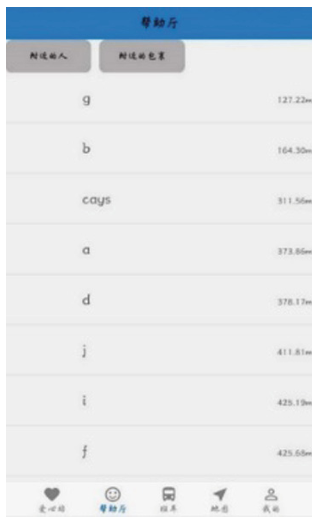 Figure 2: Real-time parcel delivery status and trajectory tracking in the app.
Critical Analysis & Conclusion
Takeaways
The work successfully bridges the gap between theoretical spatio-temporal data management and practical campus logistics. By moving away from centralized delivery to a User-Centered Incentive model, the platform reduces the cost of "last-mile" delivery to almost zero.
Limitations & Future Work
While the KD-tree handles spatial data efficiently, the current model's Incentive Mechanism is relatively simple (a basic score system). In a larger-scale social deployment (private cars, subways), more robust economic models or "gamification" strategies might be required to ensure high reliability.
The authors plan to scale this from campus shuttles to broader social vehicles, potentially turning every private car or subway commuter into a potential delivery agent for a global, decentralized logistics web.