
Bridging the Gap: Using Social Representations Theory to Deconstruct Digital Discourse for Service Design
Business Analysis of Digital Discourse for New Service Development: A Theoretical Perspective and a Method for Uncovering the Structure of Social Representations for Improved Service Development
This paper introduces a novel method for New Service Development (NSD) by leveraging Social Representations Theory (SRT) to analyze digital discourse. Using Wikipedia as a primary data source, the author demonstrates how tracking the evolution of "anchoring" and "objectification" of concepts like electric vehicles can inform service design to better align with customer expectations.
TL;DR
Building a new service often fails because of a misalignment between the technical value proposition and the customer's social perception. This paper proposes a methodology to mine Wikipedia's collaborative history through the lens of Social Representations Theory (SRT). By analyzing how technologies like Electric Vehicles (EVs) are "anchored" (classified) and "objectified" (made real) in digital discourse, developers can derive actionable insights to design services that fit seamlessly into the social fabric.
The "Constructivist" Blind Spot in Service Development
In the world of New Service Development (NSD), we often treat technology as a "given"—an objective set of features. However, customers don't see technology in a vacuum; they see it through the lens of their social group.
The author argues that traditional market research (surveys, focus groups) fails to capture how knowledge evolves over time. When a customer encounters a "Tesla," they don't just see a car; they anchor it to existing concepts (e.g., "Environmentally friendly") or prototypes (e.g., "Experimental gadgets"). If a service developer ignores these social representations, the service is likely to be viewed as "risky" or "unpredictable," leading to market failure.
Methodology: Operationalizing SRT on Wikipedia
The core innovation of this paper is transforming abstract socio-psychological concepts into quantifiable data. The author uses two fundamental processes of SRT:
- Anchoring: How we name the unfamiliar by comparing it to something known. On Wikipedia, this is operationalized as outgoing links from a topic.
- Objectification: How an abstract concept becomes a concrete "replica of reality." On Wikipedia, this is operationalized as incoming links to a topic.
The Five-Step Workflow
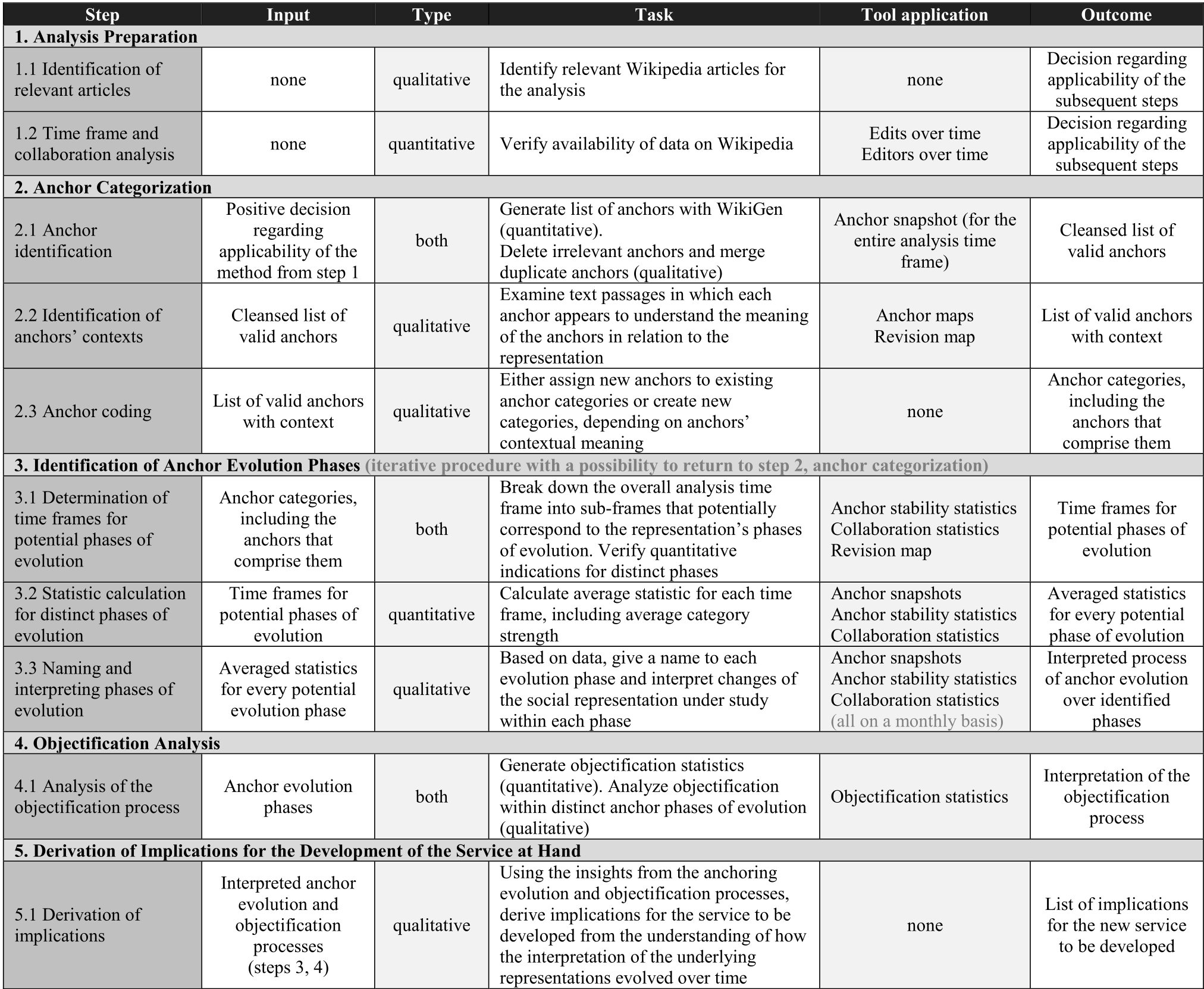
The author proposes a systematic pipeline to feed digital discourse into the NSD Analysis stage:
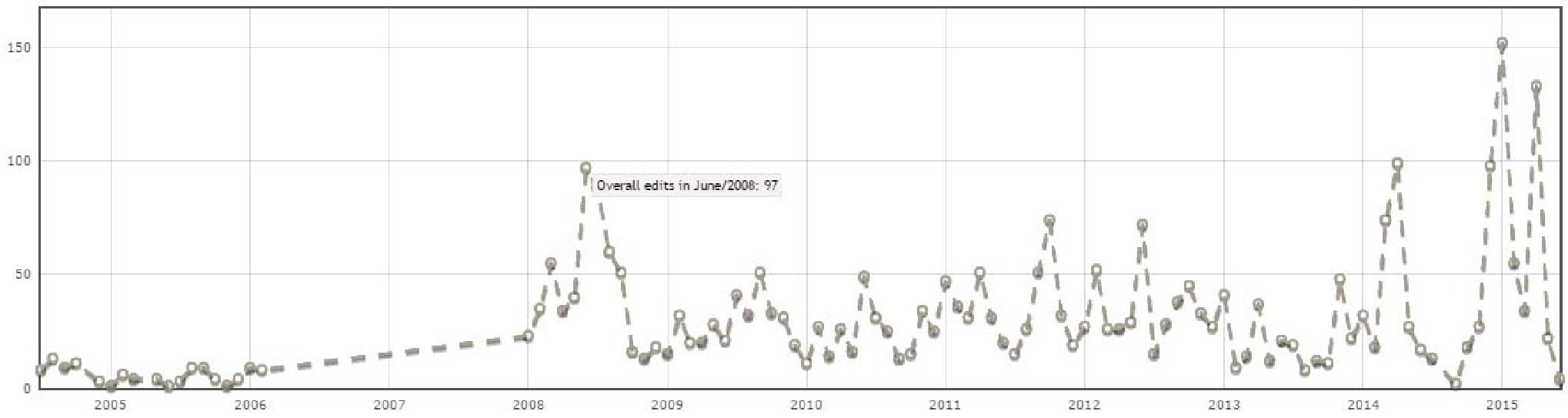
- Preparation: Identifying relevant articles and editor collaboration data.
- Anchor Categorization: Identifying and coding the semantic context of links.
- Evolution Phases: Breaking down the article's history into distinct periods of meaning-making.
- Objectification Analysis: Checking how "manifested" the concept has become in the wider social knowledge graph.
- Implication Derivation: Translating these shifts into design requirements.
Case Study: The Social Life of Electric Cars
The author tested this method on the German Wikipedia discourse regarding electric cars from 2004 to 2015.
Key Findings from the Evolution:
- Phase 1 (2004-2007): Driven by early French car manufacturers' announcements; characterized by high interest but low practical activity.
- Phase 2 (2008-2014): The "Prototypical" era. The discourse was heavily anchored to the Lunar Roving Vehicle and NASA.
- Phase 3 (2011-2015): The "Deprototypization." New models like the Tesla Model S and Nissan Leaf began replacing historical prototypes as the primary anchors.
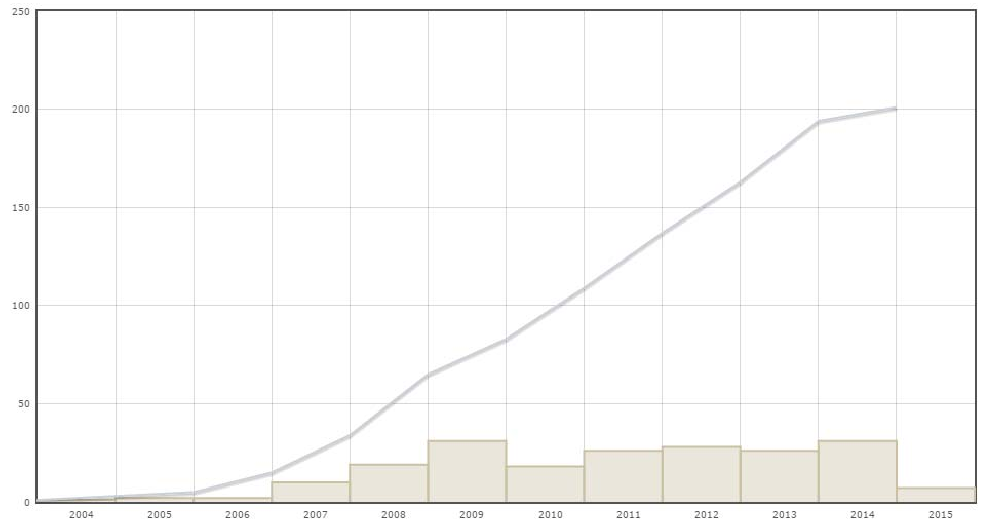
The Objectification Analysis revealed a sobering truth: while the way people talk about EVs changed, the number of other topics linking to EVs has stagnated. This suggests the representation of EVs is still unstable—it hasn't yet become a "taken-for-granted" part of the social reality.
Insights for Service Developers
How does a manager use this? The author provides clear examples for an EV-charging service:
- Avoid the "Lunar Roving" Trap: If users anchor EVs to space prototypes, they may subconsciously view the service as "experimental" or "unreliable." Marketing should focus on everyday routines (e.g., charging like a smartphone).
- Model-Specific Specialization: Since anchors shifted to specific models (Tesla, BMW i3), the service should offer model-specific UX to leverage the "modern example" anchor.
- Explicit Comparative Design: Most disadvantages were framed in comparison to combustion engines. The service UI should use these comparative metrics (e.g., "CO2 saved vs. Gas") to speak the customer's social language.
Critical Insight: The Value of "Proxy Knowledge"
This work highlights a shift in Information Systems (IS) research: Wikipedia is no longer just an encyclopedia; it is a proxy for social knowledge. By analyzing the "genealogy" of an article, we aren't just looking at text; we are looking at the struggle of a social group to make sense of innovation.
Limitations & Future Work
The study primarily focuses on the "Definition" section of Wikipedia and doesn't account for the "Talk" pages where the most heated debates occur. Furthermore, it assumes a singular social representation, whereas different social groups (e.g., tech-enthusiasts vs. environmentalists) may hold vastly different representations of the same object.
Conclusion
Friedrich Chasin’s work provides a rigorous bridge between social psychology and service engineering. For companies operating in volatile, high-tech domains like EV charging, AI, or Biotech, the ability to "read" the social representations of their core technology isn't just a marketing perk—it's a requirement for operational feasibility.