
BLP: Revolutionizing Business Location Planning with Geo-Social Influence
Business location planning based on a novel geo-social influence diffusion model
This paper introduces a novel Business Location Planning (BLP) framework for "Online-to-Offline" (O2O) businesses, leveraging a Competitive and Target-aware (CT) influence diffusion model. By integrating geographic distance, existing competitors, and targeted customer regions into an Influence Maximization (IM) objective, the method identifies optimal business sites that maximize customer attraction through social network marketing.
TL;DR
In the era of "Online-to-Offline" (O2O) commerce, traditional geography-only models are obsolete. This paper proposes a new Business Location Planning (BLP) method that uses social network "viral" marketing potential as the primary metric. By combining a Competitive and Target-aware (CT) diffusion model with a high-efficiency pruning strategy, the authors provide a way to find locations that don't just "exist" on a map but dominate the social-spatial landscape.
The "O2O" Motivation: Why Geography Isn't Enough
Traditionally, a good location was defined by Reverse Nearest Neighbors (RNN)—essentially, being the closest option for the most people. However, in modern smart cities, businesses like specialized cafes or delivery-heavy restaurants thrive on social media hype (e.g., TikTok or Instagram).
The authors identify a critical gap:
- The Absolute Distance Trap: A user might be "influenced" online, but if the shop is 50km away, they won't go.
- The Serving Region Constraint: Businesses like UberEats have fixed delivery radii.
- Competition neglect: If a user is surrounded by five competitors, your influence on them is naturally diluted.
Methodology: The CT-RIS Framework
The core innovation lies in the Competitive and Target-aware Influence Spread. Instead of treating every user in a social network equally, the model assigns a "weight" to each user based on their probability of actually visiting the location.
The Weight Function
The model uses a weight function that accounts for:
- Target Users (): Only users within a distance threshold are considered primary targets.
- Competitive Businesses (): Potential influence is divided by the presence of surrounding competitors.
- Distance Decay: Influence probability drops exponentially as absolute distance increases.
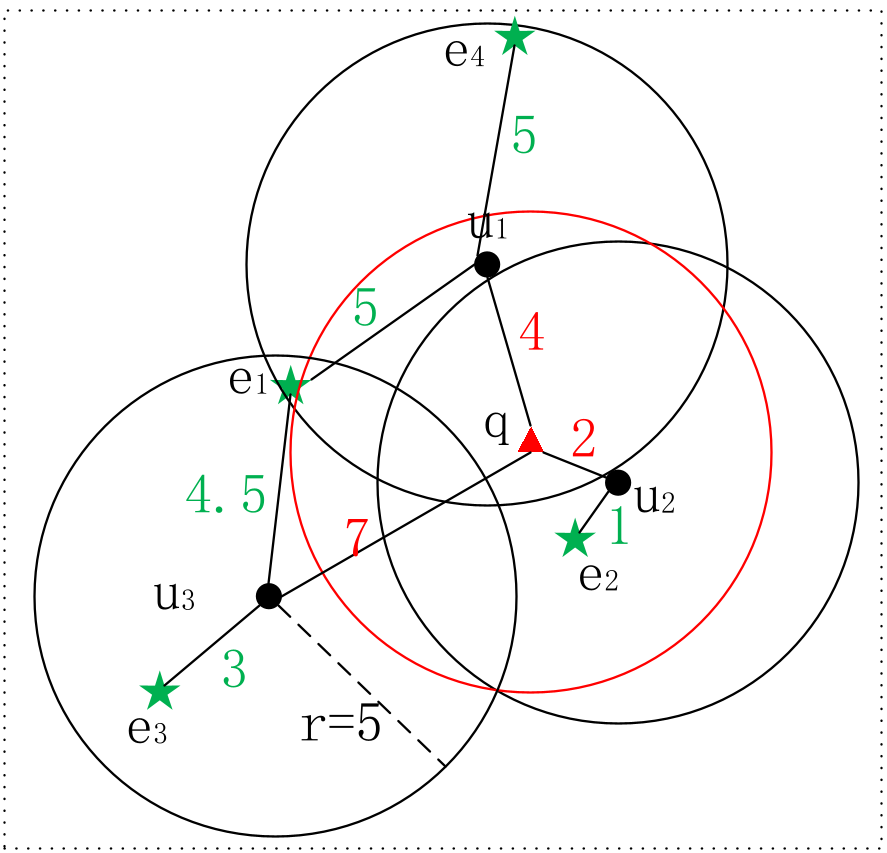 Figure 1: Motivation example showing how user u2 is a better target than u1 despite relative distances.
To solve the NP-hard problem of finding the best seed users for these locations, the authors modified the Reverse Influence Sampling (RIS) algorithm into CT-RIS, which samples only from targeted users and uses the weighted influence spread to select the top-k seeds.
Scaling Up: Clustering-based Pruning
Evaluating thousands of candidate locations is computationally expensive. The authors observed that locations close to each other have similar influence potential. They developed a pruning strategy that:
- Clusters candidate locations.
- Evaluates the cluster centers.
- Prunes entire clusters if their maximum theoretical potential (based on a distance-adjusted bound) is lower than the best-known location found so far.
Experimental Insights
The researchers tested their approach on two major datasets: Brightkite and Foursquare.
1. Effectiveness
The BLP algorithm consistently outperformed baselines like DAIM (Distance-Aware IM) and RNN. Because BLP focuses on the ratio of influenced users to targeted users, it finds locations that are more "efficient" at capturing their intended market.
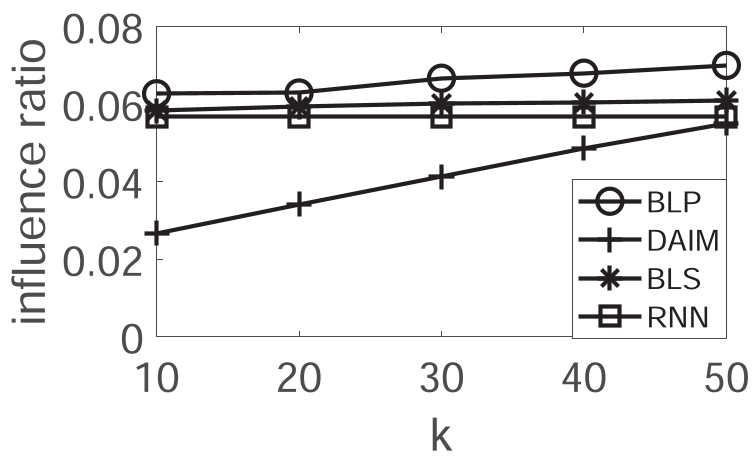 Figure 2: Performance metrics on Brightkite and Foursquare datasets.
2. Efficiency
While the weighted sampling is complex, the Clustering-based Pruning is the hero of the runtime experiments. As the number of candidate locations () increases, the BLP execution time stays manageable, whereas a "no-pruning" approach (up-BLP) sees a sharp spike in cost.
Critical Analysis & Takeaways
Key Contribution: This is the first study to successfully blend spatial competition models with sophisticated social influence diffusion for location selection. It moves the field from "statistical distance" to "social-behavioral probability."
Limitations: The model assumes a fixed distance threshold for all users. In reality, a user's willingness to travel might vary by business type or time of day. Additionally, the social influence probability is set using the standard heuristic, which could be replaced by more data-driven learning approaches in the future.
Future Outlook: This framework paves the way for "Smart Retail" tools where city planners and business owners can simulate the impact of opening new branches not just on traffic, but on the social "buzz" of the neighborhood.