
Monetizing Connectivity: A Two-Sided Market Perspective on Mobile Social Networks
On studying business models in mobile social networks based on two-sided market (TSM)
This paper investigates Mobile Social Networks (MSN) through the lens of Two-Sided Market (TSM) theory, proposing a formal economic model to analyze revenue streams. It specifically explores the "Freemium" business model, demonstrating how negative and positive network externalities between consumers and service providers drive platform profitability and user adoption.
TL;DR
Why is Facebook free? Why do some apps charge for "Pro" features while others survive solely on ads? This paper provides a rigorous economic answer by modeling Mobile Social Networks (MSNs) as Two-Sided Markets (TSM). It proves mathematically that the "Freemium" model—offering basic services for free while charging for premium features—is not just popular, but theoretically superior to traditional paid models in maximizing both user participation and platform profit.
Background: Beyond Code and Features
The technical evolution of MSNs (mobility, ubiquity, location-awareness) has moved faster than our economic understanding of them. While engineers focused on low-latency connections, a critical question remained: How do these platforms survive? The authors position MSN platforms as intermediaries that create value by enabling interactions between two distinct groups: Consumers (the subsidy side) and Service Providers/Advertisers (the money side).
The "Chicken-and-Egg" Problem & Network Externalities
The core challenge for any platform is reaching Critical Mass. An MSN with no users has no value to advertisers; an MSN with no services/content has no value to users. This paper breaks down the economic engine of MSNs into three pillars:
- Mobility: The unique value proposition of location-based services.
- Network Externalities:
- Same-side: Users want more users to interact with.
- Cross-side: Users want more Service Providers (SPs), and SPs want a larger "eyeball" count (Consumers).
- Long Tail Property: MSN facilitates a vast number of "weak ties," allowing platforms to monetize infrequent yet niche interactions.
Methodology: The Freemium Math
The authors use a Hotelling Spatial Differentiation Model to find the equilibrium where the platform maximizes profit. They define utility functions for:
- Free Users (): Utility derived from the number of SPs minus the "fit cost" of the platform.
- Premium Users (): Similar to free users but includes a subscription price () and higher gross utility ().
- Service Providers (): Profit derived from access to the total consumer base () minus the fee () paid to the platform.
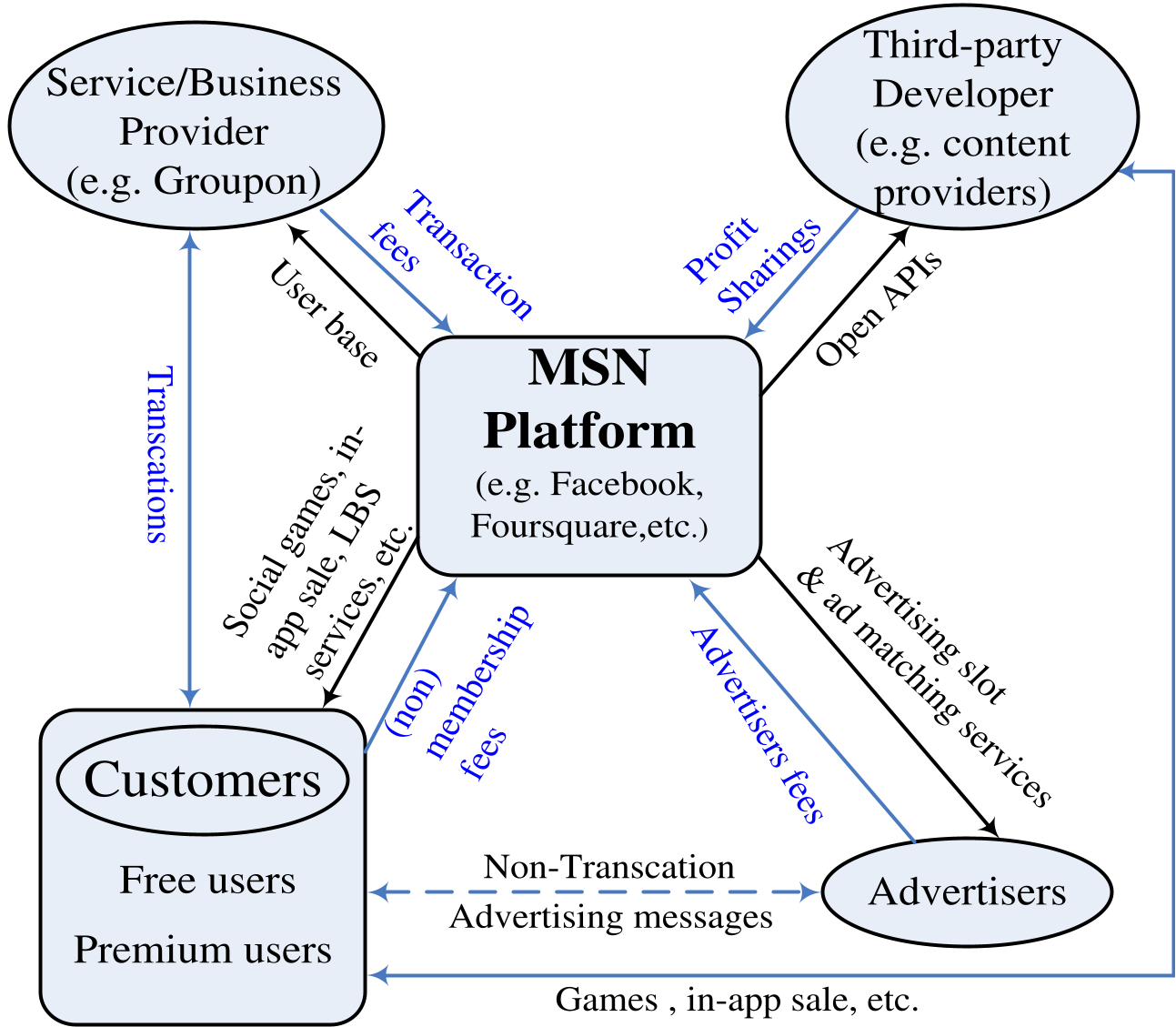 Figure 1: The TSM framework showing the flow of funds and value between users, advertisers, and the platform.
Key Insight: Why Freemium Wins
The most striking part of the analysis is the comparison between Freemium and the No-Free-user (NF) model.
1. Mutual Enhancement
In the Freemium model, free users aren't "freeloaders"; they are a product. Their presence attracts more SPs. Because there are more SPs, the value of the platform increases for Premium users. This "mutual enhancement" creates a virtuous cycle that the NF model cannot match.
2. The Power of Negotiation
The numerical results show that as the utility of free users () increases, the platform gains leverage.
- Scenario A (Consumers value SPs more): The platform usually has to subsidize SPs (negative price). However, with Freemium, the massive user base attracts SPs so strongly that the platform can reduce these subsidies (see Figure 6d).
- Scenario B (SPs value Consumers more): The platform can charge SPs a significantly higher "tax" because the free user base is so large (see Figure 8d).
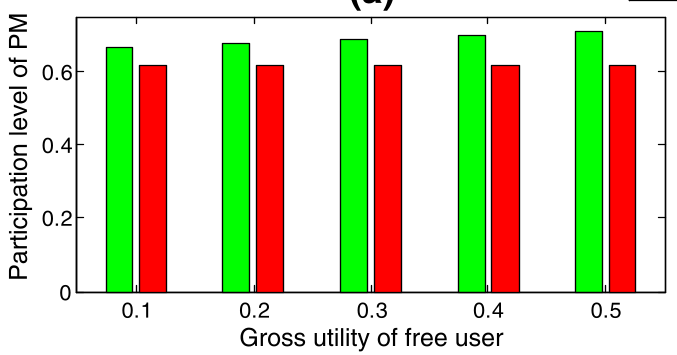 Figure 2: Participation levels of Premium Users (a) and SPs (b) are consistently higher in the Freemium model compared to the NF model.
Experimental Results & Simulations
The authors performed simulations across different externality scenarios ( vs ). In every case:
- Profitability: The Freemium profit curve () is always above the NF profit curve.
- User Base: Freemium leads to higher adoption for both premium users and third-party developers.
 Figure 3: MSN platform profit comparison showing Freemium's dominance as the utility of premium users increases.
Conclusion & Critical Analysis
This paper provides the theoretical "Why" behind the "How" of modern app economies. By treating free users as an investment in network effects rather than a cost, platforms can maximize their "Money Side" revenue.
Limitations: The model assumes a Monopoly platform. In the real world, "multi-homing" (users using both Llama and ChatGPT, or X and Threads) complicates the math. Furthermore, the model assumes "fit costs" are linear, which may not capture the psychological friction of switching platforms.
Future Outlook: As we move into AI-driven social agents, the "Two sides" might become "AI Agents" and "Human Users." The principles of TSM outlined here will be vital in determining how we pay for—or are paid by—the next generation of social algorithms.