
Beyond Demographics: Decoupling Individual Attributes from Social Communities
Business-Oriented Analysis of a Social Network of University Students: Informative Value of Individual and Relational Data Compared through Group Detection
This study evaluates the overlap between two grouping methods—classic cluster analysis (based on individual factual data) and community detection (based on relational sociometric data)—within a university student population. Using algorithms like Fast Greedy and Two-Step clustering, the authors investigate whether inexpensive individual data can substitute for costly relational data in Business Science applications.
TL;DR
Is a person’s social circle defined by who they are or who they know? This paper explores a critical question for Business Science: Can we predict social communities using cheap individual data (like age or gender) instead of expensive relational data (who talks to whom)? By analyzing a student network at Galatasaray University, researchers found that the two types of data are almost entirely complementary—meaning your demographics say surprisingly little about your actual social network structure.
Background: The Cost of Connection
In the world of Marketing and Management, understanding "communities" is the holy grail. Communities drive word-of-mouth, innovation, and decision-making. However, there is a major bottleneck: Relational Data (sociometric surveys) is expensive and sensitive to collect. Researchers often wonder if we can just use Individual Data (factual profiles) as a proxy. If we know someone's department and age, do we essentially know their social group?
The Core Conflict: Clusters vs. Communities
The authors distinguish between two types of groups:
- Clusters: Groups formed by people sharing similar individual traits (Factual Data).
- Communities: Groups formed by people having dense internal relationships (Relational Data).
The central hypothesis was to see if these two partitions overlap. If they do, managers can save money by ignoring network analysis. If they don't, network analysis remains an indispensable (albeit pricey) tool.
Methodology: A Twin-Track Approach
The researchers gathered data from 224 students, including variables like Department, High-School type, and Entrance Exam scores.
- For Individual Data: They used the Two-Step clustering algorithm, which handles both categorical and numerical data to find natural "clusters."
- For Relational Data: They built an undirected network of 552 nodes and applied four algorithms: Fast Greedy, Walktrap, Edge-betweenness, and Spinglass.
Model Architecture & Analysis
The authors used the Adjusted Rand Index (ARI) to compare the partitions. An ARI of 1 means the groups are identical; 0 means they are no more similar than a random guess.
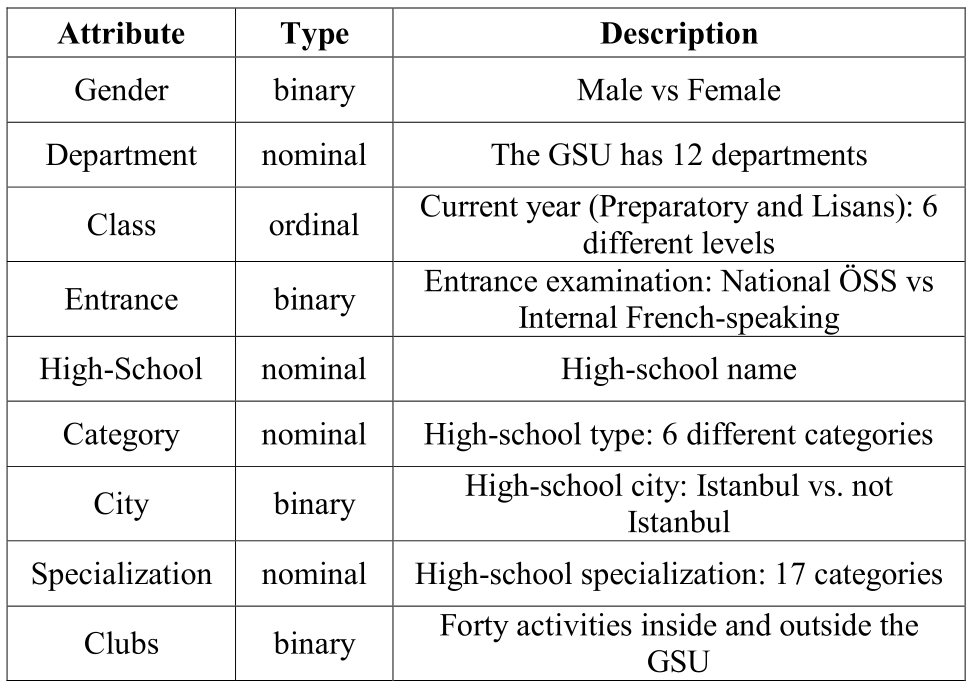 Table 1: The individual attributes used to identify student clusters.
Key Findings: The Great Divide
The results were striking. The overlap between the optimal individual clusters and the relational communities yielded an ARI of 0.043—essentially zero.
Why the Mismatch?
While the communities were highly stable (Modularity = 0.88), they didn't align with demographic clusters. However, when forcing the algorithms to find a specific number of groups, a "weak link" appeared. A combination of all attributes reached an ARI of 0.423, suggesting that social groups are influenced by a complex cocktail of traits rather than just one or two obvious ones.
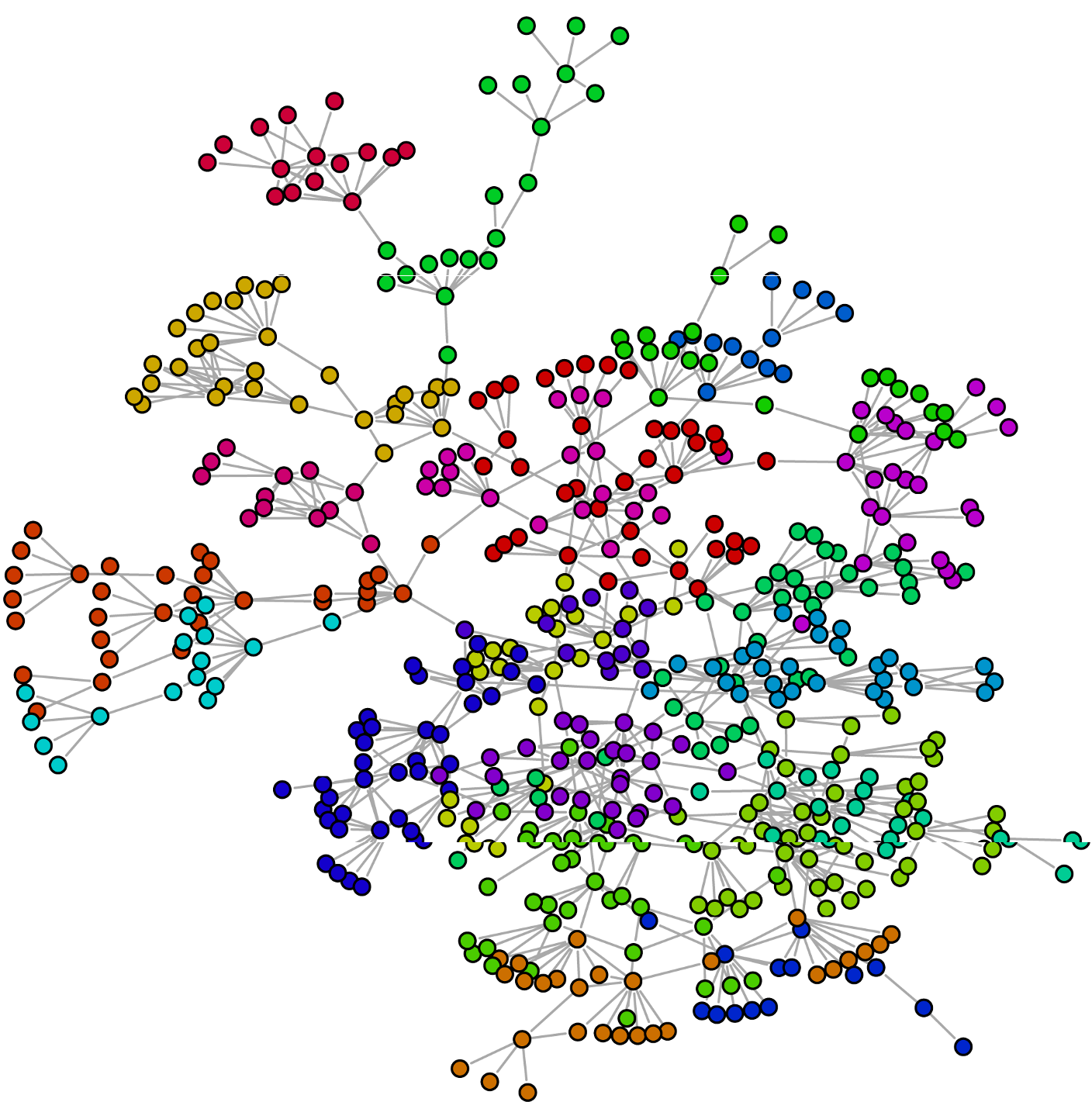 Figure 1: Communities detected by the Fast Greedy algorithm. The high modularity confirms a strong social structure exists, but it doesn't align with simple demographics.
Discriminant Insights: What Actually Matters?
By using Discriminant Analysis, the authors identified the three most "predictive" attributes for community membership:
- Class (Year of Study): The strongest predictor.
- Entrance Exam Type: Reflects whether students share a similar linguistic/socio-economic background (e.g., French-speaking high schools).
- Department: The physical proximity of classrooms.
These three factors alone correctly predicted community membership for 37.2% of students. While not a majority, it is significantly higher than a random guess in a pool of 22 communities.
Critical Insight & Future Outlook
This paper serves as a reality check for Business Science: Demographics are not destiny. To truly understand influence and information flow, you cannot ignore the network. Simple "Customer Personas" based on demographics might miss the vital social sub-structures that actually drive behavior.
Limitations: The study was conducted in a small, specialized university. Future work needs to integrate sentimental data (how people feel about brands/each other) and behavioral data (actual communication logs) to see if these "richer" individual data types can close the gap between clusters and communities.
Conclusion: Relational data remains the "gold standard" for community detection. While certain structural factors like "Entrance Type" provide a window into social groupings, the complexity of human interaction transcends simple factual profiles.