
Reengineering the Enterprise: Leveraging Social Networks for Workflow Automation
Business Process Reengineering Using Enterprise Social Network
This paper presents a Business Process Reengineering (BPR) framework that integrates Enterprise Social Networks (ESN) into traditional service workflows. By transforming ESN user profiles into automated web services within a Service-Oriented Architecture (SOA), the authors optimize the Innovation and Support Center (ISC) operations, achieving significant SOTA-level improvements in service velocity.
TL;DR
This research tackles the inefficiency of manual decision-making in technical support workflows by integrating Enterprise Social Networks (ESN) into the Business Process Reengineering (BPR) lifecycle. By converting social profile data into automated web services, the study demonstrates a 28% reduction in execution time and a 27% cost saving for a government-affiliated Innovation and Support Center.
Background: The Silo Problem
In modern organizations, internal knowledge often resides in the "social layer"—Enterprise Social Networks where employees list skills, interests, and project histories. However, core business systems like CRM (Customer Relationship Management) are often disconnected from this layer. This creates a bottleneck: team leaders must manually cross-reference support requests with available expertise, leading to delays and human error.
The Problem: Bottlenecks in the "As-Is" Process
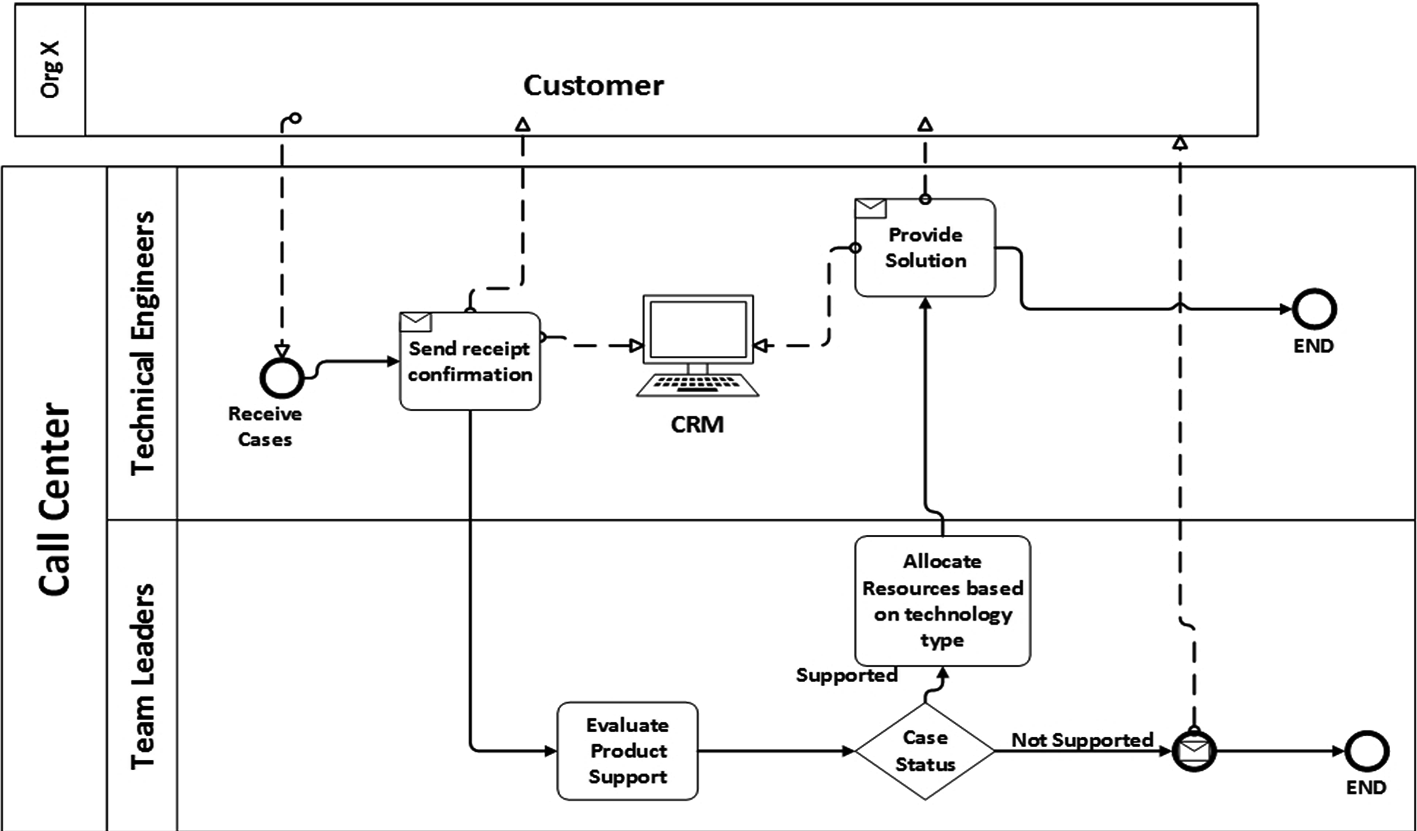
The authors analyzed the current state (As-Is) of the Innovation and Support Center (ISC) in Oman. They identified two critical failure points:
- Manual Evaluation: Team leaders manually check if a technology is supported.
- Resource Allocation: Finding the right engineer is based on a leader's personal memory rather than real-time data.
This manual intervention not only slows down the service but also interrupts the core management duties of the leadership team.
Methodology: Socializing the Business Process
The core innovation lies in the Transformation Layer. Instead of treating the ESN as just a communication tool, the authors treat it as a Dynamic Resource Database.
The "To-Be" Architecture
The proposed "To-Be" process replaces the manual team leader layer with automated ESN Web Services.
- Extraction: User profiles containing skills and availability are pulled from the ESN.
- Transformation: This data is formatted into a standardized web service.
- Integration: The CRM system invokes these services via a Service-Oriented Architecture (SOA) to automatically assign engineers to cases without human intervention.
| Business Process | Problem | Social Solution |
|---|---|---|
| Product Support Evaluation | Manual list checking by leaders. | Web service lookup of supported technologies. |
| Resource Allocation | Dependent on leader's memory. | Real-time skill-matching from ESN profiles. |
Experimental Results: Quantitative Gains
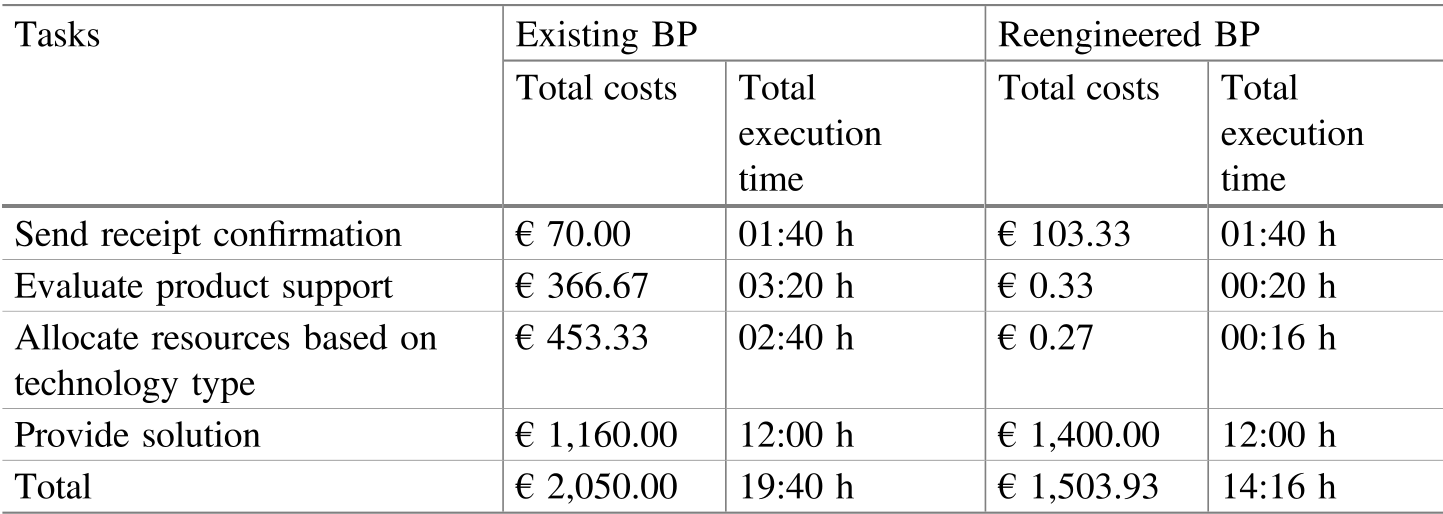
Using the Signavio simulation tool, the authors compared the "As-Is" and "To-Be" models across 20 daily cases over a 5-day period.
Key Findings:
- Cost Efficiency: Total costs dropped from €2,050 to €1,503.93.
- Time Savings: Total execution time decreased from 19:40 hours to 14:16 hours.
- Management Liberation: Team leader workload for these specific tasks was reduced from 6 hours to 36 minutes, allowing them to focus on high-level strategy.
Critical Insight: Why This Works
The success of this approach hinges on the Inductive Bias that social data is a more accurate reflection of organizational capability than static HR databases. By making this data "machine-readable" via SOA, the organization achieves Agility—the ability to reconfigure resources dynamically in response to incoming demand.
Conclusion and Future Outlook
This paper proves that BPR is no longer just about "fixing the steps"; it is about "integrating the layers" of an organization. By bridging the gap between social interaction and formal CRM workflows, the ISC saw dramatic improvements.
Limitations & Future Work:
- The study currently relies on a single simulation tool (Signavio). Future validation using Process Mining from actual event logs would provide even higher fidelity.
- The researchers plan to further investigate the specific technical requirements for ensuring social data quality before it is published to the SOA environment.
In the era of Digital Transformation, this work serves as a blueprint for organizations looking to turn their "Internal Social Noise" into "Operational Intelligence."