
Beyond Connectivity: Measuring the Business Reputation of Social Web Services
Business Reputation of Social Networks of Web Services
This paper introduces a business-centric reputation framework for Social Web Services (SWSs), enabling services to evaluate and select the optimal social network (collaboration, substitution, or competition) based on four key metrics: membershipCost, demandLevel, satisfactionLevel, and retentionLevel.
TL;DR
As Web Services evolve into Social Web Services (SWSs)—entities that maintain contacts and collaborate like humans—the choice of which "Social Network" (SN) to join becomes a critical business decision. This paper proposes a quantitative framework to measure the reputation of such networks using four business metrics: Membership Cost, Demand, Satisfaction, and Retention, providing a roadmap for services to maximize their utility in a competitive ecosystem.
The Shift from Discovery to Socialization
In the traditional Service-Oriented Architecture (SOA) paradigm, Web Services were isolated units discovered via static registries. However, the rise of Social Web Services has introduced a "social" layer where services form groups for collaboration, substitution (failing service replacement), and competition.
The problem is no longer just finding a service that works; it is about finding a network that thrives. Existing research focused heavily on the security of these networks (privacy, trust, fairness). This paper argues that without a Business Perspective, a service provider cannot judge if a network is worth the "membership fee" or if the network is too crowded to offer any real traffic.
The Four Pillars of Business Reputation
The authors define reputation through a monitoring window (e.g., every 30 days) across four specific criteria:
- Membership Cost: The barrier to entry. This must be balanced to attract services while funding the network infrastructure.
- Demand Level: Measures market share—how many services are flocking to this SN compared to its competitors?
- Satisfaction Level: A subjective but vital metric based on how many user requests the SN successfully routes to the SWS.
- Retention Level: The "churn rate" of the service world. High retention indicates that the SN provides consistent value.
Experimental Analysis: Profit vs. Quality
The researchers built a custom Java testbed to simulate three distinct market strategies. They used three networks: SN0 (Cheap/Budget), SN1 (Mid-range), and SN2 (Premium/High-cost).
Scenario A: Profit-Driven Strategy
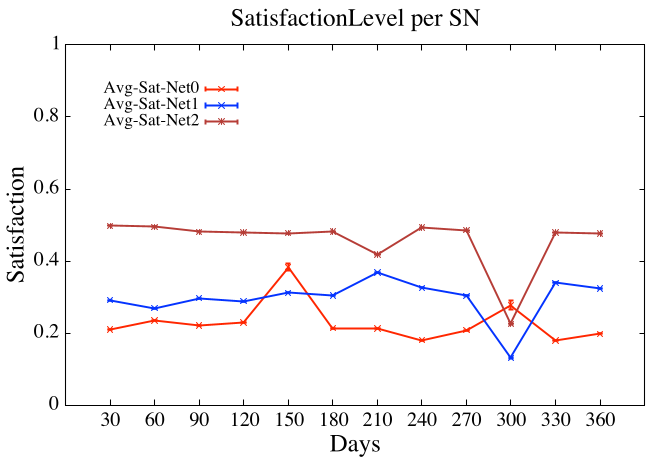
Here, networks aim to maximize membership. As shown in the simulation results, the "cheapest" network (SN0) becomes the most crowded.
- The Downside: High competition leads to a nosedive in
satisfactionLevelbecause user requests are spread too thin among too many members.
Scenario B: Quality-Driven Strategy
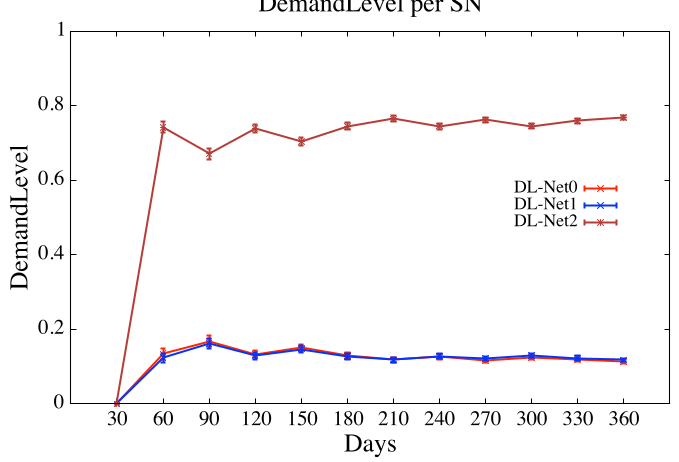
In this scenario, SN2 maintains high fees but guarantees a higher percentage of user requests.
- The Upside: Even though it costs more to stay, the
retentionLevelis superior because the services actually get work to do.
Scenario C: The Trade-off
The reality of the market is usually Scenario C. SWSs evaluate both cost and quality. The data suggests a "Limbo" effect: when satisfaction drops, services quit their current network and wait in a temporary state before migrating to a more reputable one.
Key Takeaways and Future Outlook
This work highlights a fundamental truth in automated ecosystems: incentives matter.
- For Service Providers: Reputation isn't just about uptime; it's about the "Quality of the Crowd" you join.
- For Network Operators: Over-harvesting membership fees leads to "Satisfaction decay," which eventually destroys the network through member exit.
The next frontier, as suggested by the authors, is the fusion of Security and Business reputation. A network that is profitable but insecure is just as dangerous as one that is secure but bankrupt.
Critical Perspective
While the paper provides a solid mathematical foundation for these business metrics, the simulation assumes a somewhat linear relationship between membership and request allocation. In real-world scenarios, network effects (where more members actually attract more users) might offset the competition penalty—a factor that future SWS research should investigate.