
Decoding the Buyer’s Mind: Personality Traits as the New North Star for Consumer Prediction
To Buy or Not to Buy? Understanding the Role of Personality Traits in Predicting Consumer Behaviors
This paper explores using personality traits derived from Twitter to predict consumer behavior across 100 product categories. By leveraging the IBM Watson Personality Insights API on a dataset of 188,654 individuals, the authors built classifiers that achieve an average prediction accuracy of approximately 59%, outperforming gender-based baselines.
TL;DR
Researchers from IBM and Acxiom have demonstrated that your tweets might be better at predicting your shopping cart than your gender. By mapping the Twitter activity of over 188,000 individuals to their real-world purchasing records, the study shows that derived personality traits can predict buyers across 100 product categories with nearly 60% accuracy, providing a high-scale alternative to traditional demographic targeting.
Personality vs. Demographics: Beyond the Surface
For decades, marketers have relied on the "Who" (age, gender, income) to predict the "What" (purchasing). However, demographics are often blunt instruments. Two 30-year-old men in the same city might have entirely different buying habits based on their psychological makeup.
The challenge has always been scalability. To know someone's personality, you traditionally needed them to take a 50-item survey. This paper circumvents that bottleneck by using social media fingerprints. The core insight is that our linguistic patterns on social media are a mirror of our intrinsic traits, and these traits—Openness, Conscientiousness, Extraversion, Agreeableness, and Neuroticism—directly influence how we spend money.
Methodology: Bridging the Digital and Physical Worlds
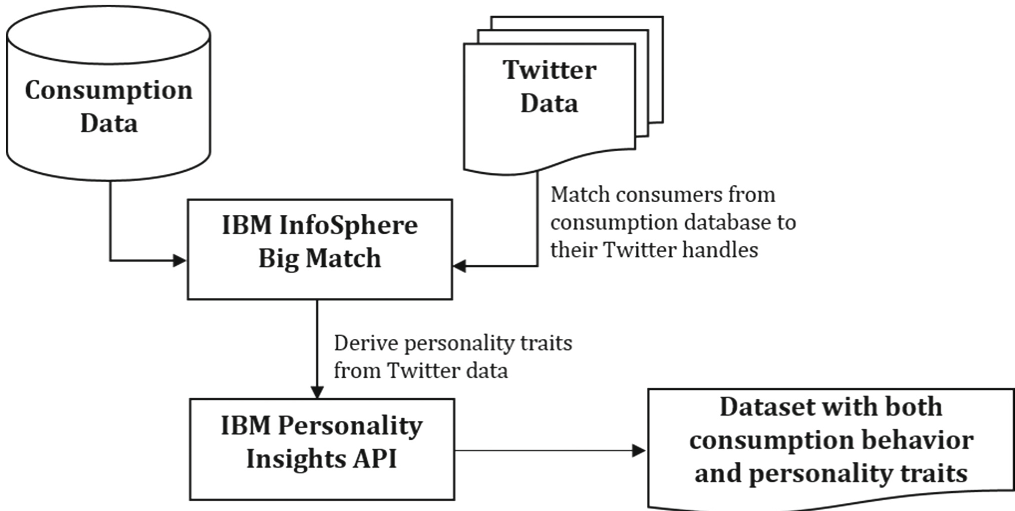
The researchers faced a massive technical hurdle: how do you link an anonymous Twitter handle to a real-world household purchase?
- Identity Resolution: Using IBM InfoSphere Big Match, they linked personal identifiers (name, email, address) from Acxiom’s marketing database to Twitter accounts with over 80% confidence.
- Psychometric Extraction: They fed the tweets into the IBM Watson Personality Insights engine to generate scores for the "Big Five" traits and their 30 specific facets (e.g., Adventurousness, Self-consciousness).
- The Single-Person Household Filter: To ensure the person tweeting was the one buying, they focused on single-person households, resulting in a clean dataset of 188,654 records.
Key Findings: What Your Traits Say About Your Receipts
The study utilized Logistic Regression and other supervised learning models to classify "buyers" vs. "non-buyers."
- The Power of Openness: High scores in "Openness" were strong predictors for camping/hiking gear, sports apparel, and music. Conversely, individuals high in Openness were less likely to buy computing software.
- Impulse and Detail: Traits like "Immoderation" were key indicators for gardening and home furnishing purchases. "Self-consciousness" was a primary driver for the purchase of nutraceuticals and vitamins.
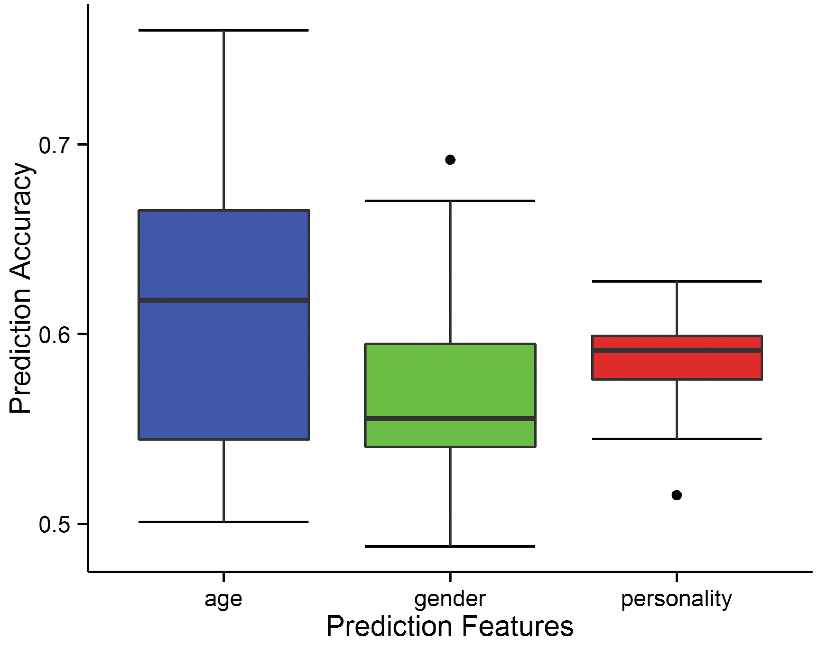
- Personality vs. Gender: In 72% of categories, personality traits provided a more accurate prediction than gender. Personality was specifically superior in gender-neutral categories like "green living" or "DVD videos."
| Consumption Category | Accuracy | Top Personality Feature |
|---|---|---|
| Computing Software | 62.2% | Openness |
| Nutraceuticals | 62.1% | Self-consciousness |
| Gardening | 61.9% | Immoderation |
| Travel | 61.3% | Adventurousness |
Critical Insight: Deficiency vs. Growth Needs
One of the most profound observations in the paper is the split between Deficiency Needs (basic survival, safety, belonging) and Growth Needs (self-actualization, esteem).
- Personality traits are highly effective at predicting purchases that satisfy deficiency needs (clothes, housewares).
- Demographic features, particularly age, still hold a slight edge in predicting growth needs (career improvement, inspirational goods).
The researchers argue that while age is a powerful predictor, it is "sensitive" data and often harder for companies to acquire legally or ethically than public social media text.
Conclusion and Future Outlook
This work validates that our digital "vibe"—quantified through AI—is a powerful economic indicator. By shifting from demographics to psychographics, businesses can move away from "spray and pray" advertising toward highly personalized messaging that resonates with a consumer's fundamental character.
Limitations: The study relies on inferred data (social media inferred personality). Future research using "ground truth" personality tests linked to purchases would further solidify these findings. However, for the modern marketer, the message is clear: To know what someone will buy, read between the lines of what they write.