
[SCET 2026] Resumming the C-Parameter Shoulder: Solving the Step-to-Spike Mystery in QCD
Resummation of the C-Parameter Sudakov Shoulder Using Effective Field Theory
This paper presents the first Soft-Collinear Effective Theory (SCET) factorization theorem for the C-parameter distribution near its kinematic "Sudakov shoulder" at C=3/4. By deriving new one-loop jet and soft functions, the authors achieve NLL+NLO matched resummation, successfully smoothing the unphysical fixed-order "spike" into a continuous Sudakov shoulder.
Executive Summary
In the landscape of precision QCD, the C-parameter has long been a staple for extracting the strong coupling constant . While the "two-jet" limit (where ) is well-studied, the distribution exhibits a violent feature at known as a Sudakov Shoulder. At this point, the three-parton phase space reaches its maximum, and the entry into four-parton territory triggers logarithmic divergences that break standard perturbation theory.
This paper, authored by Matthew D. Schwartz (with assistance from Claude 4.5), provides the first rigorous Effective Field Theory (SCET) treatment of this boundary. By constructing a new factorization theorem, the work transforms the unphysical NLO "spike" into a smooth, resummed shoulder at NLL+NLO accuracy.
The Core Challenge: Why is the Shoulder Different?
Most event shapes have a "kink" at their kinematic boundaries. The C-parameter is unique—it has a step discontinuity. At tree level, the distribution is finite right up to and then instantly drops to zero.
The culprit is the quadratic nature of the C-parameter. Near the symmetric "Mercedes" trijet configuration, the gradient of the C-parameter vanishes (). While the phase space volume shrinks as you approach the boundary, the Jacobian diverges at exactly the same rate. These two effects cancel perfectly at leading order (LO), leaving a finite "step." However, at NLO, this cancellation fails, leading to the infamous Sudakov logarithms.
Methodology: The SCET Factorization
To tame these logs, the authors matched QCD onto a 3-jet SCET framework. The resulting factorization theorem decomposes the cross-section into:
- Hard Function (): Standard trijet production at separation.
- C-Shoulder Jet Functions (): New operators that measure "azimuthally-weighted" transverse momentum.
- Soft Function (): A new global soft function where radiation contributes proportional to .
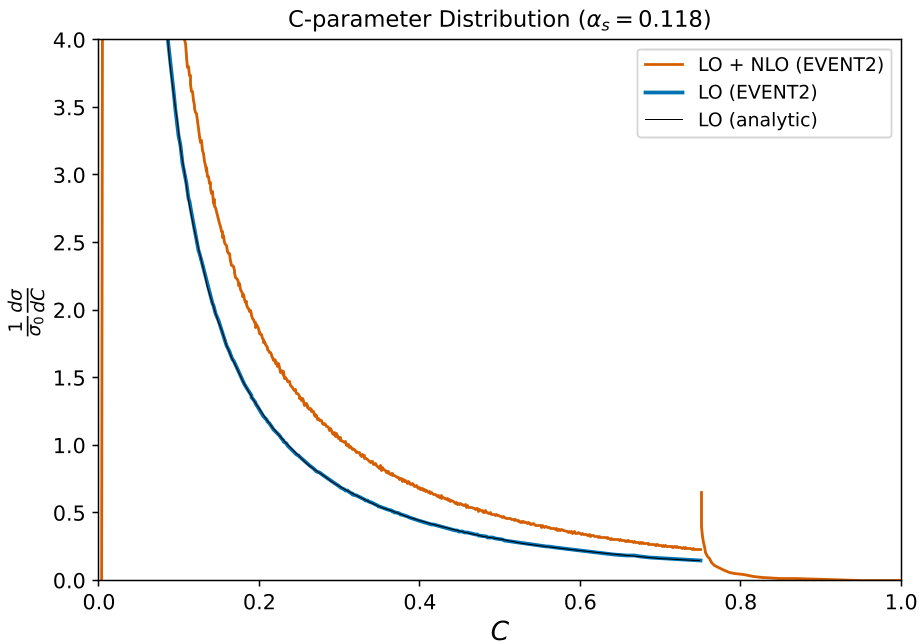 Figure 1: The "Mercedes" trijet configuration (left) and the resulting LO step vs. NLO spike (right).
The key mathematical insight is that the soft contribution is quadratic in the out-of-plane momentum component. Only radiation outside the event plane can push the C-parameter beyond the 3/4 boundary.
Experiments and Results
The authors validated their SCET predictions against EVENT2 (a fixed-order Monte Carlo). The singular coefficients derived from SCET anomalous dimensions perfectly matched the numerical data across all color channels ().
The final "Matched" distribution (NLL+NLO) uses profile scales to transition between the resummation region and the fixed-order tail.
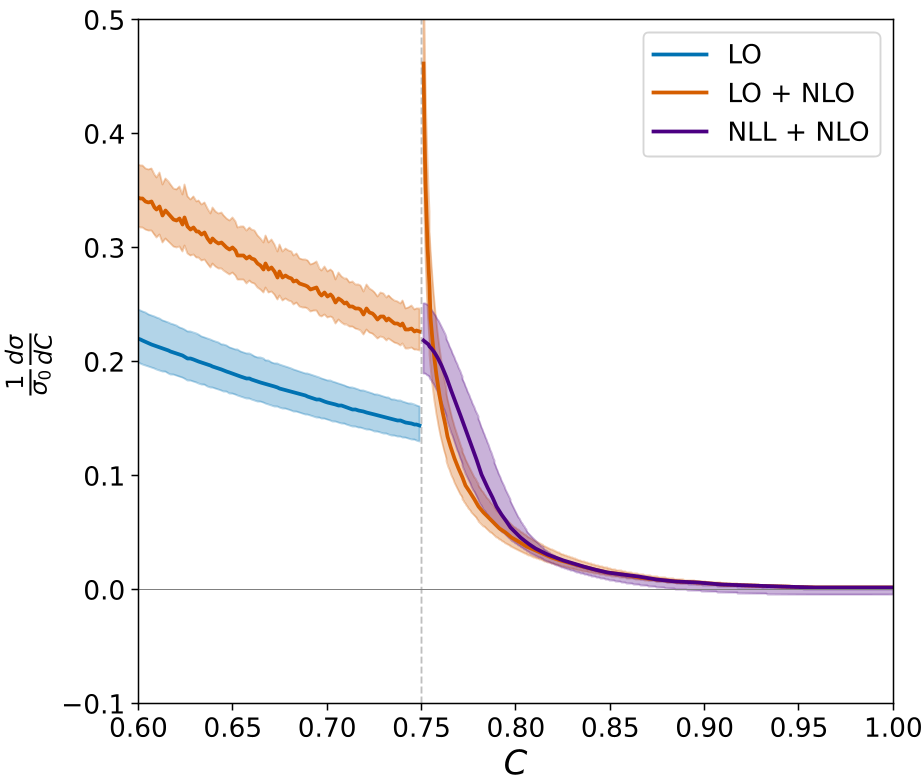 Figure 2: The purple curve shows the NLL+NLO result. Note how the unphysical NLO spike (orange) is smoothed out, approaching the shoulder value gracefully from below.
Key Achievements:
- No Sudakov-Landau Pole: Unlike heavy jet mass, the C-parameter's additivity allows for stable momentum-space resummation.
- Global Physics: As a global observable, it is free from non-global logarithms (NGLs) at leading power.
- Theoretical Precision: Achieved an uncertainty band of , typical for NLL event shape studies.
Critical Insight & Future Outlook
The most striking takeaway is the "Automation" of physics. This paper was largely prepared by an AI assistant (Claude 4.5) under physicist supervision. This marks a milestone in AI-driven theoretical physics, where complex loop integrals and SCET derivations were handled by the agent.
Limitations: The current work is NLL. To reach percent-level accuracy for future colliders like FCC-ee, two-loop jet and soft anomalous dimensions (NNLL) and non-perturbative power corrections will be required.
Conclusion: This work completes a major piece of the QCD puzzle for the C-parameter. By treating the kinematic shoulder as a perturbation of the symmetric trijet, it provides a robust framework for high-precision tests of the Standard Model in regions previously thought to be "divergent" and "inhospitable" for theory.