
Smart Switching: Optimizing Crowdsourcing Costs via Intelligent Cache Reuse
A Cache-based Approach to Dynamic Switching between Different Dataflows in Crowdsourcing
This paper introduces a general framework for optimizing crowdsourcing dataflows when switching from an old execution plan to a new one. It proposes a cost-estimation method to determine if completing "dangling" intermediate tasks is more economical than restarting them in the new workflow.
TL;DR
Crowdsourcing workflows are notoriously slow and expensive. When a process needs to change midway (e.g., swapping a complex translation chain for a simpler one), most systems either start over or use basic caching that breaks when the structure changes. This paper introduces a formal framework to calculate the "Cost-to-Remove" dangling data, allowing managers to decide exactly which intermediate tasks are worth finishing to maximize savings in a new workflow.
The Motivation: The "Dangling Result" Dilemma
In crowdsourcing, we often encounter a scenario where a dataflow (a sequence of human tasks) is partially complete, but we suddenly realize a better way to do things.
- Previous Approach: Systems like TurKit cache results based on specific task signatures. If you change a task from "Translate J-E" to "Translate J-S," the cache becomes useless.
- The Insight: Even if the new workflow is different, "finishing" a few tasks in the old workflow might produce an output that is useful for the new one. The challenge is: Is the money spent finishing these "dangling" tasks less than the money saved by skipping them in the new flow?
Methodology: Quantifying the Tradeoff
The authors define a mathematical framework to estimate the cost of clearing dangling data items.
1. Sequential and Join Costs
For a simple line of tasks, the cost is the sum of tasks remaining until a reusable output is reached. However, in Join tasks (where two data streams merge), the cost calculation becomes a recursive problem. The paper provides a specific formula for "Cost2Remove":
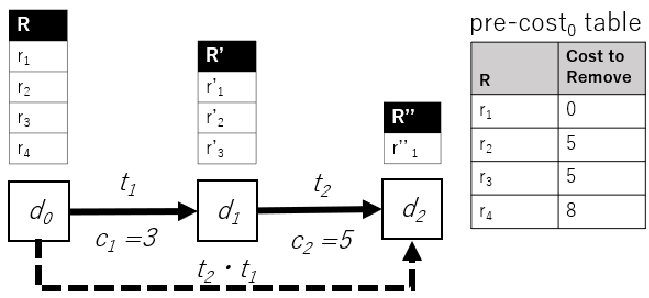 Figure 2: Estimating the cost to remove a data item by finishing its path to a reusable state.
2. The Formula for Joins
The authors handle joins by generating a "Join Cost Table." The cost to remove a source tuple is calculated as the sum of its pre-join costs and the marginal costs incurred during and after the join, ensuring no task is double-counted.
Experimental Insights: No "Silver Bullet"
Through simulations with varying task cost distributions (e.g., increasing cost, decreasing cost, or uniform cost), the researchers found two critical lessons:
- Optimal Points Exist: There is almost always a "sweet spot" on the tradeoff curve where finishing a specific number of old tasks leads to the lowest total cost for the project.
- Context is Everything: As shown in the graph below, the best place to switch depends entirely on whether your expensive tasks were at the beginning or the end of the original flow.
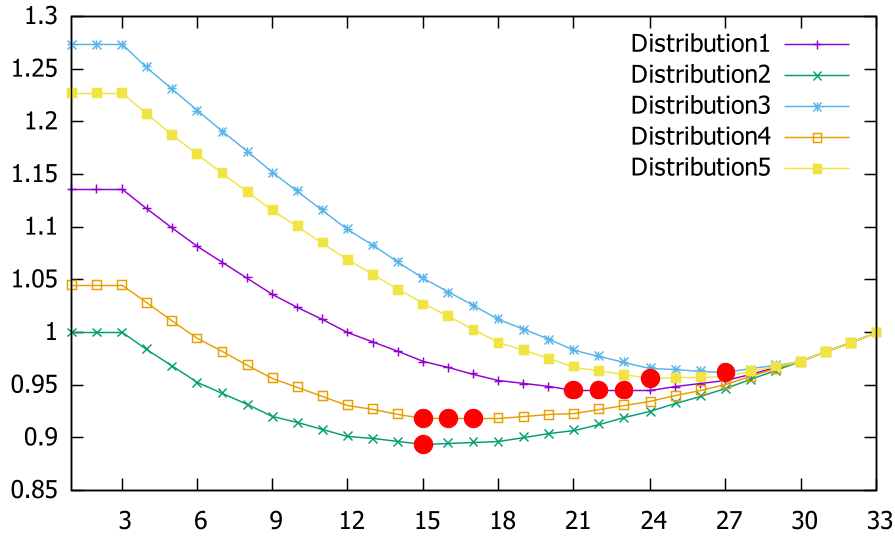 Figure 4: Total cost curves for various distributions. Red dots indicate the optimal points to stop the old flow and transition to the new one.
Critical Analysis & Future Outlook
The beauty of this work lies in its Inductive Bias: it assumes that human task results are assets with "residual value" even when the plan changes.
Limitations:
- The current model assumes the destination node of the new dataflow is a simplified version of the old one.
- It doesn't yet account for the quality of the crowdsourced results, only the monetary cost.
Conclusion: This paper moves crowdsourcing from "static execution" toward "dynamic optimization." By treating intermediate human outputs as manageable cache items, developers can build more resilient and cost-effective AI-human hybrid systems.