
Cachet: Solving the Performance-Privacy Paradox in Decentralized Social Networks
Cachet: A Decentralized Architecture for Privacy Preserving Social Networking with Caching
This paper presents Cachet, a decentralized architecture for privacy-preserving online social networks (OSNs) that utilizes a hybrid structured-unstructured overlay. By combining Distribution Hash Tables (DHTs) with gossip-based social caching and Attribute-Based Encryption (ABE), Cachet achieves significant performance gains in timeline generation (newsfeed) tasks while protecting user metadata and content.
TL;DR
The dream of a decentralized Facebook often dies at the hands of latency: fetching and decrypting a single newsfeed can take minutes. Cachet introduces a "social caching" layer on top of a standard DHT (Distributed Hash Table), reducing newsfeed load times from hundreds of seconds to under ten. By allowing online friends to serve as encrypted data caches, it preserves privacy through Attribute-Based Encryption (ABE) while delivering the speed users expect.
Background: The Cost of Privacy
Moving social networks away from central authorities (like Meta or Google) is essential for data sovereignty. However, decentralization introduces two major hurdles:
- The Infrastructure Gap: Without a central server, data is scattered across a DHT. Finding "all status updates from all my friends" requires massive parallel lookups.
- The Cryptographic Tax: To keep data private from untrusted storage nodes, every piece of content is encrypted using ABE. Decrypting hundreds of posts is computationally expensive.
Cachet identifies that in a social context, trust and proximity are underutilized resources.
Methodology: Hybrid Overlays and Social Caching
Cachet’s architecture is a clever marriage of structured and unstructured P2P systems.
1. The Container Model
Data is stored in "Containers" which contain encrypted content and references. These are protected by:
- Read Policy: Enforced via ABE.
- Write/Append Policy: Controlled by digital signatures.
- Storage: Untrusted DHT nodes.
2. The Gossip-Based Caching Algorithm
The "Secret Sauce" of Cachet is how it uses social links. Instead of always querying the DHT, a node performs a Presence Protocol:
- Identify online friends: Use the DHT to find the IP of a few key contacts.
- Pull cached data: Connect to those friends. If they have already fetched and decrypted updates from mutual offline friends, they share that data (provided the receiver satisfies the ABE policy).
- Recursive discovery: Use the info from friends to find more online nodes, creating a fast-moving gossip wave of data.
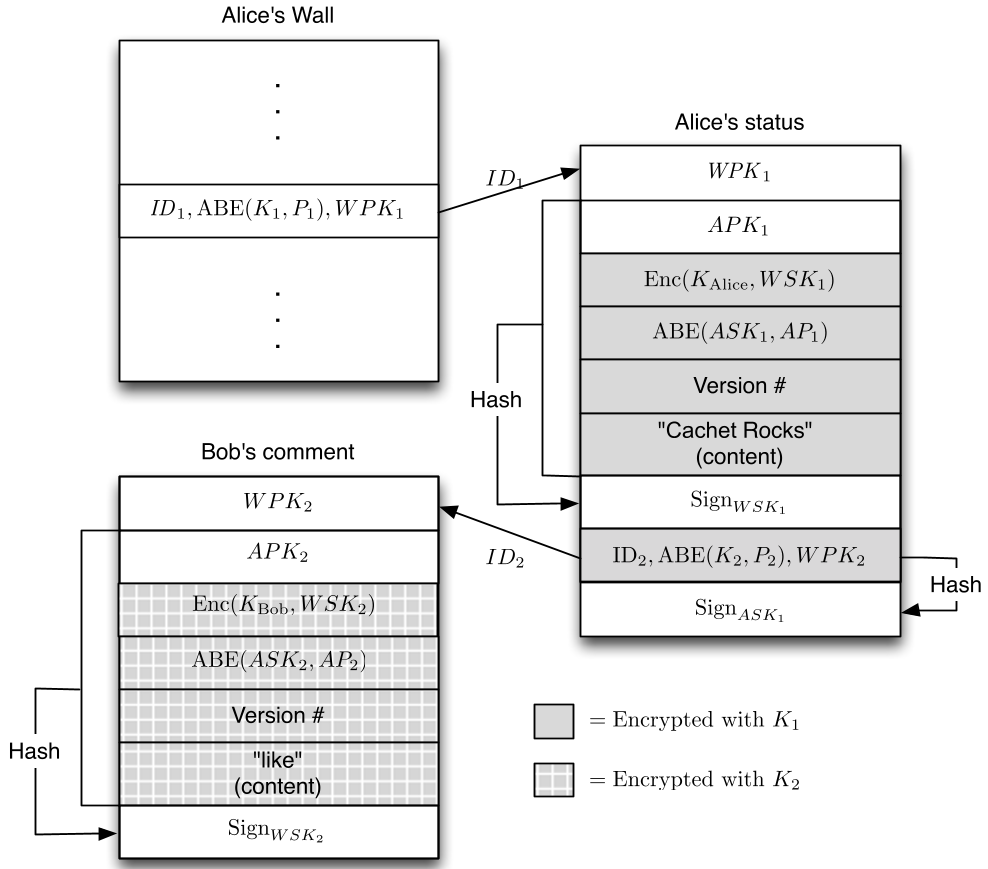 Figure 1: The object structure showing how status updates and comments are linked via cryptographic containers.
Experiments: Proving the Gains
The authors tested Cachet using real-world friendship graphs from Facebook. The results were dramatic.
- The Speedup: In the base architecture (pure DHT), newsfeed generation was non-practical. Cachet brought this down to a usable sub-10-second window.
- The "Hit Rate" Efficiency: Remarkably, you don't need everyone to be online. With just 10-30% of a user's circle online, the system achieves a high "hit rate," meaning most data comes from the fast gossip layer rather than the slow DHT.
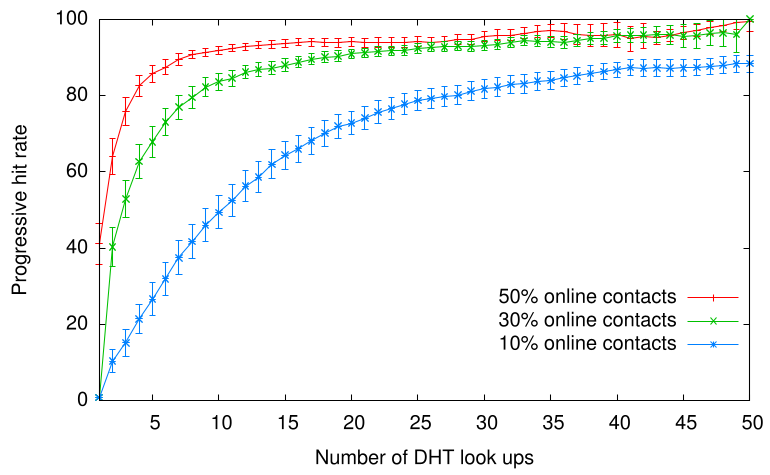 Figure 2: Performance comparison showing that social caching significantly lowers the latency threshold across different online friend percentages.
Critical Insights
While Cachet solves the latency problem, it introduces interesting trade-offs:
- Privacy Leakage: By caching data for others, friends essentially learn that they share specific attributes or mutual contacts. The paper acknowledges this as a "trade-off for efficiency."
- Resource Burden: Users must volunteer CPU and bandwidth. However, since social data (text/status) is small, this burden is minimal compared to the privacy gains.
Conclusion
Cachet proves that decentralization doesn't have to mean "slow." By leveraging the natural structure of human relationships—where friends frequently interact and share mutual interests—we can build cryptographic systems that are both private and performant. For the future of the "DWeb," Cachet provides a blueprint: use the DHT for persistence, but use the social graph for speed.