
Intelligent Edge: Boosting D2D Offloading via Personalized Recommendation Systems
17607_Caching Placement with Recommendation Systems for Cache-Enabled Mobile Social Networks.
This paper proposes a recommendation-driven caching placement strategy for mobile social networks, utilizing "Important Users" (IUs) as decentralized hubs. The core method integrates a cascaded recommendation engine (Collaborative Filtering and Latent Factor Models) to predict individual content preferences, significantly enhancing D2D (Device-to-Device) offloading efficiency compared to traditional popularity-based caching.
TL;DR
This research shifts the paradigm of mobile edge caching from "one-size-fits-all" popular content to personalized interest-driven delivery. By combining Collaborative Filtering and Latent Factor Models, the authors predict what users actually want and cache those specific files on strategically chosen "Important Users" (IUs). The result? A significantly higher data offloading ratio and a lighter load on cellular base stations.
Problem & Motivation: The "Popularity" Fallacy
In many mobile social networks, caching strategies assume that everyone wants to see the latest viral video. However, as the authors point out, a user obsessed with military history might be completely indifferent to the "hottest" World Cup highlights.
Existing SOTA methods often overlook this Individual Character. In a D2D (Device-to-Device) environment, if the neighborhood "helper" device stores content that nobody in its social circle cares about, the cache is wasted, and everyone reverts to fetching data from the congested Base Station (BS). The motivation here is to align physical cache placement with the psychological latent factors of the users.
Methodology: The Cascaded Recommendation Engine
The paper proposes a sophisticated pipeline to solve the "what to cache" problem. Instead of a simple heuristic, they treat caching as a recommendation task.
1. IU Selection (The Physical Layer)
Before recommending content, the system identifies Important Users (IUs). These aren't just users with big hard drives; they are selected based on Social Importance (), a weighted combination of:
- Available Storage (A): Physical capacity.
- Betweenness Centrality (B): A graph-theory metric measuring how often a user acts as a bridge in the shortest paths between others.
2. Recommendation Pipeline (The Logic Layer)
The system processes the download history matrix through three stages:
- Pre-filtering: Pruning the "monster matrix" to remove niche records that add noise.
- Collaborative Filtering (CF): Using Cosine Similarity to find "neighbor" users with similar tastes.
- Latent Factor Model (LFM): Decomposing the user-item matrix into hidden preference vectors.
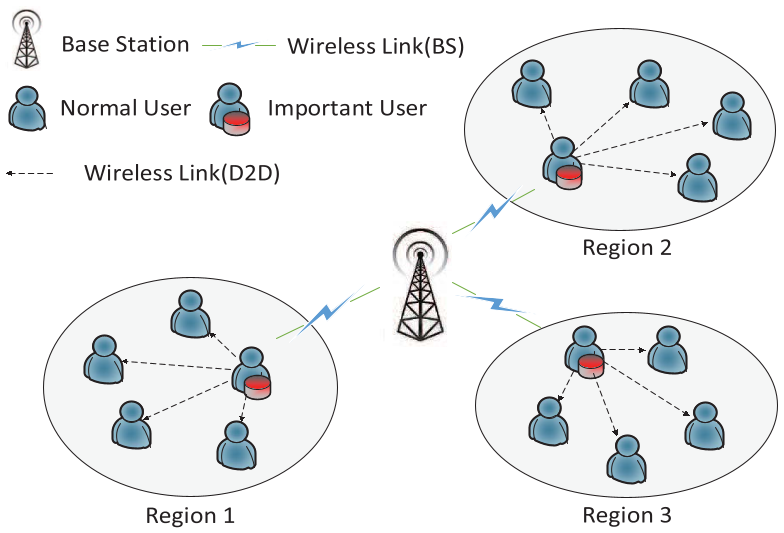 Figure 1: The mobile social network model where IUs serve geographical clusters based on social ties.
The LFM is particularly elegant, using a loss function with regularization to prevent overfitting: This allows the network to "learn" user preferences even when the download history is sparse.
Results: Why Personalization Wins
The authors validated their approach against two common baselines: Random Caching and Most Popular Caching.
Offloading Efficiency
The recommendation-based scheme consistently outperformed both. Interestingly, the performance is tied to the "Social Relationship" () density. As social ties become more cohesive, the IU's personalized cache becomes exponentially more effective because the recommended content for the IU aligns better with the interests of its "friends" in the D2D range.
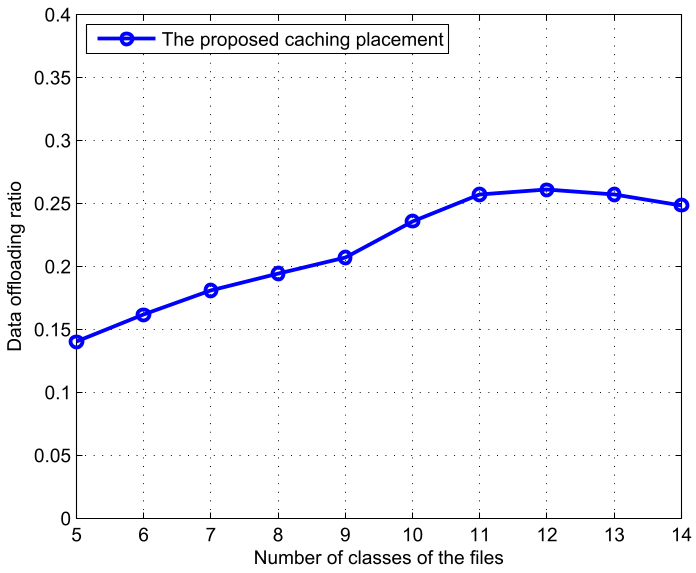 Figure 2: Data offloading ratio vs. the number of content classes.
One of the most insightful findings is shown in the figure above: the offloading ratio peaks at a certain complexity of content classes (~12). If there are too few classes, popularity-based caching is "good enough." If there are too many, the users' interests become too fragmented (sparse) for any recommendation system to predict accurately without more data.
Critical Analysis & Conclusion
Takeaway
The paper successfully demonstrates that content awareness is just as important as channel awareness in modern wireless networking. By leveraging the abundance of local storage and the predictability of human social behavior, we can offload significant traffic from the core network.
Limitations & Future Work
While the mathematical framework is robust, the study assumes a relatively static social graph. In reality, mobile social networks are highly dynamic—users move, and interests shift seasonally. Future iterations could benefit from:
- Temporal Dynamics: Adding a time-decay factor to the Latent Factor Model.
- Energy Efficiency: Analyzing the battery drain on IUs, as acting as a social cache hub is energy-intensive.
- Privacy: Implementing Federated Learning so that users' download histories (highly private) don't need to be uploaded to a central BS in plain text.
This work serves as a foundational bridge between Data Mining and Wireless Communications, proving that the next generation of 6G networks will likely be as much about "knowing the user" as they are about "moving the bits."