
Beyond DHTs: Optimizing DOSNs with Socially-Aware Caching Structures
Caching Structures for Distributed Data Management in P2P-based Social Networks
The paper introduces a social caching mechanism for Distributed Online Social Networks (DOSNs), specifically implemented within the LibreSocial P2P framework. It proposes three selection strategies—random, trend, and social score—to manage proactive data dissemination, achieving a cache hit ratio of up to 99.2% when combined with default DHT caching.
TL;DR
This research addresses the inefficiency of data management in Distributed Online Social Networks (DOSNs). By introducing a social caching mechanism that uses a "Social Score" (based on the intensity and duration of friend interactions), the authors achieved a 99.2% cache hit ratio. This effectively eliminates the latency and overhead typically associated with Distributed Hash Table (DHT) lookups in P2P networks.
Background & Motivation: The Decentralization Dilemma
Decentralized Social Networks (DOSNs) like LibreSocial aim to return data ownership to users by removing central servers. However, this creates a massive technical headache: Data Availability vs. Consistency.
In a centralized system, Facebook or X (Twitter) manages updates instantly. In a P2P environment, fetching a friend's latest post usually requires an expensive lookup in a Distributed Hash Table (DHT). If you check your feed frequently, these lookups create massive network overhead. Existing solutions either:
- Passive Request-Reply: Wait for the user to ask, then search the network (Slow).
- Epidemic/Gossip Protocols: Flood the network with updates (Wasteful).
The authors' insight is simple: Use the social graph to predict what users will ask for. If Alice talks to Bob every day, Bob's node should proactively push his updates to Alice's cache.
Methodology: The Social Score Strategy
The core of the paper is the integration of a Social Cache into the LibreSocial architecture.
1. The Selection Mechanism
A node cannot cache everything from every friend due to resource constraints. The authors tested three strategies to select which "subscriptions" to maintain:
- Random: Subscribes to new contacts until the limit is reached, then replaces them randomly.
- Trend: Ranks contacts by the number of interactions in a fixed window.
- Social Score (The Winner): A sophisticated metric combining Tie Strength (frequency of interaction) and Medium Interaction Length (MIL) (how long the relationship has lasted).
2. Architecture Integration
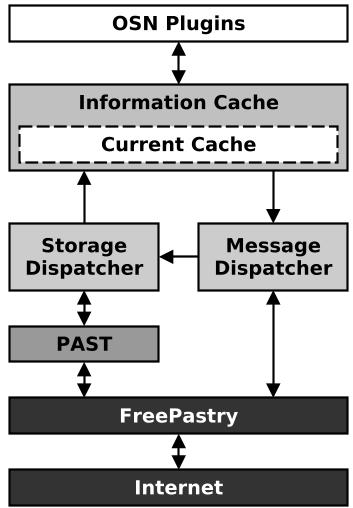
The social cache sits within the Information Cache layer, acting as a "first responder" before the system even considers hitting the DHT.
3. Consistency via Social Updates
When a user updates their profile or posts a message, the "Social Cache" triggers a Social Update. This is pushed through an instance channel to all subscribed "alters" (friends). This ensures that Alice’s cache of Bob’s profile isn't just fast—it’s actually accurate.
Experimental Evidence: SOTA Performance
The researchers evaluated their system using real-world Facebook interaction data.
Strategy Performance
While all three strategies provided high hit ratios (>92%), the Social Score strategy was significantly more "local-resource efficient." It maintained a smaller cache size and required fewer subscription messages to achieve its results.
The Power of Combination
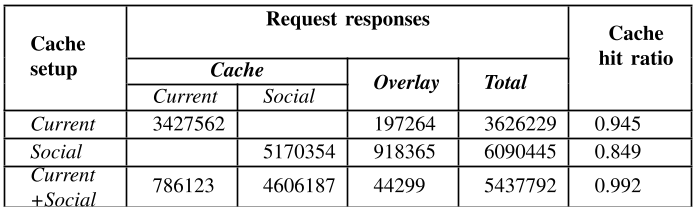
The most striking result came from combining the new Social Cache with the existing DHT (PAST) cache.
Key takeaways from the results:
- Current Cache Only: 94.5% hit ratio (but relies on aging/expiration).
- Social Cache Only: 84.9% hit ratio (but guarantees consistency for friends).
- Combined: 99.2% hit ratio. Under this setup, nearly all social traffic is handled locally, leaving the DHT only for rare, non-social discovery.
Critical Analysis & Conclusion
The "Dunbar" Limit
One of the smartest features of this work is the objective limit on subscriptions based on the Dunbar Number (150). By recognizing that humans can only maintain roughly 150 active relationships, the system prevents the social overlay from exploding into a second, unmanageable DHT.
Limitations
- Memory Overhead: The combined approach consumes significantly more memory (up to 400MB per instance) than the basic DHT.
- Bootstrapping: Initial subscriptions require a "warm-up" period where full content must be transferred initially.
Final Thoughts
This paper serves as a blueprint for designing user-centric distributed systems. By aligning technical caching layers with human social patterns, we can build decentralized apps that match the performance of their centralized counterparts without sacrificing privacy.