
CAESAR: Bringing Social Intelligence to the 2G "Feature Phone" Era
CAESAR: A Context-Aware, Social Recommender System for Low-End Mobile Devices
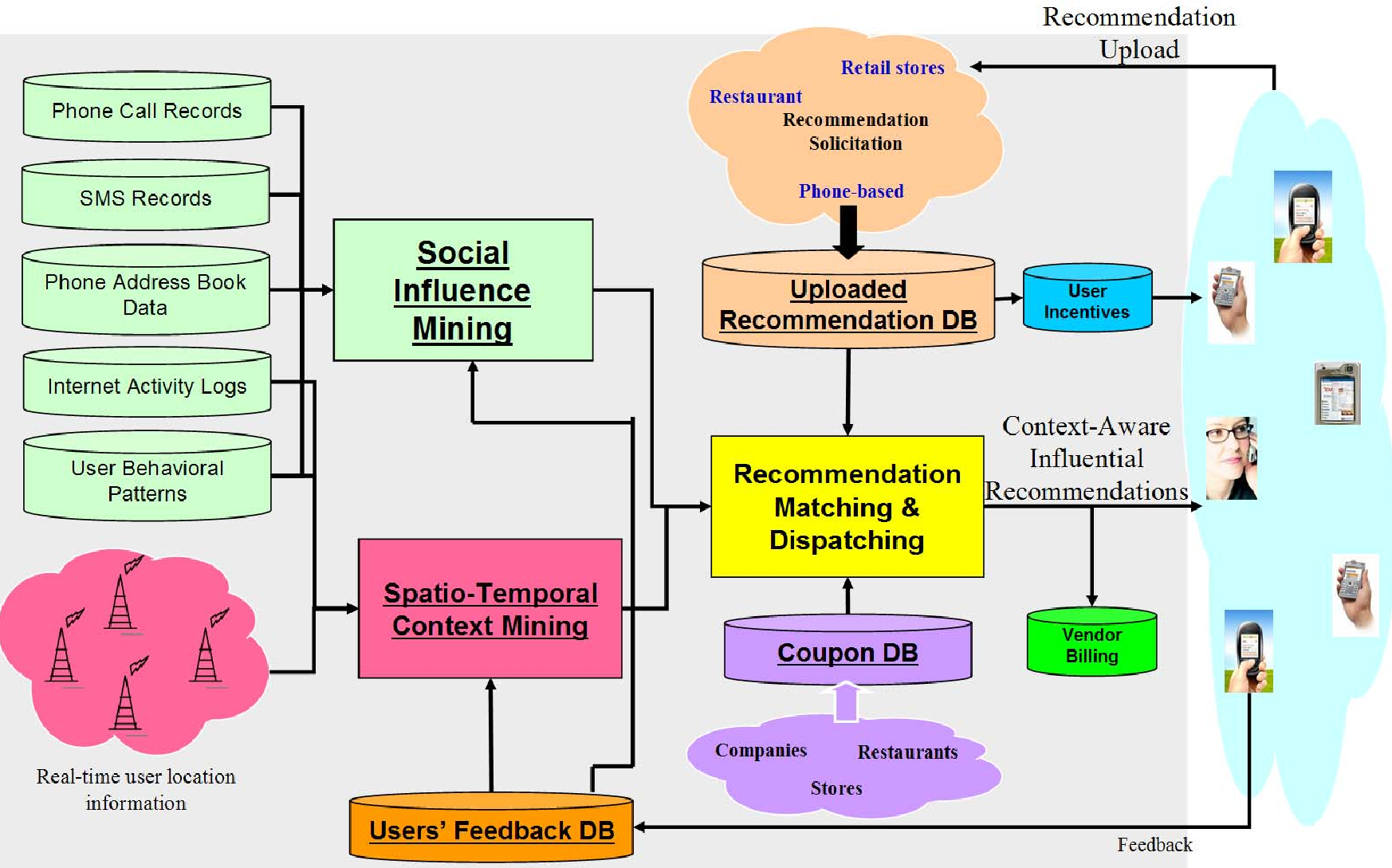
CAESAR is a context-aware social recommender system specifically designed for low-end 2G mobile devices. It leverages social affinity mining from call records and address books, combined with spatio-temporal filtering, to deliver highly targeted advertisements and coupons via SMS or USSD.
TL;DR
In an era dominated by 3G/4G/5G and smartphones, CAESAR proves that social networking isn't just for high-end devices. By leveraging Social Affinity Mining (who you talk to) and Spatio-Temporal Context (where you are and what time it is), the system delivers hyper-targeted recommendations to basic 2G phones using nothing but SMS and missed calls.
Problem & Motivation: The 2G Digital Divide
While the tech world focuses on rich media and GPS-heavy apps, a staggering 2.96 billion users (as of the paper's context) still rely on 2G GSM phones. These users are often ignored by modern recommender systems.
Existing mobile advertising faces two major hurdles:
- Intrusiveness: Random SMS ads are often ignored as spam.
- Resource Constraints: Low-end devices lack GPS, high-speed data, and high-performance CPUs.
The authors' insight is brilliant in its simplicity: Treat the cellular network itself as the sensor. If we know who a user calls and which cell tower they are connected to, we have enough data to build a trust-based, location-aware recommendation engine without needing a single app install or a GPS lock.
Methodology: The Three Pillars of CAESAR
1. Social Affinity Computation
CAESAR doesn't ask you to "Add Friends." Instead, it mines existing relationships:
- Call Data Records (CDR): If User A and User B talk frequently and for long durations, a high social affinity is assigned. The weight is normalized against the total talk time to ensure relative influence is captured.
- Address Book Intersections: The system looks for common contacts. If two people share many of the same contacts, they likely belong to the same social circle.
2. Spatio-Temporal Filtering
A restaurant recommendation is useless at 3 AM or when you are 50 miles away. CAESAR uses:
- Temporal Hotness: A periodic step function that recognizes, for example, that cafes peak in the afternoon, while restaurants peak at lunch and dinner.
- Spatial Relevance: An exponential decay function based on the distance between the user’s current cell tower and the business.
3. The "Missed Call" Feedback Loop
To "Like" a business, a user simply places a "missed call" to a designated number. This is free for the user and provides a clear signal to the engine. When a friend enters the vicinity of that business during its "hot" hours, CAESAR triggers an SMS coupon.
Experiments & Results: Efficiency is King
For a system targeting low-end devices, battery and bandwidth are precious.
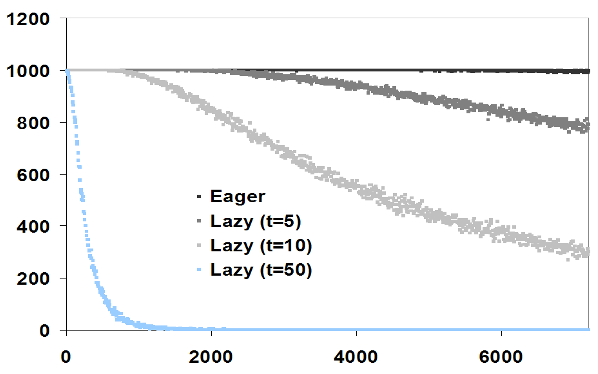
- Communication Optimization: The authors compared "Eager" (update immediately) vs. "Lazy" (batch updates) for address books. The Lazy approach showed a massive reduction in communication costs, making the system viable for users on limited SMS plans.
- Location Tracking: By using a Likelihood-based approach (estimating if a user could have reached a store based on travel speed), the system reduced location queries by up to 85%.
Critical Analysis & Conclusion
Takeaway: CAESAR acts as a bridge between the physical social circle and the mobile cyberspace. It effectively uses "found data" (CDRs and Zip codes) to create a premium recommendation experience on the most basic hardware.
Limitations:
- Privacy: Centralized mining of call records and address books raises significant privacy concerns by modern standards.
- Accuracy: Coarse-grained location (Zip codes/Cell IDs) might lead to "near-miss" recommendations in dense urban environments compared to GPS.
Future Outlook: The logic behind CAESAR—filtering recommendations by social trust and environmental context—remains the gold standard for ad-tech today. As we move toward privacy-first computing, the challenge will be implementing CAESAR’s social mining using on-device encrypted processing.