
SmartSocial: Bridging Telco Data and Social Networks to Quantify Individual Influence
Calculating user's social influence through the SmartSocial Platform
The paper introduces the SmartSocial Platform (SSP), a novel system designed to calculate the social influence of modern ICT users by integrating multi-source data. Unlike existing solutions, the proposed SmartSocial Influence Algorithm combines telecommunications data (calls, SMS) with social network activities (Facebook) to generate a comprehensive influence score ranging from 1 to 100.
In an era where a single tweet can tank a company's stock or a disgruntled customer can trigger a mass exodus from a mobile provider, understanding Social Influence is no longer a luxury—it's a survival requirement for modern enterprises. While platforms like Klout once dominated this space by analyzing the "Big Data" of the web, a team from Ericsson and the University of Zagreb is arguing for a more integrated, "ego-centric" approach.
TL;DR
The SmartSocial Platform (SSP) is a framework that calculates a user's social influence by merging two previously siloed worlds: their cellular behavior (calls/SMS) and their social media engagement (Facebook). By focusing on the user's immediate "ego-network," the system achieves high scalability and provides a more holistic view of the "Modern ICT User."
The Missing Link: Why Telco Data Matters
Most influence algorithms suffer from a "Big Brother" bias—they try to monitor everyone everywhere. However, the most potent influence often happens within a user's direct circle.
The authors identify a critical gap in churn prevention. Traditionally, telcos only care about "high-value" business users. They ignore the "pre-paid long tail." But what if one of those pre-paid users is a local influencer? If they leave, they might take fifty other subscribers with them. Current tools like Klout don't see your phone calls; the SmartSocial Platform does.
Methodology: The Hybrid Influence Engine
The SmartSocial Influence Algorithm operates on a dual-track scoring system, normalized on a scale of 1 to 100.
1. Telco Influence ()
The model looks at "out-degree" parameters:
- Frequency of outgoing calls.
- Total call duration.
- Volume of SMS messages. It uses a logarithmic normalization to ensure that extreme outliers don't break the scale, focusing on how a user compares to the most active person in their immediate network.
2. Internet Influence ()
Using a Modified Limited Recursive Algorithm (MLRA) on Facebook data, the system measures:
- Degree Centrality: Friendship count (capped at 1,000 for statistical relevance).
- User Engagement Rate (UER): How many friends actually interact with a specific post.
- Magnitude of Influence (MOI): The aggregate impression across the entire network.
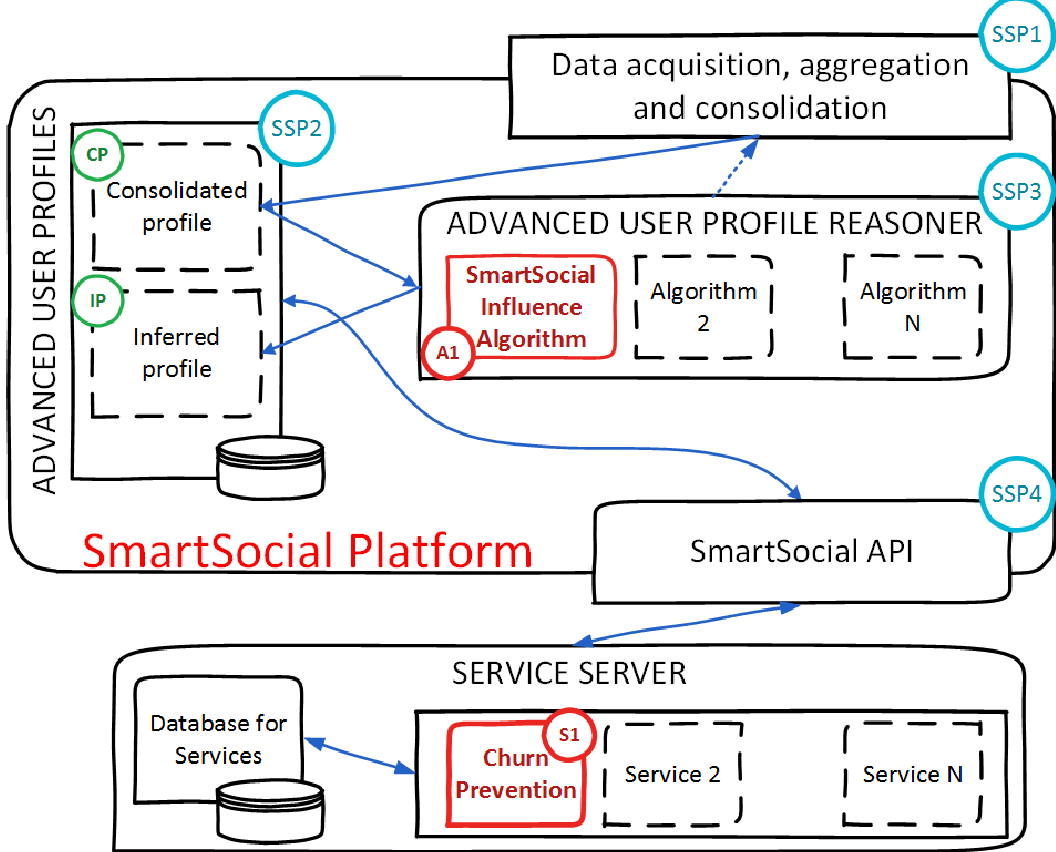 Figure 1: The architecture of the SmartSocial platform, showing the integration of User Profile Gateways (Telco) and Internet APIs.
Experimental Evidence
The researchers tested their model on 123 active ICT users. The results were telling. The "Total Influence" followed a normal distribution, but the sub-components revealed high-resolution behavioral patterns.
- Social Network Influence showed a bimodal distribution: "Observers" (low engagement) vs. "Content Creators" (high engagement).
- Telco Influence was also bimodal but shifted higher, suggesting that while many are passive on Facebook, most people are active users of basic communication services.
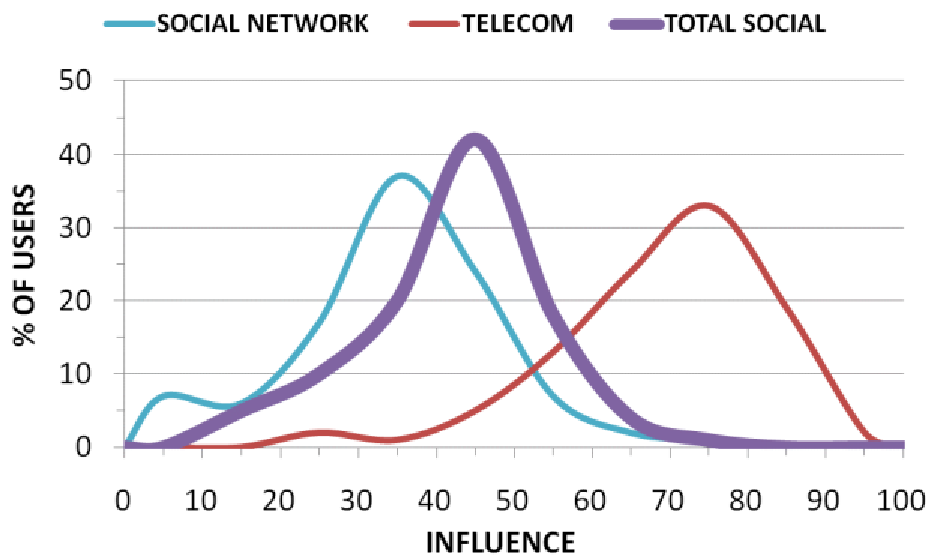 Figure 2: The distribution of social influence scores. Note the median of 45, which mirrors the distribution found in market leaders like Klout (shown below).
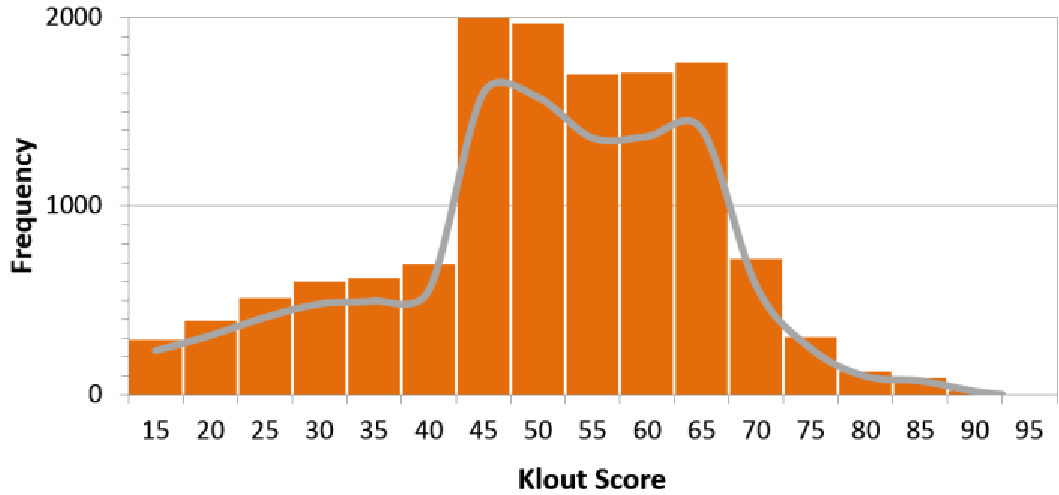 Figure 3: Benchmark Klout score distribution, validating the SSP results.
Critical Analysis & Future Outlook
The SmartSocial Platform's greatest strength is its Inferred Knowledge capability. By using NoSQL technologies like Redis for speed and MongoDB for complex data structures, it can calculate these scores without the massive overhead of global web crawlers.
Limitations:
- The Weighting Problem: Currently, weights for Telco vs. Social are set heuristically (0.25 vs 0.75). The authors admit that "ideal" weight calibration requires more large-scale longitudinal data.
- Privacy: Accessing private Telco data and Facebook APIs requires explicit user consent, which may limit the system's "passive" monitoring capabilities.
Takeaway: The study proves that social influence isn't just about how many "likes" you get; it's about the intersection of your digital persona and your real-world communication habits. For Telcos and Marketers, this hybrid approach is the key to identifying the true "hubs" of our modern, hyper-connected society.