
Beyond Absolute RSS: A Robust, Calibration-Free Approach to Crowdsourced Indoor Positioning
A Calibration-Free Crowdsourcing-Based Indoor Localization Solution
The paper proposes a calibration-free indoor localization solution designed for crowdsourcing environments. Utilizing underlying relationships between Access Points (APs) and Received Signal Strength (RSS) jitter, the system achieves a 94.4% success rate in building/floor detection on the UJIIndoorLoc dataset.
TL;DR
Indoor localization usually breaks when you switch devices or don't have enough time to scan. This paper solves that by ignoring absolute signal strength and focusing on the relationships between Access Points. By using "Key AP Sets" and "Virtual Scan Records," the authors achieved better accuracy (7.0m) and a 94.4% success rate on the massive UJIIndoorLoc dataset without any device calibration.
The "Device Diversity" Headache
In the world of WiFi-based indoor positioning, the biggest enemy is heterogeneity.
- Device Diversity: Your high-end smartphone and an old tablet will perceive a -70dBm signal differently due to antenna gain and chipset variance.
- Short-duration Scans: Crowdsourcing volunteers don't stand still for minutes to collect "clean" data; they provide "noisy" snapshots.
Most prior works (like DIFF or HLF) try to fix this by looking at RSS ratios or differences. However, they still struggle when the training data is sparse. The authors of this paper argue that the absolute value of RSS is a distraction—the real secret lies in the underlying structure of the signal environment.
Methodology: Finding Stability in the Noise
The authors propose a two-step estimation pipeline that prizes invariance over precision.
1. Rough Localization: The Key AP Set
Instead of checking every AP, the system identifies a "Key AP Set"—those APs detected in over 80% of records at a location.
- Physical Intuition: Because APs have limited ranges, the overlap of detected "strong" signals is a powerful indicator of physical proximity.
- Stability: Since these are the strongest signals, they are detected by almost all devices regardless of hardware quality.
 Table 1: Overview of the UJIIndoorLoc dataset used for validation.
2. Precise Localization: The Virtual Record
Instead of matching a user's scan against an average radio map, the system generates a Virtual Scan Record.
- This virtual record explores the "jitter scope" (the range of possible values) of the training data.
- It searches for a combination of RSS values within that scope that best fits the user's current report.
- The Logic: If the user is at Position A, there should exist a valid signal combination in Position A's history that highly correlates with the user's current scan.
Experimental Results
The researchers tested their approach against four industry standards: Euclidean Distance, DIFF, HLF, and FreeLoc.
| Method | Success Rate (%) | Average Error (m) |
|---|---|---|
| Euclidean Distance | 89.7% | 8.2 |
| HLF / DIFF | ~90.6% | 7.9 |
| Our Method | 94.4% | 7.0 |
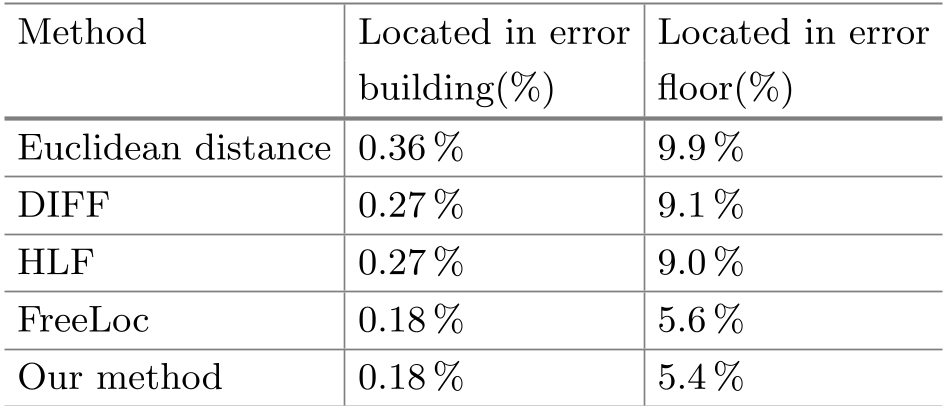 Table 5: The method significantly reduces building and floor classification errors.
The most striking result is the Building/Floor success rate. By using the AP set similarity first, the system almost entirely eliminates the "wrong building" problem (down to 0.18%).
Critical Analysis & Takeaways
The brilliance of this paper lies in its philosophical shift. Most researchers treat RSS noise as something to be filtered out through averaging. This work treats noise as a bounded scope—an inherent property of the location that can be used for correlation.
Limitations:
- The method relies on the "continuity of WiFi infrastructures." In environments with very sparse AP deployments, the rough localization step might lose resolution.
- While "calibration-free," it still requires a robust training database (even if that database is crowdsourced).
Future Outlook: This approach is a perfect candidate for integration with modern Deep Learning. Imagine a Neural Network trained specifically to recognize these "invariant relationships" rather than raw RSS. For developers building real-world apps, this paper provides a clear blueprint: stop calibrating devices and start modeling environmental relationships.