
CaMR: Bridging the Gap Between Visual Metaphors and Musical Emotions
CaMR: Towards Connotation-aware Music Retrieval on Social Media with Visual Inputs
This paper introduces CaMR, a novel Connotation-aware Music Retrieval framework designed to match music to visual inputs (images) based on implicit emotional and metaphorical meanings rather than just explicit object similarity. By constructing a metaphor information network and leveraging hybrid meta-path learning, CaMR achieves state-of-the-art performance on social media datasets, significantly outperforming baselines in retrieval precision.
TL;DR
CaMR (Connotation-aware Music Retrieval) is a breakthrough framework designed to retrieve music that matches the feeling of an image. Unlike older models that just look for matching keywords (like "tree" or "sun"), CaMR identifies the underlying metaphors—such as "loneliness" or "peace"—linking visual data and audio through a sophisticated metaphor information network. In real-world tests, it outperforms existing models by accurately capturing the "soul" of the artwork.
Back to the Soul: Beyond Object Detection
In the era of social media, we often want to pair a photo with the "perfect" song. Existing recommendation engines are surprisingly literal: if you post a picture of a house in winter, they might suggest a song about "Christmas" or "snow."
But what if the photo isn't about the snow? What if it’s an abandoned house that signifies desolation and loss? A happy Christmas song would be a terrible match. This is the connotation gap. Humans perceive abstract ideas beyond the pixels, but AI usually stays at the surface. CaMR's mission is to navigate this latent space of metaphors.
Methodology: The Metaphor Network (MNet)
The brilliance of CaMR lies in its Metaphor-enriched Connotation Extraction (MCE) module. The researchers realized that metaphors are the common currency between visual arts and music.
1. Constructing the Heterogeneous Network
The authors built a Metaphor Network (MNet) consisting of:
- Semantic Entities: Adjective-noun phrases from lyrics (e.g., "lonely shadow").
- Sentiment Entities: Textual tone (e.g., "joy", "sadness").
- Audio Entities: Physical acoustic qualities from Spotify API (e.g., "energy", "danceability") mapped to emotions like "relaxed" or "stressed."
2. Weighted Random Walks
To find the connection between a photo and a song, CaMR doesn't just look for a single link. It uses Hybrid Meta-Path Learning (HML). It performs "random walks" through the graph. For example, a walk might start at a "bare tree" (visual), link to "sadness" (sentiment), and find its way to a "depressed" melody (audio).
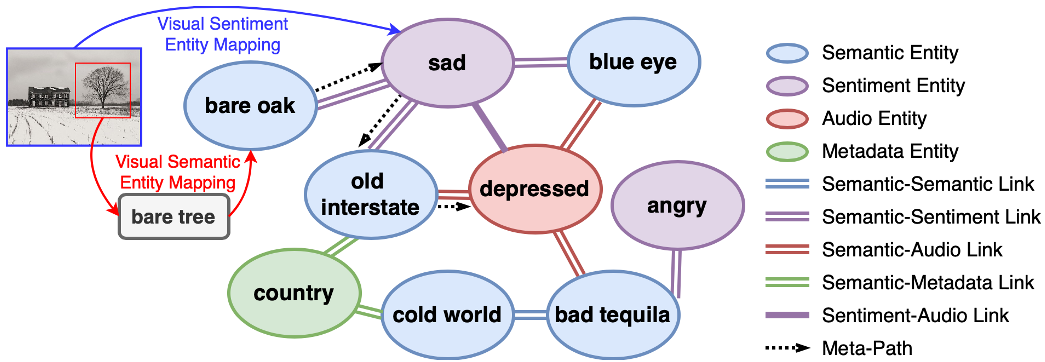 Figure 1: The MNet architecture showing how disparate entities like lyrics, audio, and metadata are linked.
Proving the Point: SOTA Results
The researchers didn't just rely on math; they used Amazon Mechanical Turk to get thousands of human evaluations on whether the retrieved music felt right.
- Precision Gains: CaMR significantly surpassed models like RecSys18 and Im2P. While Im2P is great at describing what's in an image, it fails to understand what the image means.
- The Power of Consistency: By measuring Semantic, Lyric, and Audio consistency concurrently, CaMR ensures that the vibe of the instruments matches the meaning of the words and the mood of the photo.
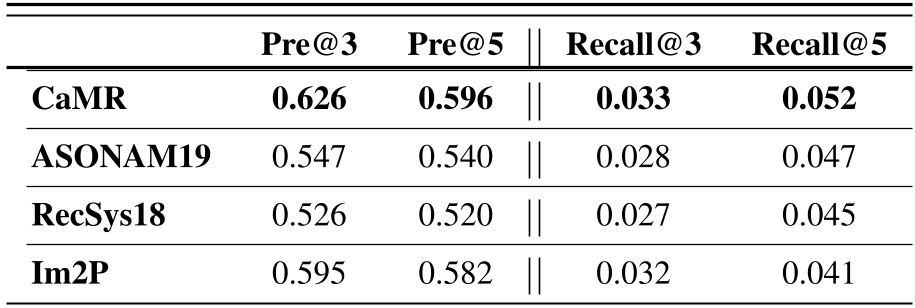 Table 1: CaMR outperforming baseline models across all key retrieval metrics.
Critical Insight: Why This Works
Most AI models suffer from "semantic noise"—they get distracted by irrelevant details. CaMR uses Visual Entity Mapping to curb "unknown entity" issues, allowing for a degree of flexibility (e.g., mapping a "bare tree" to a "bare oak"). This mimicry of human "fuzzy logic" is why the retrieval feels more natural to a social media user.
Conclusion & Future Look
CaMR is the first framework of its kind to explicitly prioritize connotation. While the current model relies on pre-defined entities, the future likely involves Large Language Models (LLMs) and Vision-Language Models (like CLIP) to generate even more nuanced metaphorical connections.
For developers building the next generation of content creation tools, the takeaway is clear: don't just tag the objects in the frame; understand the emotion they evoke.