
CAN: Composable Accessibility Infrastructure — Scaling Digital Inclusion via Data-Driven Crowdsourcing
CAN: composable accessibility infrastructure via data-driven crowdsourcing
This paper introduces CAN (Composable Accessibility Infrastructure), a data-driven crowdsourcing framework designed to identify and fix web accessibility issues. By composing "Accessible Components" (ACs) on-the-fly, the system achieves SOTA automation in fixing common violations like missing alt-text and keyboard navigation across the top 100 popular websites.
TL;DR
The web is still largely inaccessible to people with disabilities, and the gap between guidelines (WCAG) and implementation is widening. CAN (Composable Accessibility Infrastructure) bridges this gap by crowdsourcing actual web failures and providing modular, open-source "Accessible Components" (ACs) that fix sites on-the-fly. It turns the "messy reality" of the web into a living classroom for developers, automating fixes for images, contrast, and complex dynamic components.
Background: An Inaccessible Status Quo
In a survey of the top 100 websites conducted for this study, a staggering 59% had keyboard accessibility issues, and 35% lacked alternative text for images. The problem isn't just a lack of empathy; it's a technical and educational bottleneck. Developers often treat accessibility as an afterthought because it requires deep expertise in screen readers and assistive technologies.
The "Why": Why Existing Tools Fail
Prior solutions like AChecker or WAVE are diagnostic: they tell you what is wrong but leave the "How" to the developer. Furthermore, static fixes fail when sites use dynamic JavaScript or complex CSS selectors. The authors' insight was to treat accessibility as a composable problem—if we can crowdsource a fix for a dropdown menu on one site, why not apply that logic to others automatically?
Methodology: The CAN Framework
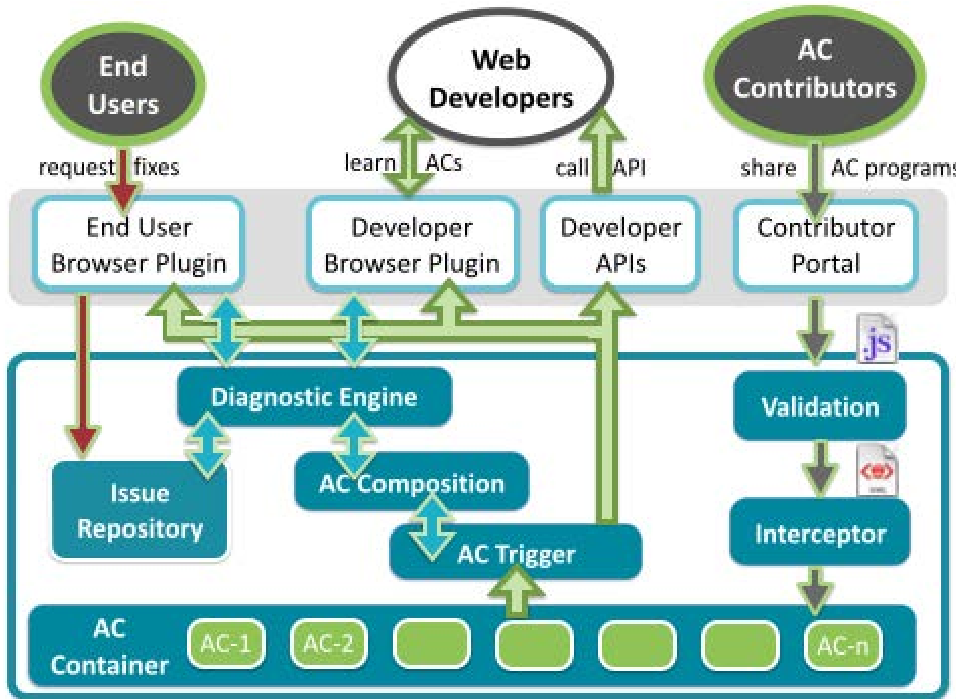
CAN operates through a three-tier architecture that connects end-users, open-source contributors, and developers.
1. The Composable Engine
Unlike monolithic fix-it scripts, CAN uses a Diagnostic Engine to identify the specific failure patterns on a page. It then requests a specialized Accessible Component (AC) from a centralized repository.
2. The Interaction Loop
- End-Users: Benefit from "Implicit Crowdsourcing." By simply browsing with a plugin, the system logs failures to an Issue Repository without requiring the user to fill out a report.
- Open-Source Contributors: Upload modular JavaScript snippets (ACs) via a Contributor Portal.
- Web Developers: Use a "Proactive/Reactive" mode where the plugin suggests code changes directly in the browser console.
3. Solving Complex States (Dropdowns & Logins)
A significant contribution of CAN is handling Dynamic DOM States. For instance, many dropdown menus rely on hover states that keyboard users cannot trigger. CAN's AC-3 detects these patterns and automatically attaches focusin and focusout event listeners to the DOM elements, making the menu navigable via the TAB key.
Experiments: Real-World Impact
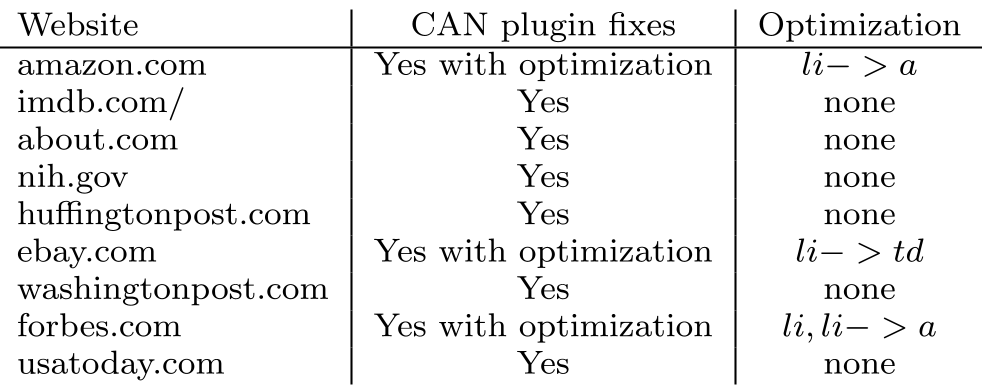
The researchers tested CAN on the 100 most popular websites. The results highlight the scalability of the "one AC for many sites" model:
- Alt-Text (AC-1): Fixed 100% of sites identifying missing text.
- Color Contrast (AC-2): Correctly adjusted contrast for 30 out of 32 failing sites.
- Login Forms: On 73 of 89 tested sites, CAN was able to "hoist" the login form to the top of the DOM tree, ensuring screen reader users could find it immediately upon landing.
| Target | Success Rate | Mechanism |
|---|---|---|
| Keyboard Redirection | High | Event listener injection |
| Alt-Text Generation | 100% | Contextual attribute mining |
| Login Prioritization | 82% | DOM tree restructuring |
Deep Insight: Beyond Manual Fixing
The genius of CAN lies in its Data-Driven Discovery. By aggregating common implementation failures, the system identifies "anti-patterns" in web development. The paper highlights that even professional developers struggle to fix dropdown menus manually, requiring hours of search; however, with CAN's developer plugin, they could understand and implement a solution in minutes.
Conclusion & Future Outlook
CAN proves that the "messy" web doesn't have to stay that way. By utilizing crowdsourcing not just for reporting, but for composing code, we can create a self-healing internet.
Limitations: The system faces challenges with "Cross-Origin" CSS files and sites that frequently update their DOM structure, requiring the AC repository to be constantly maintained by contributors.
Perspective: As we move toward 2026, integrating CAN-like logic into CI/CD pipelines and using LLMs to generate these ACs could finally make an "Accessible by Default" web a reality.
Paper cited: Huang, Y., et al. "CAN: Composable Accessibility Infrastructure via Data-Driven Crowdsourcing." W4A 2015.