
Unmasking the Magnitude: A Data-Driven Deep Dive into the #MeToo Movement
Can women break the glass ceiling?: an analysis of #MeToo hashtagged posts on Twier
This paper presents a quantitative analysis of approximately one million #MeToo tweets collected in October 2017 to explore the demographics, themes, and psychological constructs of the movement. Utilizing Biterm Topic Modeling (BTM) and Face++ for demographic inference, the study reveals significant regional disparities in participation and highlights "power imbalance" as the primary psychological driver across global contexts.
TL;DR
By analyzing nearly 450,000 unique tweets from the peak of the 2017 movement, researchers used AI to map who was speaking out and why. The study confirms that #MeToo wasn't just a Western phenomenon, but its reach was stymied by digital inequality in Asia. Crucially, computational linguistics proved that the movement was fueled by a collective drive to reclaim Power in the face of widespread institutional failure.
Problem & Motivation: Breaking the Silence through Data
For decades, sexual harassment lived in the shadows. Traditional reporting mechanisms—HR departments, police reports, and academic surveys—often failed to capture the sheer scale of the problem due to fear of retaliation and social stigma.
The #MeToo movement changed the "Inductive Bias" of social research. Suddenly, a massive, organic dataset was available. The authors recognized that this wasn't just a social trend; it was a high-dimensional signal that could help us understand the intersection of technology, culture, and gender dynamics. They aimed to move beyond the "What" to understand the "Who" and the "Why."
Methodology: The AI Toolkit for Social Science
The researchers didn't just count hashtags; they employed a sophisticated pipeline to extract meaning from the noise:
- Demographic Inference: Using Face++ API, they analyzed profile pictures to determine age and gender, allowing them to compare participation across different cultural "Manifolds" (e.g., U.S. vs. Asia).
- Short-Text Discovery: Standard LDA (Latent Dirichlet Allocation) often fails on 280-character tweets because they are too sparse. The authors used Biterm Topic Modeling (BTM), which focuses on word-pair co-occurrences, to identify six core themes—ranging from the "Weinstein Effect" to specific locations of harassment (school, work, street).
- Psychological Mapping: Using LIWC (Linguistic Inquiry and Word Count), they mapped tweets to psychological buckets like "Affective Processes" and "Drives."
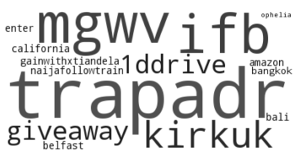 Figure: Topic modeling reveals the diverse facets of the movement, from support to specific harassment contexts.
Key Insights: Power, Not Just Lust
The experiment yielded several "Aha!" moments that align with—and quantify—feminist theory:
1. The Digital Divide in Activism
There was a stark contrast between U.S. and Asian cities. In the U.S., female participation hovered around 73%, while in Asian cities like Mumbai and Dhaka, it dropped significantly. The authors attribute this not to a lack of harassment, but to digital gender bias where middle-aged males often control Internet access within households.
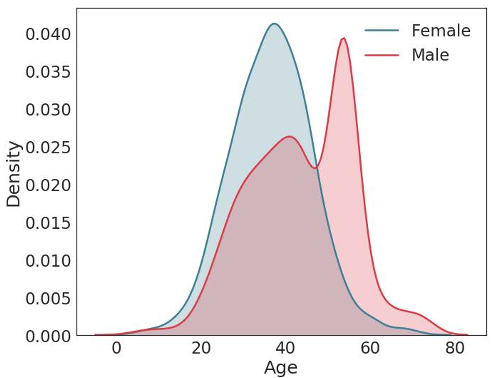 Figure: Density plots showing the age distribution of participants across continents.
2. The Dominance of "Power"
Perhaps the most striking finding was in the psychological "Drives" category. Phrases related to Power significantly outweighed those related to Risk or Reward. This provides empirical evidence for the sociological theory that sexual harassment is primarily a tool for establishing dominance and symbolic ownership.
3. Emotional Transfusion
While victims shared sadness and anger, the study noted that many male participants joined to show support. This suggests that platforms like Twitter acted as emotional conductors, allowing "Anger" and "Empathy" to bridge different communities, which is essential for systemic policy change.
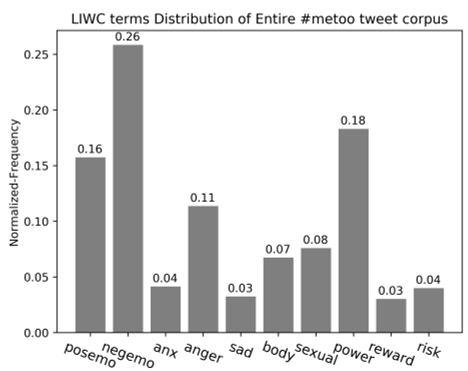 Figure: LIWC analysis showing the dominance of Negative Emotions and Power as driving factors.
Critical Analysis & Conclusion
This paper is a vital example of how Computational Social Science can validate qualitative theories at scale. However, it has its limitations: the analysis is restricted to English-only tweets, likely missing local-language nuances in non-Western regions. Furthermore, using profile pictures for gender inference is a heuristic that may overlook non-binary identities.
Takeaway
The #MeToo analysis proves that the "Glass Ceiling" isn't just a corporate metaphor—it's a structural barrier maintained by silence. By leveraging AI to quantify this silence, we can better inform the laws, policies, and educational frameworks needed to dismantle the power imbalances revealed in these millions of tweets.