
Cancelable Fusion: Strengthening Biometric Security via Social Network Analysis
Cancelable fusion using social network analysis
The paper introduces a novel biometric template protection method called "Cancelable Fusion using Social Network Analysis (SNA)," which transforms facial and ear biometric features into a non-invertible domain. By constructing a Virtual Social Network (VSN) and utilizing Eigenvector Centrality, the method achieves multi-level cancelability with significant improvements in recognition accuracy.
The security of biometric data—our faces, ears, and fingerprints—is a growing concern. Unlike passwords, you cannot simply "reset" your face if it is stolen from a database. This paper, "Cancelable Fusion using Social Network Analysis," presents a clever solution that uses mathematical properties of networks to create "cancelable" templates that are both highly secure and more accurate than the original data.
TL;DR
The authors propose a method to transform biometric features using Social Network Analysis (SNA). By treating feature correlations as a "social network" and calculating Eigenvector Centrality, they create a fused template that is non-invertible (cannot be reversed to find the original face/ear). Surprisingly, this transformation doesn't just protect the data—it boosts accuracy by up to 10% for face recognition.
The Core Problem: The "Immutable Identity" Paradox
In standard biometrics, templates are often stored in a format that allows attackers to reconstruct the original image. If a hacker steals your biometric template, your identity is compromised across all systems using that biometric.
The ideal solution is Cancelable Biometrics: transforming the data so that:
- Non-invertibility: You can't get the original face back from the template.
- Revocability: If a template is stolen, you can change the "key" (transformation parameters) and issue a new one.
- Discriminability: The transformation shouldn't make everyone look the same to the AI.
Methodology: Building a Virtual Social Network
The authors introduce a multi-level architecture to achieve high-security entropy.
1. Random Cross-Folding
The process begins by splitting the biometric feature vector into two separate folds using random indices. This ensures that even before the fusion begins, the data is scrambled.
2. The SNA Transformation (The "How")
Instead of just adding or multiplying these folds, the authors construct a Virtual Social Network (VSN).
- Nodes: Represent the feature instances.
- Edges: Represent the correlation between features of individuals.
- The Feature: They calculate the Eigenvector Centrality of the nodes. In network theory, this measure determines the influence of a node in a network. In this context, it extracts deep relational patterns that are unique to the individual but abstract enough to be non-invertible.
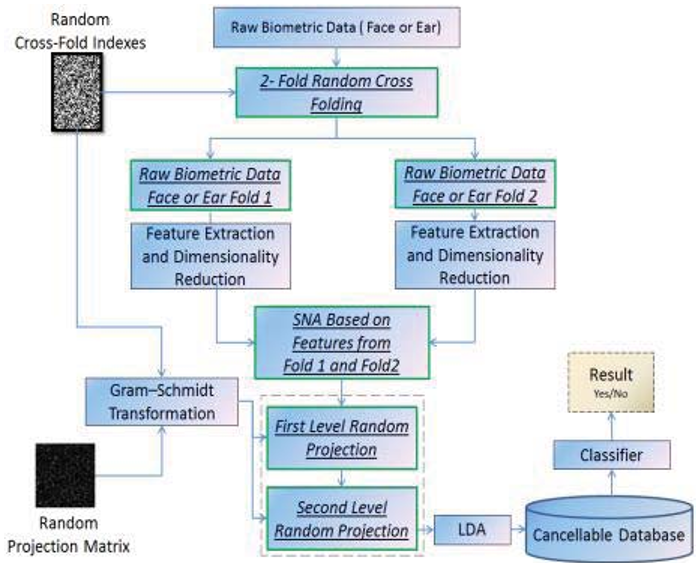 Fig 1: The proposed architecture showing the flow from raw features to the SNA-based fused template.
3. Orthonormal Projection and LDA
To further secure the template, the SNA features undergo two levels of Random Projection using matrices orthonormalized via the Gram-Schmidt process. Finally, Linear Discriminant Analysis (LDA) is used to maximize the "gap" between different individuals, making the system more accurate.
Experimental Results: Security without Sacrifice
Most security measures come with a performance penalty. However, the authors' SNA-based approach showed a performance gain.
- Face Recognition: Using the FERET and VidTIMIT databases, the SNA-cancelable templates improved performance by over 10% compared to the original raw templates.
- Ear Recognition: On the USTB database, accuracy improved by approximately 8%.
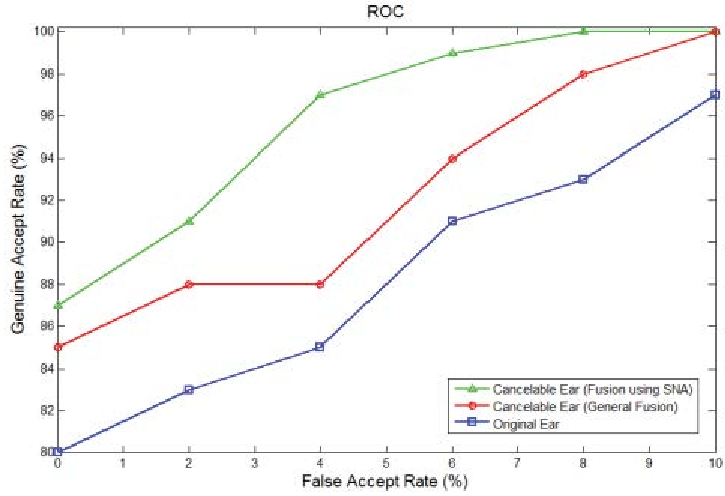 Fig 2: ROC curve showing that the Cancelable Ear Template (SNA) significantly outperforms the original ear biometric template.
The ROC curves (Receiver Operating Characteristic) clearly demonstrate that the SNA method maintains a lower False Acceptance Rate (FAR) while achieving a higher True Acceptance Rate (TAR).
Critical Insight & Conclusion
Why does it work?
The brilliance of this paper lies in its "Fusion" strategy. By using Eigenvector Centrality, the system captures the structural importance of features rather than the raw pixel/feature values. This acts as a natural noise filter and emphasizes the unique relational characteristics of a person's biometric traits.
Limitations & Future Work
While the paper demonstrates success on ear and face biometrics, it primarily focuses on single traits. The computational cost of building these networks for massive real-time databases (millions of users) remains an open question. Future research could explore "SNA-based Multi-modal Fusion," combining face, ear, and fingerprint into a single, unbreakable social-graph-based identity.
Final Takeaway: This research proves that privacy and performance are not a zero-sum game. By applying tools from social science (SNA) to biometric engineering, we can create security systems that are both harder to hack and more accurate to use.