
CTA: Optimizing Crowdsourced Web Testing via Capability Matching and Heuristic Search
Capability Matching and Heuristic Search for Job Assignment in Crowdsourced Web Application Testing
This paper proposes a Collaborative Testing Approach (CTA) for crowdsourced web applications, utilizing a greedy algorithm to solve a job assignment problem framed as Integer Linear Programming (ILP). The method matches test case complexity with tester capability and trustworthiness, outperforming existing heuristic strategies in both efficiency and accuracy.
TL;DR
Crowdsourcing offers a massive, diverse labor pool for web testing, but "blind" task assignment often leads to low-quality results. This paper introduces a Collaborative Testing Approach (CTA) that models job assignment as an Integer Linear Programming (ILP) problem. By using an intelligent greedy heuristic instead of an exhaustive solver, it matches complex test cases to highly capable testers, achieving real-time performance and superior quality control compared to traditional methods.
The Bottleneck: Quality Control in the Crowd
Testing modern, interactive web applications is a resource-intensive nightmare. While crowdsourcing platforms like Amazon Mechanical Turk provide the scale, they lack a mechanism to ensure the right tester is doing the right job.
Previous approaches often focused on bug report generation or simple workflows, but failed to address the Job Assignment Problem. When you treat all testers as equal, two things happen:
- Over-taxing: Low-capability testers fail at complex tasks, leading to poor coverage.
- Resource Waste: Highly skilled testers waste time on trivial tasks.
Methodology: Bridging the Capability Gap
The authors define the problem through five core constraints, including page coverage, tester availability, and Page Support. The heart of the innovation lies in how they quantify "Complexity" and "Trustworthiness."
1. Defining Complexity
A web page's complexity () is no longer a guess. It is a weighted sum of:
- Degree Complexity: How many links go in and out.
- I/O Complexity: The number of attribute-value pairs.
- Code Complexity: Lines of Code (LOC).
2. The Matching Heuristic (TCS-H)
Instead of using a standard solver like CPLEX (which chokes on large datasets), the authors use a greedy search. Each iteration calculates a Page Gain and assigns the test case to the tester that minimizes Match Variance ().
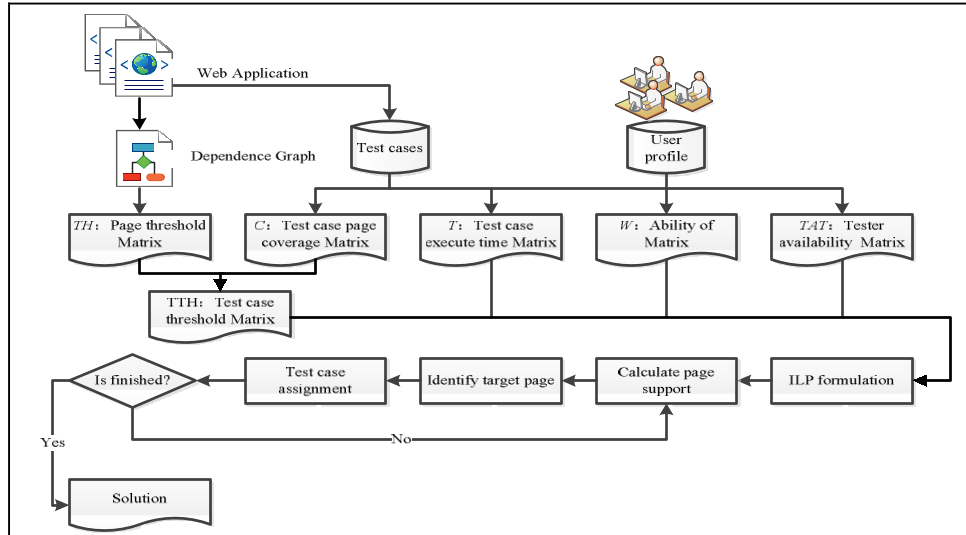 Figure 1: The workflow shows how dependence graphs and tester profiles fuel the ILP formulation.
Experiments: Speed vs. Optimality
The researchers conducted three large-scale simulations using data from XTurk, a prototype crowdsourcing system.
Real-Time Performance
The comparison against the industry-standard CPLEX solver was stark. As problem size (variables) grew:
- CPLEX: Execution time grew exponentially, reaching 2162 seconds.
- CTA: Remained stable at roughly 0.46 seconds.
This proves that while CTA finds a "sub-optimal" solution, its speed makes it the only viable choice for a live system where testers are waiting for assignments in real-time.
Matching Quality
By measuring the Variance of Matching (VOM), the authors proved that their heuristic creates a more harmonious "Fit" between the human and the task.
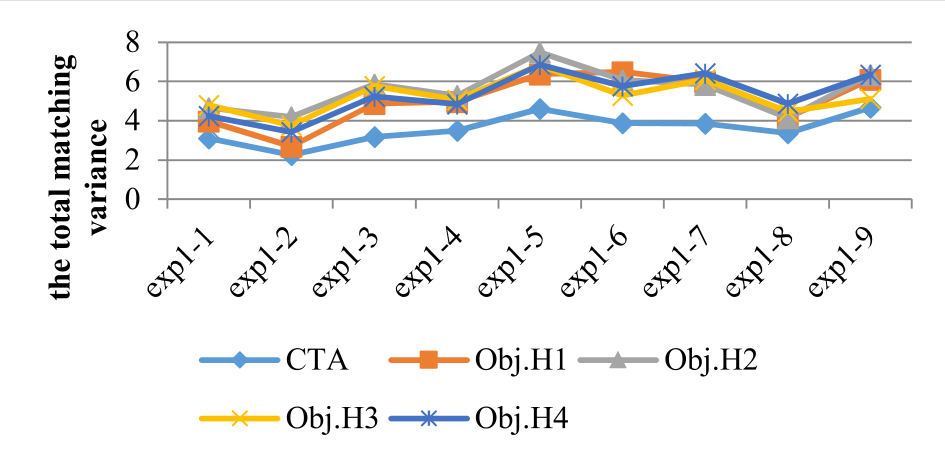 Figure 2: CTA (lowest curve) consistently achieves the lowest match variance across various test configurations.
Critical Insight: Why This Matters
The fundamental takeaway is that in human-centric computing (like crowdsourcing), Perfect is the enemy of Good. A mathematically "optimal" schedule that takes 30 minutes to calculate is useless if the human testers log off after 2 minutes of waiting.
By reducing the objective optimal by only a small margin (approx. 15-20%), CTA secures a 4000x speedup and significantly reduces false positives by ensuring that difficult bugs are handled by the most trustworthy participants.
Conclusion & Future Work
The study successfully validates that Capability Matching is a cornerstone of quality control. However, the system currently relies on static "Trustworthiness" scores. A future evolution of this work would likely involve a dynamic feedback loop—where a tester's capability score updates in real-time based on the accuracy of their current session's bug reports.