
Beyond Expertise: Scaling Socially-Aware and Capacity-Constrained Team Formation
Capacitated team formation problem on social networks
The paper introduces the "Capacitated Team Formation Problem" (CTFP), which seeks to assemble a team of experts from a social network who possess required skills while minimizing social collaboration costs (Diameter, Steiner, or Bottleneck) and respecting individual workload capacities. It proposes approximation algorithms (MinDiamSol, MinAggrSol) and an exact algorithm (MinMaxSol) to solve these NP-hard problems on large-scale networks.
TL;DR
Building a dream team isn't just about finding the right skills—it's about ensuring teammates can talk to each other and that nobody is burnt out. This paper formalizes the Capacitated Team Formation Problem (CTFP), introducing user workload limits into social network-based team selection. The authors provide robust algorithms that outperform traditional "expert-only" methods by up to 40% in collaboration efficiency.
The Missing Piece: Why Skill and Connection Aren't Enough
In the era of "Social Coding" (GitHub) and "Participatory Sensing," collaboration is the heartbeat of production. Previous SOTA methods focused on two pillars:
- Expertise: Does the team have the right skills (e.g., Python, C++, UI Design)?
- Social Proximity: Are the members close enough in the social graph to communicate effectively?
However, they missed a critical real-world constraint: Capacity. In previous models, a single "super-expert" could be assigned to a hundred tasks simultaneously, creating a bottleneck. This paper argues that a team is only "effective" if it is feasible under strict packing constraints (workload limits) and covers all project requirements while remaining socially cohesive.
Methodology: The Core Mechanics
1. Determining Team Feasibility
The authors treat the assignment of tasks to users as a Max-Flow problem. By constructing a bipartite graph where items flow from a source to users (with capacities as edge bounds), they can determine in polynomial time if a set of users can actually handle a project.
2. Solving for Social Costs
The paper tackles three cost models:
- Diameter Cost: Minimizing the maximum distance between any two members.
- Steiner Cost: Minimizing the total weight of the tree connecting all members (an aggregate measure).
- Bottleneck Cost: Minimizing the weight of the "weakest link" in the team's communication tree.
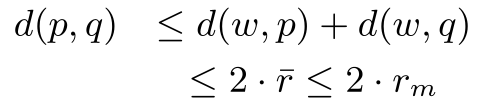
The MinAggrSol algorithm is particularly clever. It uses a greedy approach driven by the Submodular Cover property. By calculating the "utility" of a user (the marginal gain in skill coverage divided by the social distance cost), it builds a team that balances "cost-to-distance" effectively.
Experimental Proof: Lessons from GitHub
The authors validated their theory by crawling a massive dataset from GitHub (135k users, 905k projects).
Insights from the Data:
- Social Correlation: Projects with more "social" teams (more edges, fewer components) have significantly higher commit activity.
- Capacity Reality: Most users contribute to far fewer projects than they are "listed" in, confirming that human capacity is a tangible, restrictive resource.
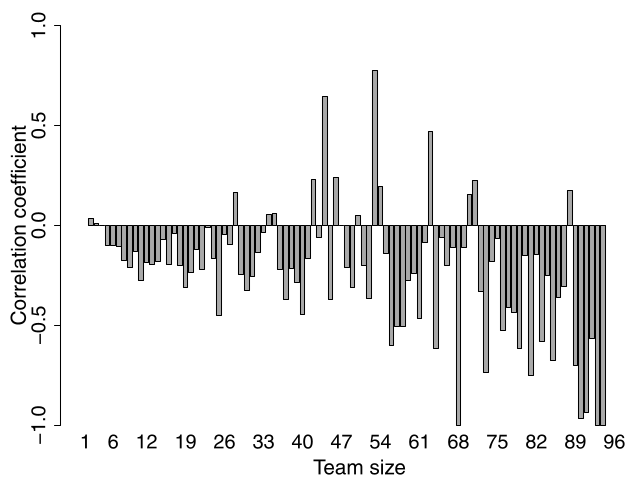 Figure: The positive correlation between social edges and project activity (commits).
Performance:
When compared to baselines that only consider "rarest skills" first, the proposed algorithms achieve a 40% reduction in Steiner cost and a 25% reduction in Diameter cost. Crucially, the algorithms are fast—MinDiamSol runs in roughly 30 seconds even on a network of 135,000 nodes, making it practical for real-time recommendation systems.
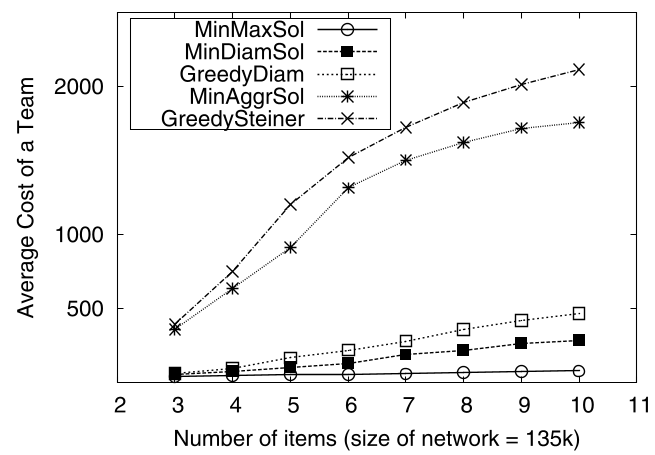 Figure: Our algorithms (MinDiam/MinAggr) significantly outperform Greedy baselines as task complexity (number of items) grows.
Critical Insight & Conclusion
The genius of this work lies in proving that MaxItems (the skill coverage function) is submodular. This mathematical property allows the use of greedy algorithms with provable approximation guarantees, bridging the gap between complex social theory and efficient combinatorial optimization.
Takeaway: For platform designers at GitHub, LinkedIn, or internal corporate HR, the message is clear: when suggesting collaborators, don't just look for the best person; look for the best available person who is already in the right social "orbit."
Limitations
The current model assumes fixed edge weights. In reality, relationship strength evolves. Future work could integrate "temporal" social links or handle "soft" constraints where exceeding capacity merely increases cost rather than rendering a team "infeasible."