
Fractal D2D Social Networks: Deciphering the Trade-off Between Trust and Capacity
On the Capacity of Fractal D2D Social Networks with Hierarchical Communications
This paper investigates the maximum capacity of fractal Device-to-Device (D2D) social networks, considering both direct and hierarchical communication models. By leveraging renormalization and power-law distributions, the authors derive analytical upper bounds for network throughput under various destination selection rules, highlighting the impact of the correlation exponent ε on network scalability and capacity.
TL;DR
This research provides a rigorous mathematical framework to calculate the capacity limits of D2D networks that mirror real-world fractal social structures. The core finding suggests a "security tax": as we move from direct communication to hierarchical, multi-level social relaying (for better trust and privacy), the network capacity degrades in proportion to the network's fractal correlation exponent .
Background: Why Fractality Matters
Most wireless capacity research following the seminal work of Gupta and Kumar assumes a "flat" world. However, human social networks are inherently fractal—they exhibit self-similarity across scales and a phenomenon known as hub repulsion, where influential nodes avoid direct links with each other to maintain a broad reach. When we overlay these social constraints onto a physical D2D network, the "path" a packet takes is no longer just a physical shortest route, but a socially trusted route.
Motivation: The Problem of Social Trust
In modern D2D communications, privacy is paramount. Users often trust direct friends (Direct Communications) but require intermediate acquaintances to reach strangers (Hierarchical Communications). This introduces a critical question: How does this socially-bounded hopping affect the total data rate the network can support?
Methodology: The Power of Renormalization
The authors model the network using two power-law foundations:
- Degree Distribution (): Characterizes the scale-free nature of the network.
- Joint Probability Distribution (): Captures the correlation between connected nodes through the exponent .
To visualize the internal structure, they employ the Box-Covering Algorithm:
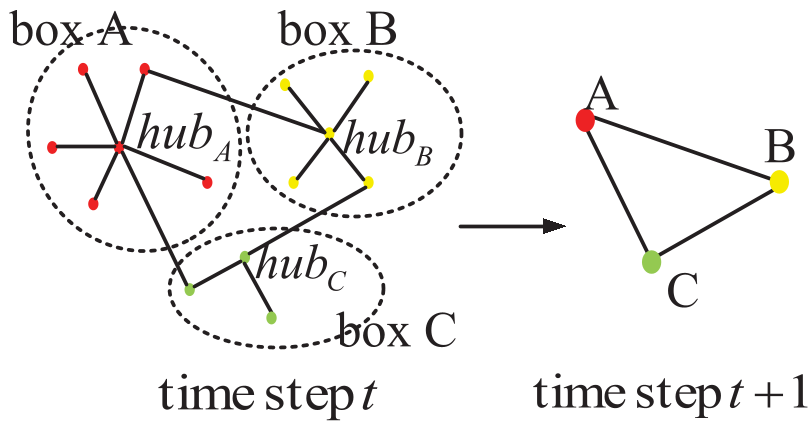 Figure 1: Illustration of renormalization. By grouping nodes into boxes of size , the underlying fractal pattern emerges.
Key Results: The Capacity Bounds
The research breaks down the capacity () based on how destinations are chosen:
1. Direct Social Communications
- Uniform Selection: If you pick any friend at random, the capacity matches the classical result: .
- Distance-Aware (Power-law) Selection: If users prefer communicating with physically closer friends (parameter ), the capacity can reach when .
2. Hierarchical Communications (The "Security Tax")
When packets must traverse "social levels", the average number of hops increases dramatically. The capacity reduction is governed by the exponent :
- Extensible Networks (): Capacity drops by a factor of .
- Boundary Case (): Capacity collapses by a factor of .
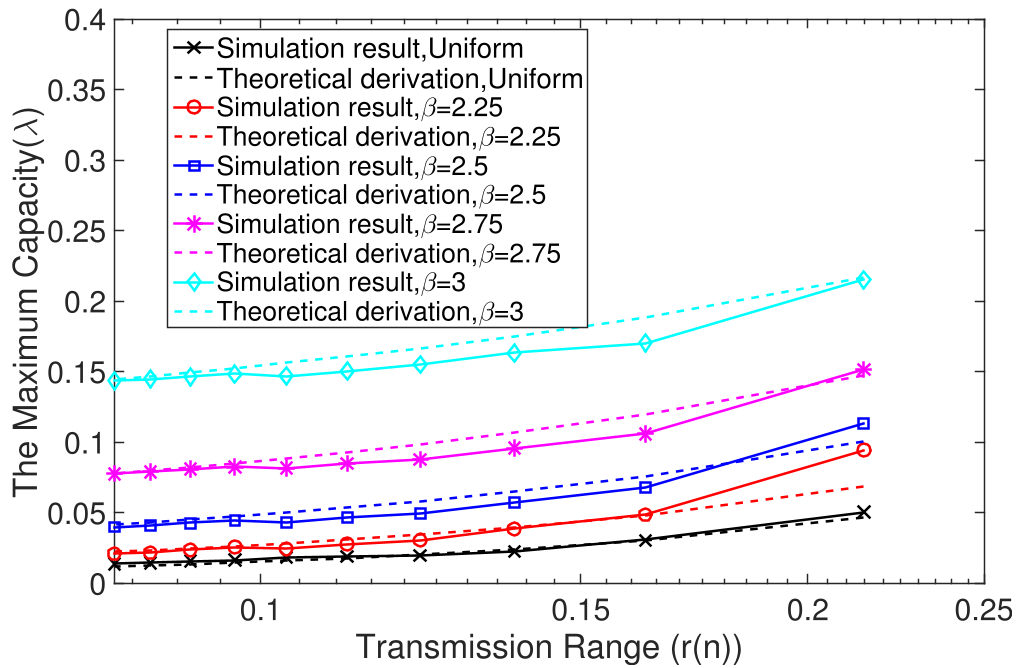 Figure 2: Performance comparison showing the sharp decline in capacity when moving from direct to hierarchical communications.
Critical Insight & Conclusion
The study proves that is a critical phase-transition boundary. Below this value, the network can expand its branches continuously (extensibility), whereas above it, the branching stops rapidly.
The Takeaway for Engineers: If you are designing 5G/6G D2D resource allocation algorithms, you must account for the social topology. High fractality in a user group increases the relaying burden on the physical layer, effectively shrinking the available bandwidth for everyone. Future work should focus on "fractality-aware" routing that minimizes these social hop penalties without compromising user trust.
Limitations
The current model assumes a static network. In real-world scenarios, the mobility of users might "break" the fractal structure or create opportunistic links that could potentially bypass the capacity limits derived here.