
Capacity of Hybrid Wireless Networks: Decoding the Impact of Social Contacts and Access Modes
Capacity of Hybrid Wireless Networks With Long-Range Social Contacts Behavior
2016-10-21
Summary
Problem
Method
Results
Takeaways
Abstract
This paper investigates the throughput capacity of hybrid wireless networks by integrating a long-range social contact traffic model and two distinct base station (BS) access modes. It identifies the optimal routing policy under the L-maximum-hop framework to maximize network efficiency across different social behavior parameters.
## TL;DR
How much traffic can a hybrid wireless network—one that mixes direct device-to-device (ad hoc) and base-station-mediated (cellular) paths—really handle? This paper moves beyond the "random uniform" assumption to account for real-world **social behaviors** (where we talk to specific friends, near and far) and **access modes** (how we reach the base station). It proves that the "optimal" routing logic isn't fixed; it shifts based on how socially clustered users are and whether they can reach the base station in a single "jump."
## The Motivation: Moving Beyond Randomness
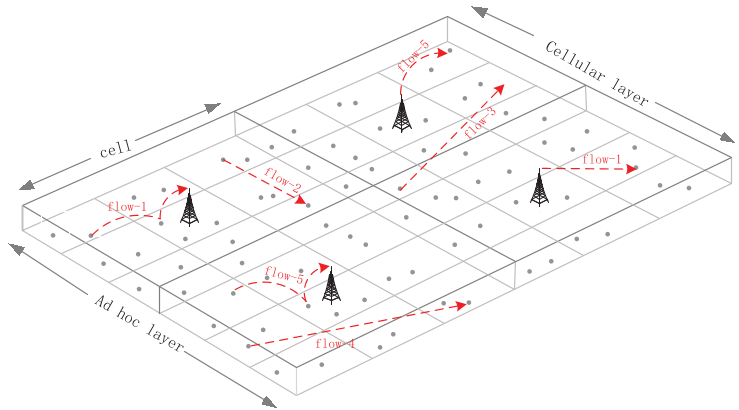
In the classic Gupta and Kumar model, every node talks to every other node with equal probability. In reality, we exhibit **social contact behavior**. We have "local" neighbors and specific "long-range social contacts" (LSCs).
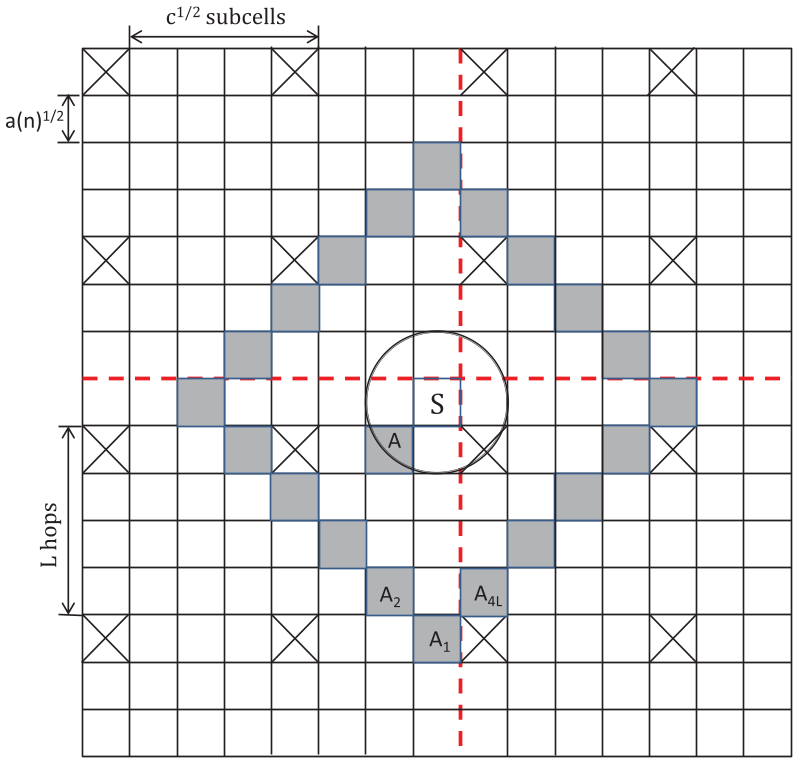
The core problem addressed here is the **L-maximum-hop routing policy**:
- If your friend is within $L$ hops, use ad hoc mode.
- If they are further, use the cellular highway.
*The million-dollar question: What is the optimal $L$?* If $L$ is too small, we overwhelm the base stations. If $L$ is too large, ad hoc interference kills the throughput.
## Methodology: The Core Framework
The authors analyze the capacity of these networks by focusing on three variables:
1. **Traffic Model (α, q)**: How likely we are to talk to someone at distance $d$ (proportional to $d^{-\alpha}$).
2. **Access Mode**:
- **One-hop**: Direct link to the BS (High power).
- **Multi-hop**: Hopping through other nodes to reach the BS (Saves power, but uses ad hoc bandwidth).
3. **Routing Policy (L)**: The threshold for choosing between ad hoc and cellular.
## Deep Dive: One-Hop vs. Multi-Hop Insights
The paper provides a rigorous mathematical derivation of throughput. A critical insight is the **resource competition** in multi-hop access.
- **In One-Hop Access**: The ad hoc and cellular layers are relatively decoupled. The capacity grows linearly with the number of base stations ($m$).
- **In Multi-Hop Access**: A cellular flow *also* consumes ad hoc resources to get its packets to the base station. This "tax" on the ad hoc layer means that adding more base stations doesn't always yield a linear capacity boost—it depends heavily on the social contact parameter $\alpha$.
### The "Social" Factor ($\alpha$):
- **$\alpha < 2$ (Dispersed Socializing)**: Most contacts are far away. The network behaves more like a uniform random network.
- **$\alpha \geq 2$ (Strong Social Clustering)**: Destinations are mostly local. Here, the ad hoc layer is very efficient, and the dependency on $L$ begins to disappear because naturally, most flows are short.
## Key Results and Performance
The authors prove that the optimal $L$ for a network with social behavior is significantly different from a uniform one.
**Key takeaways from the data:**
- **One-hop access is superior** for pure throughput capacity but requires nodes to have higher transmission power to reach the BS directly.
- **The Optimal Threshold**: For 0 ≤ α < 2, the optimal $L$ is a complex function of $n, \alpha,$ and $q$. However, once social clustering is strong (α ≥ 3), the network capacity becomes independent of $L$ because social choice, not routing policy, limits the hop count.
## Critical Analysis & Conclusion
This work is a fundamental piece of the puzzle for **Hybrid Wireless Networks**. It highlights that designing routing protocols (like those in 5G/6G D2D) without considering social clustering is a recipe for inefficiency.
**Limitations**: The study assumes static nodes. In a mobile environment, social contacts might remain constant, but the "hops" to reach them would change dynamically, requiring a temporal analysis that this paper leaves for future work.
**Future Outlook**: As we move toward 6G, where base stations and devices become increasingly integrated, the "multi-hop access" scenario will become the norm. This paper provides the theoretical groundwork to ensure that the "ad hoc tax" paid by cellular uplinks doesn't collapse the local device network.