
Hybrid Wireless Networks: Decoding Scale Capacity through the Lens of Social Behavior
Capacity of Hybrid Wireless Networks With Long-Range Social Contacts Behavior
This paper investigates the throughput capacity of Hybrid Wireless Networks (HWNs) by integrating social contact behavior into the traffic model. It evaluates the impact of L-maximum-hop routing and two base station access modes (one-hop vs. multi-hop) on network scaling laws, establishing the first comprehensive capacity framework for social-driven hybrid networks.
TL;DR
How much data can a city-scale wireless network actually carry? This paper breaks away from the "uniform traffic" myth, proving that when nodes communicate based on social proximity (the "small-world" effect), Hybrid Wireless Networks (HWNs) can achieve much higher throughput. By optimizing the maximum hop count () for ad hoc routing, the authors show that capacity scaling is deeply intertwined with how users access base stations and how "local" their social circles are.
Back to Reality: Why Uniform Traffic is a Flaw
Since Gupta and Kumar's seminal work in 2000, we've known that pure ad hoc networks don't scale—per-node capacity vanishes as the number of nodes grows. Hybrid networks (Ad Hoc + Cellular) were the solution. However, most research assumes every node is equally likely to talk to any other node.
In reality, we exhibit Social Contact Behavior. You are more likely to send a file to a colleague 50 meters away than to a stranger 5 miles away. This paper introduces the parameter to model this: the probability of a contact at distance is proportional to .
The Core Conflict: One-Hop vs. Multi-Hop Access
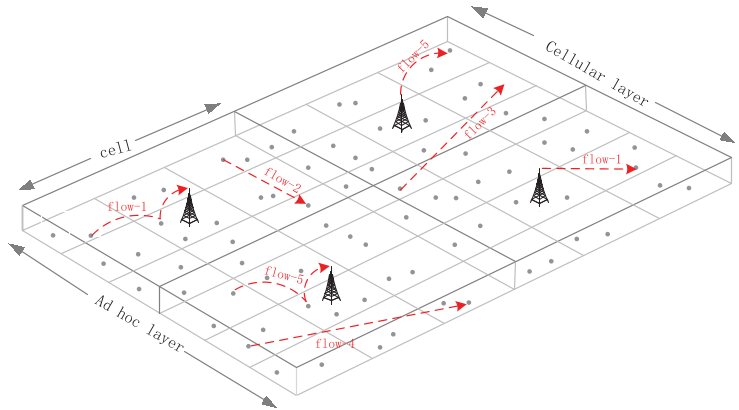
The researchers investigate the L-maximum-hop routing policy:
- If the destination is within hops, use Ad Hoc mode.
- Otherwise, use Cellular mode (via Base Stations).
A critical contribution is the analysis of Access Modes:
- One-hop access: Every node has enough power to reach a Base Station (BS) directly.
- Multi-hop access: Nodes must "hop" through other nodes to reach a BS.
The "Multi-hop" scenario is more realistic for low-power IoT devices, but it creates a "hidden tax": cellular traffic consumes ad hoc bandwidth before it even reaches the wired infrastructure.
Methodology: The Math of Social Hops
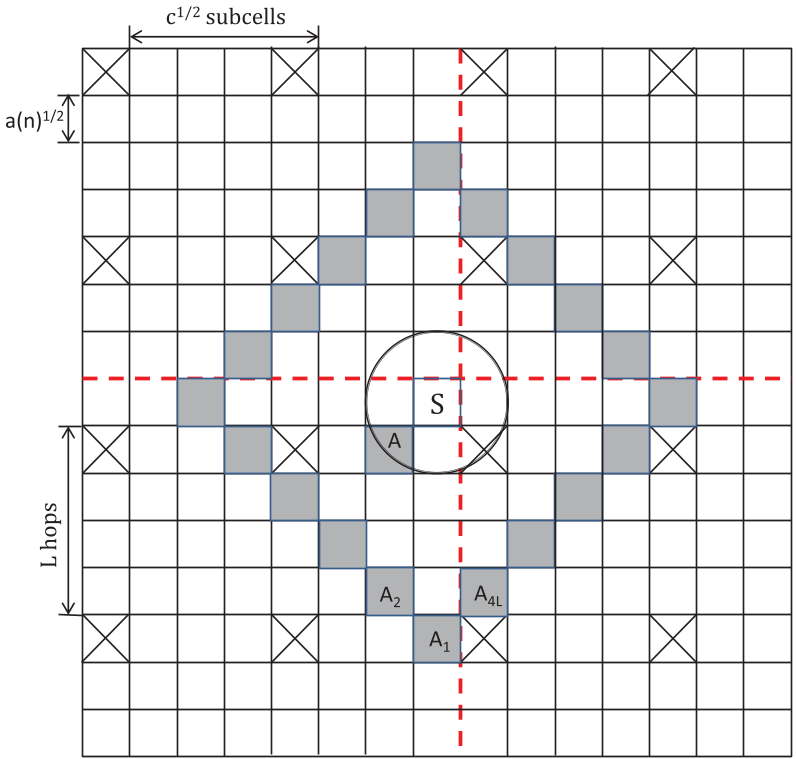
The authors derive capacity by calculating the average number of flows passing through any given "subcell" in the network. The social factor changes everything:
- Low (Uniform-ish): Traffic is spread out; must be carefully tuned to prevent interference.
- High (Socially Local): Traffic is naturally clustered. becomes less relevant because most destinations are already close.
One of the most elegant parts of the derivation is Lemma 2, which defines the expected hop count as a function of the routing threshold and social factor .
Key Experimental Findings & SOTA Comparison
The paper provides a rigorous asymptotic analysis. The most striking result is the comparison of capacity scaling:
- One-Hop Superiority: One-hop access consistently provides higher capacity ( increases linearly with BS count) because it doesn't "steal" ad hoc resources for the uplink.
- Threshold Effect: For (high sociality), the network reaches a "sweet spot" where capacity grows significantly faster because the ad hoc layer handles local traffic with minimal hops.
Optimal Analysis
The authors demonstrate that the "Optimal " is not a static number. In multi-hop access modes, the optimal depends on the number of base stations . If you have many BSs, you should decrease to force traffic into the infrastructure sooner.
Critical Insight: The Future of HWNs
This paper shifts the focus from "physical hardware limits" to "user behavior limits." It suggests that if we can predict social clusters (e.g., in a stadium or a campus), we can dynamically reconfigure the threshold in real-time to maximize throughput.
Limitations: The model assumes a static network of nodes. In a world of mobility (self-driving cars, drones), the "distance" between social contacts changes in seconds. Future work must bridge this social model with high-mobility temporal dynamics.
Conclusion
By proving that social behavior is a "resource" rather than a variable, this work provides the mathematical foundation for the next generation of hybrid networks. Whether it's 6G or decentralized mesh networks, understanding the "why" of traffic is now just as important as the "how."