
CAPER: Bridging the Gap Between Social Interaction and Semantic Intelligence for Law Enforcement
CAPER: Crawling and analysing Facebook for intelligence purposes
This paper presents a specialized Facebook crawling and analysis subsystem developed for the EU FP7 CAPER project, aimed at assisting Law Enforcement Agencies (LEAs) in preventing organized crime. The method integrates automated data acquisition via Graph API/FQL with a sophisticated pipeline for Natural Language Processing (NLP) and Social Network Analysis (SNAV).
TL;DR
The CAPER (Collaborative information, Acquisition, Processing, Exploitation and Reporting) project introduces a robust platform for Law Enforcement Agencies (LEAs) to turn public Facebook data into actionable intelligence. By merging Social Network Analysis (SNA) with Natural Language Processing (NLP), it visualizes the hidden links between users, locations, and organizations, helping to prevent organized crime through Open Source Intelligence (OSINT).
The OSINT Bottleneck
Identifying criminal networks in the digital age is a "needle in a haystack" problem. LEAs face three primary hurdles:
- Data Volume: The sheer scale of Facebook (1 billion+ users) makes manual monitoring impossible.
- Privacy & Technical Barriers: Most crawling is blocked by platform rate limits or privacy settings.
- Fragmented Analysis: Traditional tools look either at who is talking to whom (Network Analysis) or what is being said (Text Mining), but rarely both simultaneously.
The CAPER project addresses these by focusing on publicly available data, using heuristic algorithms to bypass the need for private profile access while still mapping deep relationships.
Methodology: The Power of Dual-Network Fusion
The technical core of CAPER lies in its ability to synthesize two distinct types of data into a single "Network of Knowledge."
1. The Interaction Network
Instead of relying on "friends" lists (which are often private), CAPER analyzes active interactions: Likes, Comments, and Mentions. The authors implemented a greedy algorithm that crawls Facebook Pages, Groups, and Events to establish edges between users based on shared actions.
- Single Interactions: User A mentions User B.
- Multiple Interactions: Multiple users commenting on the same post.
2. The Named Entity Network
Simultaneously, a multilingual NLP pipeline processes the text of posts and comments. It identifies Persons, Locations, and Organizations using a dedicated Knowledge Base for crime patterns.
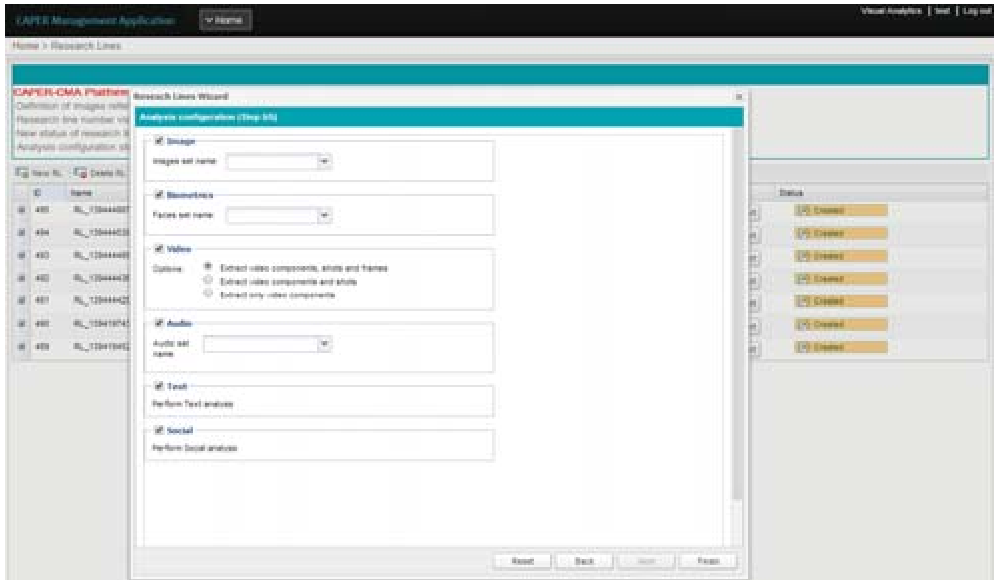 Fig 1: The Central Management Application (CMA) used by analysts to configure the crawling and analysis workflow.
3. Merging the Graphs
The true innovation is the mathematical union of these networks: Where is the set of Facebook Users and is the set of Entities (Persons, Places, etc.). An edge exists if a user interacts with another or if a user cites an entity in their text.
Advanced Visual Analytics (SNAV)
Data is useless if it isn't interpretable. CAPER provides two primary visualization modes:
- Circular Layout: To show the overall density of relationships in a group or page.
- Star Graph Layout: Used for pattern matching, showing all entities (dates, locations, names) revolving around a specific focal point, such as a "New York" location or a specific suspect.
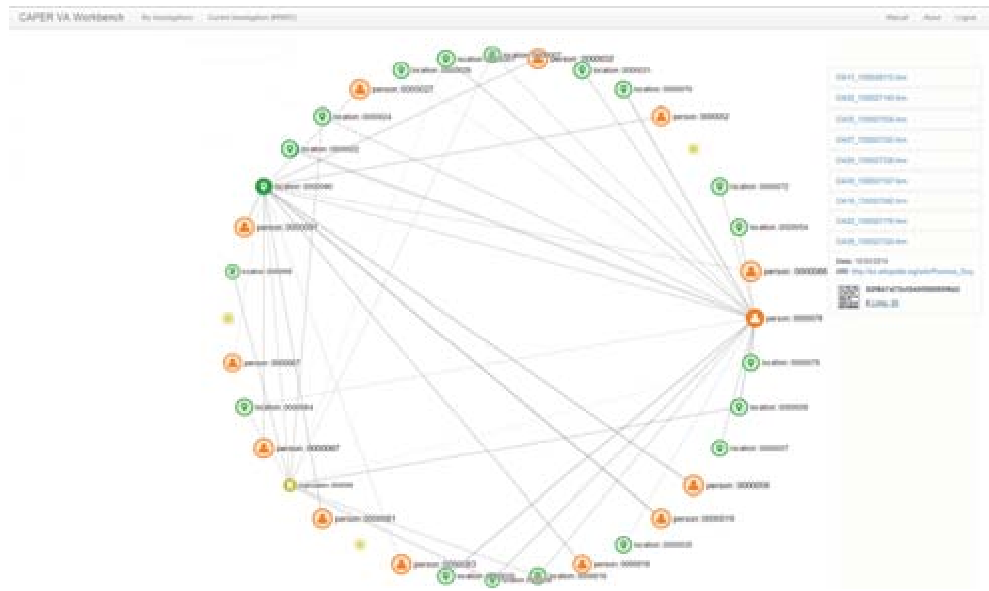 Fig 3: Visualization of entity relationships in the CAPER VA application.
Performance and Real-World Impact
The system’s NER module, trained on the CoNLL 2003 dataset, achieved an F1 measure of 84.80%. More importantly, qualitative testing on "flashmob" keyword crawls demonstrated that the tool could successfully identify event patterns and key actors that might generate law enforcement alerts.
Critical Insight & Future Outlook
While the CAPER system is powerful, its reliance on Facebook's Graph API and FQL (Facebook Query Language) makes it sensitive to platform policy changes. However, the architectural philosophy—treating linguistic citations as network edges—remains a gold standard for OSINT.
Takeaway: Future iterations will likely move toward Entity Linking (connecting findings to DBpedia) and more advanced reasoning engines to assist LEAs not just in finding data, but in making decisions. This work proves that ethical, public-data crawling can provide a high-fidelity map of criminal influence without overstepping privacy bounds.