
Friendship-Event Networks: Quantifying Social Capital and Benefit in Academic Circles
Capital and benefit in social networks
This paper introduces the "Friendship-Event Network" (FEN), a novel framework for modeling the interplay between social relationships (friendship) and institutional roles (organizers/participants). It defines quantitative metrics for Social Capital and Benefit within a temporal context, specifically analyzed through 10 years of computer science conference data.
Executive Summary
TL;DR: This paper moves beyond simple "friend graphs" to introduce Friendship-Event Networks (FEN). By mapping researchers (actors) to conferences (events) and roles (PC members vs. authors), the authors quantify Social Capital—the power derived from having friends in high places—and Benefit Received. Their 10-year study of CS conferences reveals that "insiders" don't just have more friends; they have strategically positioned friends that correlate with higher publication rates.
Positioning: This is a foundational work in descriptive social mining. It bridges the gap between qualitative sociology (Social Capital theory) and quantitative graph mining by providing concrete formulas for "influence" and "benefit" within professional hierarchies.
The Problem: Beyond the FOAF (Friend-of-a-Friend) Graph
Most social network research treats every connection equally. However, in professional settings, the context of the connection matters. Being friends with a peer is one thing; being friends with the person deciding your paper's fate (the Program Committee member) is another.
Existing models lacked the language to describe:
- Event-based roles: How roles change from one year to the next.
- Temporal decay: The fact that a co-authorship from 20 years ago doesn't carry the same weight as one from last year.
Methodology: Formalizing "Goodwill"
The authors define the Friendship-Event Network through a series of interlocking relationships.
1. The Core Metrics
- Social Capital (SC): . Essentially, how many of your friends are on the "Organizing Committee" of a specific event?
- Benefit Given (BG): Measured from the organizer's perspective—how much "participation" (e.g., paper acceptances) an organizer's friend circle receives.
2. Temporal Friendship
Friendship isn't forever. The authors introduce a time window (). You are only considered "friends" at time if you collaborated within the last years.
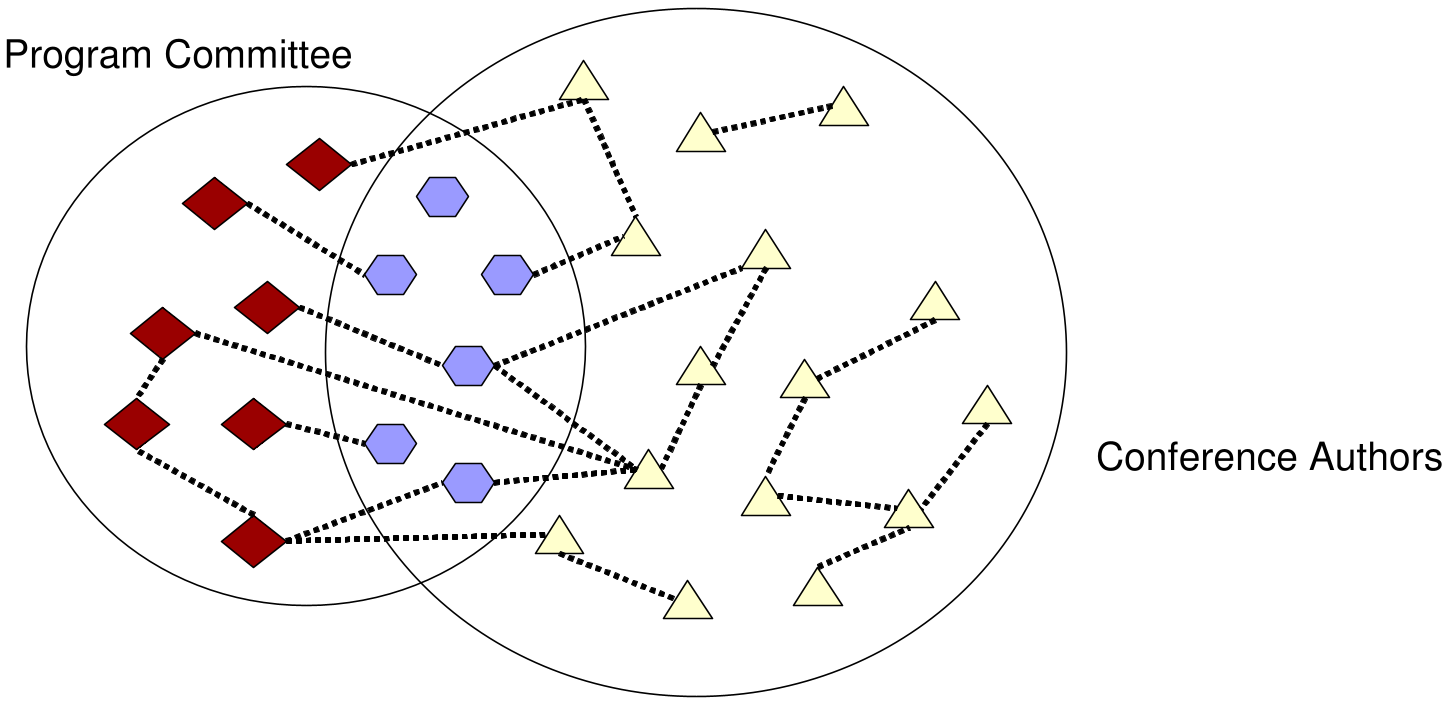 Figure 1: The tripartite structure of a FEN. PC members (Organizers) and Authors (Participants) overlap, creating a complex flow of social capital.
Experiments & Results: Is the "Old Boys' Club" Real?
The study analyzed three major Computer Science conferences (labeled C1, C2, and C3) over a decade.
The "PC-Author" Advantage
The authors categorized actors into three groups: PC-Authors, PC-Non-Authors, and Non-PC-Authors.
| Group | Capital (Avg) | Capital-to-Friend Ratio |
|---|---|---|
| PC-Author | High (1.29 - 1.76) | Highest |
| PC-Non-Author | Low (0.11 - 0.27) | Lowest |
| Non-PC-Author | Medium | High |
Key Finding: PC members who publish in the conference they are organizing have more than double the Social Capital of other PC members. This suggests that the decision to submit is highly correlated with having a "home-court advantage."
Longitudinal Trends
Over 20+ years, the "friendship density" in scientific communities has increased, but the Social Capital Ratio of PC-Authors has remained consistently dominant.
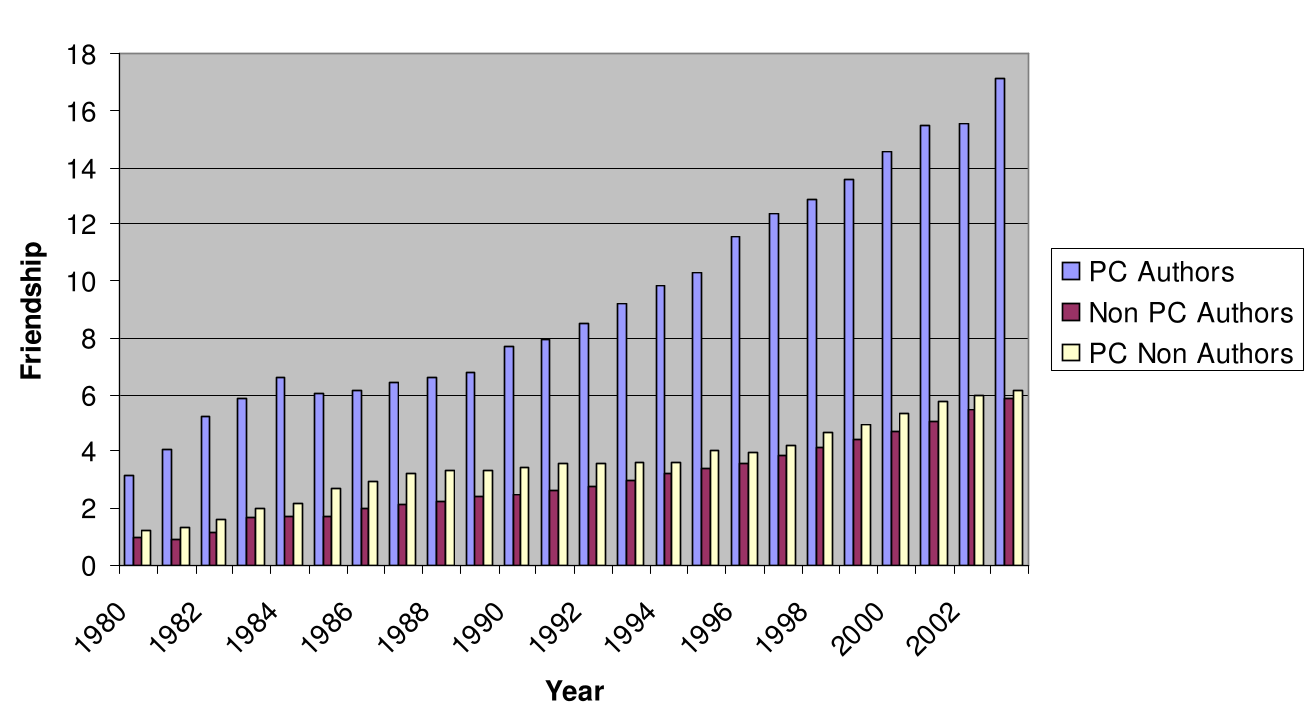 Figure 2: (a) Friendship levels increase over time for all groups, but PC-Authors (top line) maintain a significant lead.
Critical Insight & Conclusion
While the authors are careful to state they are not proving "malicious bias," the data is striking. The Social Capital metric provides a quantitative shadow of what we intuitively call "networking."
Comparison to SOTA
Unlike contemporary works that focus on "Infection" or "Information Flow," Licamele et al. focus on "Benefit Flow." This shifts the focus from how an idea spreads to how resources and status are allocated.
Limitations & Future Work
The study lacks "rejection data"—we don't know the social capital of those whose papers were denied. Future iterations could integrate "Friendship Strength" (measured by number of collaborations) rather than a binary 0/1 link.
The Takeaway: In any institutional setting, success is a function of both human capital (your talent) and social capital (your friends in the committee). FEN gives us the tools to finally measure the latter.