
Beyond Sequences: Leveraging Capsule Networks to Unmask Social Media Clickbaits
Capsule Network on Social Media Text: An Application to Automatic Detection of Clickbaits
2019-01-01
Summary
Problem
Method
Results
Takeaways
Abstract
The paper introduces a Capsule Network-based architecture for automatic clickbait detection in social media. By combining Bi-directional GRU layers with Capsule layers and dynamic routing, it achieves a SOTA accuracy of 98.41% on standard benchmark datasets.
## TL;DR
Social media clickbaits are evolving, and so must our detection methods. This paper proposes a **Capsule Network** architecture that moves beyond simple sequential modeling (LSTM) and manual feature engineering. By capturing the spatial hierarchies of words, the model achieves a record-breaking **98.41% accuracy**, proving that how words relate spatially is just as important as the order they appear in.
## Background & Motivation: The Clickbait Problem
In the attention economy, clickbaits serve as "baits" using sensationalist headlines to lure users into clicking links. Historically, detecting these required experts to define "handcrafted" features (like punctuation density or specific "power words"). While LSTMs improved this by looking at word sequences, they often miss the broader **spatial properties**—the nuanced way words group and interact to create "luring" context.
The author identifies a critical gap: **CNNs** lose information through pooling, and **LSTMs** are limited to sequence. Capsule Networks, originally designed for computer vision to recognize parts-to-whole relationships, are perfectly suited to fill this gap for short, dense social media text.
## Methodology: The Architecture of Reasoning
The proposed model is a sophisticated pipeline designed to transform raw tokens into high-dimensional spatial vectors.
### 1. The Embedding and Recurrent Layer
The model starts with **GloVe word embeddings** to capture semantic meaning. Instead of feeding these directly to the Capsule layer, the author uses a **Bi-directional GRU (Gated Recurrent Unit)**. This choice is strategic: GRUs handle the vanishing gradient problem more efficiently than standard RNNs and provide a refined feature set for the capsules.
### 2. The Capsule Layer & Dynamic Routing
This is the heart of the paper. Unlike standard neurons that output a single scalar, capsules output **vectors**.
- **Primary Capsules**: These capture the local ordering and semantic representations.
- **Dynamic Routing**: Instead of "max-pooling" (which just picks the strongest signal), dynamic routing acts like an intelligent filtering mechanism, ensuring that important word relationships are passed to the higher-level capsules while noise is ignored.
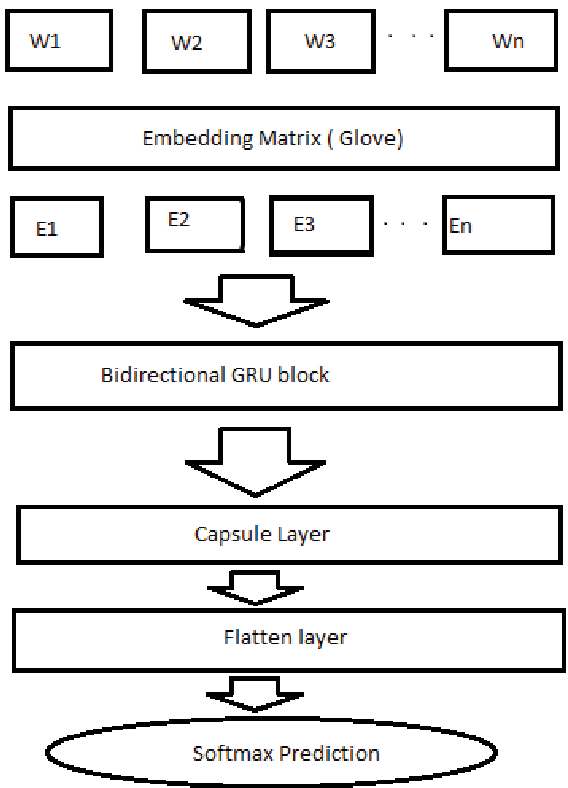
*Figure 1: The multi-layered flow from Word Embeddings to the Capsule Network output.*
## Experimental Results: SOTA Performance
The model was tested against several heavyweight baselines, such as Logistic Regression, Random Forest, and various LSTM configurations.
| Approach | Accuracy | F1-Score |
| :--- | :--- | :--- |
| StopClick (Handcrafted) | 93.00% | 0.9300 |
| Glove+LSTM-128 | 98.09% | 0.9809 |
| **Glove+Caps (Proposed)** | **98.41%** | **0.9841** |
While the accuracy gain over LSTM (+0.32%) might seem incremental, the **Precision (98.65%)** and **AUC (99.85%)** scores indicate a much more robust and reliable classifier that handles the nuances of clickbait headlines better than traditional neural networks.
### The Hidden Cost: Computational Complexity
Innovation comes with a price. The research highlights that **Capsule Networks are computationally expensive**. As seen in the training time comparison, Capsule Networks take significantly longer to converge per epoch than LSTMs.
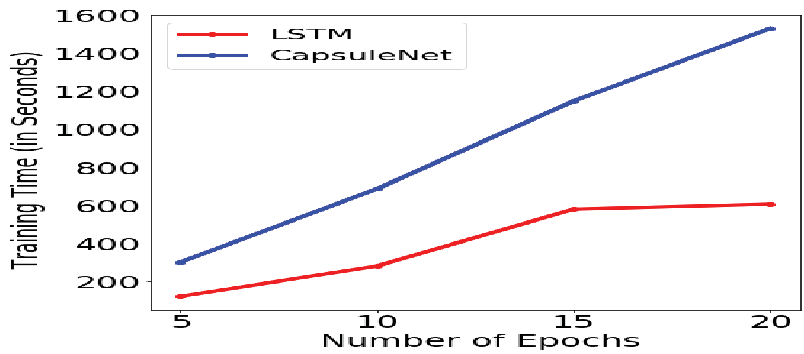
*Figure 2: The clear trade-off between the better spatial understanding of Capsules and the speed of LSTMs.*
## Critical Analysis & Future Outlook
The success of this work demonstrates that Capsule Networks' ability to handle **spatial hierarchies** (the "where" and "how" of word clusters) is extremely valuable for short-text classification.
**Key Takeaways:**
- **Feature Engineering is becoming obsolete**: The Capsule Network automatically identifies patterns that previously required manual labor.
- **Spatial is the new Sequential**: In short texts, the relative importance and "orientation" of words matter more than long-term dependencies.
**Limitations**: The primary bottleneck is the **dynamic routing algorithm**, which is inherently iterative and slow. Future research should focus on optimizing this routing process (e.g., via "Fast Routing") to make it viable for real-time, large-scale social media monitoring.
## Conclusion
By moving from scalar-based neurons to vector-based capsules, this research provides a stepping stone toward more "perceptive" NLP models. It proves that Capsule Networks are not just for pixels—they are a powerful tool for decoding the subtle art of clickbait.