
Beyond Symmetry: Capturing Social Dynamics with Relation Strength Similarity (RSS)
Capturing missing edges in social networks using vertex similarity
2011-06-26
Summary
Problem
Method
Results
Takeaways
Abstract
This paper introduces Relation Strength Similarity (RSS), an asymmetric vertex similarity measure designed to capture missing edges in social networks. By leveraging local topology and an adjustable discovery range, RSS predicts future collaborations in weighted networks like CiteSeerX, significantly outperforming Jaccard, Adamic-Adar, and SimRank.
## TL;DR
Researchers from Pennsylvania State University have proposed **Relation Strength Similarity (RSS)**, a novel graph measure that predicts missing links by accounting for the asymmetric nature of social connections. Tested on a massive coauthorship network (CiteSeerX), RSS outperformed industry-standard benchmarks like SimRank and Jaccard similarity by a wide margin, specifically excelling at predicting future collaborations.
## The Problem: Why Traditional Similarity Fails
In the world of social networks, not all connections are created equal. Prior works generally fall into two categories:
1. **Local Measures (Jaccard, Adamic-Adar):** These only look at "friends of friends" (two hops). If you don't share a direct neighbor, your similarity is zero—a massive limitation for growing networks.
2. **Global Measures (SimRank):** These consider the whole graph but treat relationships as **symmetric**.
**The Insight:** Real-world relationships are often unbalanced. A junior researcher (low degree) finds a connection to a senior professor (high degree) extremely significant, whereas for the professor, that same link is just one of many. Standard algorithms miss this "directionality of interest."
## Methodology: How RSS Works
RSS introduces a normalized weighting system where the strength of a link depends on the source vertex's total capacity.
### 1. The Core Formula
The relation strength $R(A, B)$ is defined as:
$$R (A, B) := \frac {\alpha_{A B}}{\sum_{\forall X \in N (A)} \alpha_{AX}}$$
where link strength is relative to the "social budget" of vertex A.
### 2. Path Summation & Discovery Range
Unlike SimRank, which explores everything, RSS uses a **Discovery Range ($r$)**. This allows the model to search for connections within a specific radius (e.g., 2 or 3 hops), which is more computationally efficient and matches the "small world" reality of social circles.

*Fig 1: The paper illustrates how researcher connections flow through different paths, emphasizing the asymmetric nature of the proposed measure.*
## Experimental Results: Dominating the Baseline
The authors used the CiteSeerX database to build a coauthorship graph ($G_0$) and predicted new edges in three future time windows ($G_1, G_2, G_3$).
### SOTA Comparison
The results in Table 1 show a staggering lead for RSS:
* **Near-term (G1):** RSS (r=3) is **598 times** better than random selection, while Jaccard is only 221 times better.
* **Long-term (G3):** Even as the network evolves and becomes harder to predict, RSS remains the most robust predictor.
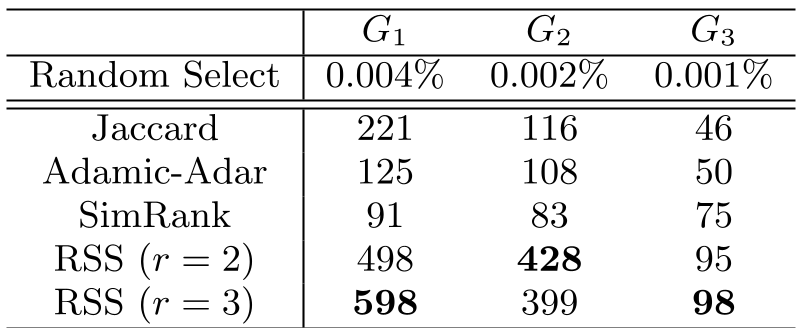
*Table 1: RSS consistently outperforms traditional local and global measures across all time spans.*
## Critical Analysis & Future Outlook
The true power of RSS lies in its **inductive bias**: it acknowledges that nodes with fewer neighbors place higher "value" on their existing links.
**Key Takeaways:**
* **Asymmetry is Feature, not a Bug:** Modeling directed interest improves prediction accuracy.
* **Local-Global Balance:** The "discovery range" parameter $r$ allows RSS to capture more than Jaccard without the noise/complexity of full SimRank.
**Limitations:** While RSS is efficient, the current study focuses on coauthorship networks. Its performance on highly fluid networks (like Twitter/X followers) or transactional networks (e.g., banking) remains an open area for research.
## Conclusion
RSS represents a shift toward more "sociologically aware" graph algorithms. By mathematically modeling the relative importance of connections, it provides a superior tool for recommendation systems and network analysis.