
Capturing Order in Social Interactions: The Dawn of Socially Intelligent Machines
Capturing Order in Social Interactions
The paper explores "Social Signal Processing" (SSP) by demonstrating how turn-taking patterns in human conversations—who speaks, when, and for how long—can be used to automatically recognize social roles, group dynamics, and conflict structures. Using simple statistical models like Markov chains and Social Affiliation Networks, the author achieves high accuracy in identifying participants' roles (up to 83.9%) and group boundaries in broadcast media.
TL;DR
Can a machine understand your social role or identify a group conflict without understanding a single word you say? Alessandro Vinciarelli's research proves the answer is yes. By analyzing the "physics" of conversation—specifically who talks when (Turn-Taking)—machines can decode complex social structures like roles, groups, and conflicts with startling accuracy.
The "Social Animal" vs. the "Unsocial Machine"
For decades, computers have been "unsocial." While humans are biologically wired for interaction—from mirror neurons to facial muscles—machines have historically treated audio and video as mere data streams. The author argues that for computers to truly integrate into our lives (remote learning, virtual worlds, etc.), they must become socially intelligent.
The breakthrough insight is that social behavior, while seemingly chaotic, is governed by predictable patterns. These patterns leave physical, detectable "traces" in signals like turn-taking, allowing us to bridge the gap between human sociology and signal processing.
Methodology: The Geometry of Conversation
The paper focuses on Turn-Taking as the primary behavioral cue. It mathematically represents a conversation as a sequence of speakers and durations:
1. Social Affiliation Networks (SAN)
To recognize roles (e.g., Anchorman vs. Guest), the author uses a SAN—a bipartite graph linking actors to "events" (time segments). If two people frequently talk in the same segments, they have a "social link."
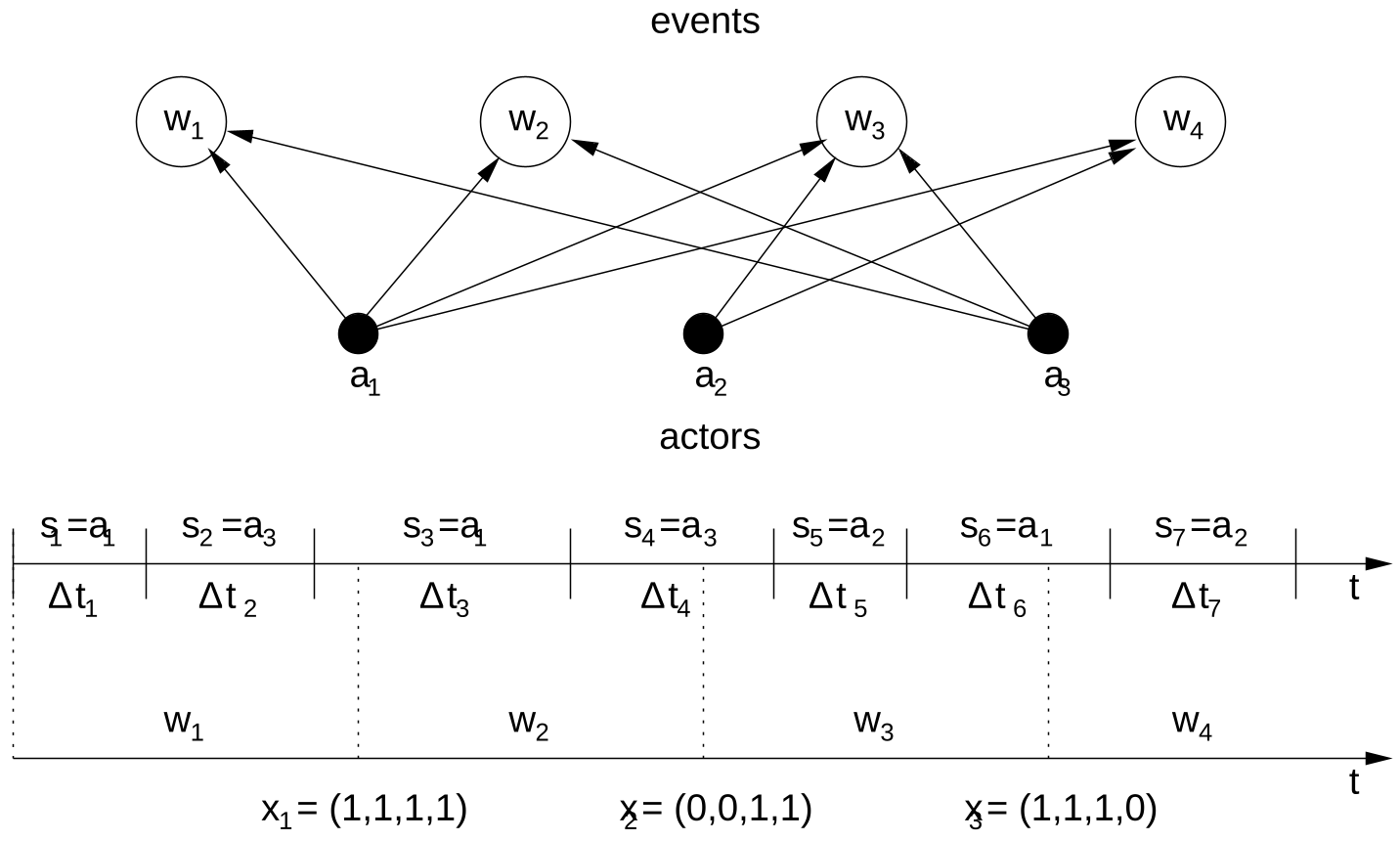
2. Modeling the "Hidden" Social State
The author employs a Bayesian approach and Markov Chains to determine the most likely role or story sequence given the observed turn patterns. For instance, in a conflict, the participant talking at turn is statistically dependent on who talked at (people react to those they disagree with).
Key Breakthroughs & Results
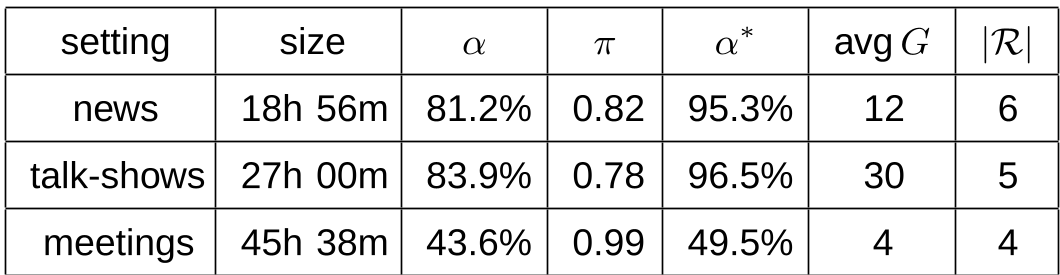
The experiments covered over 90 hours of media, yielding impressive results across three social dimensions:
| Setting | Task | Accuracy | Key Finding |
|---|---|---|---|
| News/Talk-Shows | Role Recognition | ~82% | Roles like "Moderator" create rigid, detectable patterns. |
| Meetings | Role Recognition | 43.6% | Lower due to the highly spontaneous nature of informal groups. |
| Political Debates | Conflict Detection | 64.5% | Dramatically outperformed random chance (6.5%) in identifying factions. |
Robustness to Errors
Crucially, the research demonstrates that even when "Speaker Diarization" (the machine's ability to tell voices apart) is imperfect, the underlying social order is strong enough that the models still perform reliably.
Deep Insight: Why This Matters
The most profound takeaway is that Social Signal Processing (SSP) and Social Computing (SC) are two sides of the same coin. SSP looks at the "micro" level (small groups, nonverbal cues like head tilts), while SC looks at the "macro" level (millions of users on social media).
Is order present in conflict? Conventionally, we think of a heated argument as "noisy" or "disordered." Vinciarelli shows that conflict actually imposes its own strict structural order: the "reactive" nature of disagreement (back-and-forth turns between opponents) is easier for a machine to model than a polite, multi-way consensus.
Conclusion & Future Perspectives
The future of AI isn't just about better language models (LLMs); it’s about multimodal social awareness. By integrating findings from psychology and anthropology into signal processing, we can build machines that don't just "calculate," but "understand" the social fabric they are woven into.
Limitations: The current work relies heavily on formal or semi-formal settings (broadcasts). The real "frontier" lies in purely spontaneous, unscripted human-human interactions in the wild, where speaker overlaps and interruptions are frequent and messy.