
Unlocking the Silent Narrative: Mining Social Video Content through eADR
Capturing User Generated Video Content in Online Social Networks
This paper introduces an innovative IT artifact designed to capture and analyze user-generated video content and metadata from social networks like YouTube. Using an elaborated Action Design Research (eADR) approach, the authors developed "TUBE TOPIC," a system that automates the construction of a metadata-enhanced corpus for Latent Dirichlet Allocation (LDA) topic modeling.
TL;DR
Researchers have developed a new framework and tool called TUBE TOPIC to bridge the gap between simple social network graph analysis and deep semantic video mining. By leveraging elaborated Action Design Research (eADR) and discovering undocumented API gateways, the team successfully automated the extraction of YouTube captions and metadata, enabling scalable topic modeling (LDA) directly within a database environment.
The Problem: The "Forbidden" 403 Barrier
In the world of social network analysis, text is king because it is easy to parse. However, video is the dominant medium of modern interaction. Practitioners and researchers face a "wicked problem":
- API Gaps: Standard APIs often return
403 Forbiddenwhen attempting to download video captions unless third-party contributions are specifically enabled. - Fragmented Workflows: Most analytical pipelines require jumping between web scrapers, local file systems, and disparate R/Python environments.
The authors observed that while existing literature (Table 1 in the paper) covers traffic characterization and metadata, very few works successfully automate the fusion of captions and metadata for semantic analysis.
Methodology: The eADR Journey
The researchers didn't just build a tool; they followed a rigorous Design Science Research (DSR) process. They used the eADR (elaborated Action Design Research) model, which focuses on iterative cycles of Diagnosis, Design, Implementation, and Evolution in collaboration with industry experts.
The Breakthrough Discovery
During the design phase, the team collaborated with developers from DIYCaptions.com and unearthed an undocumented YouTube internal API:
https://youtube.com/get_video_info?&video_id={videoid}
This URL provides an encoded string containing a baseURL that points directly to the XML caption tracks, bypassing the limitations of the standard YouTube Data API.
System Architecture: TUBE TOPIC
The evolution from Version 1 to Version 2 represented a shift from a "file-shuffling" workflow to a "unified-database" workflow.
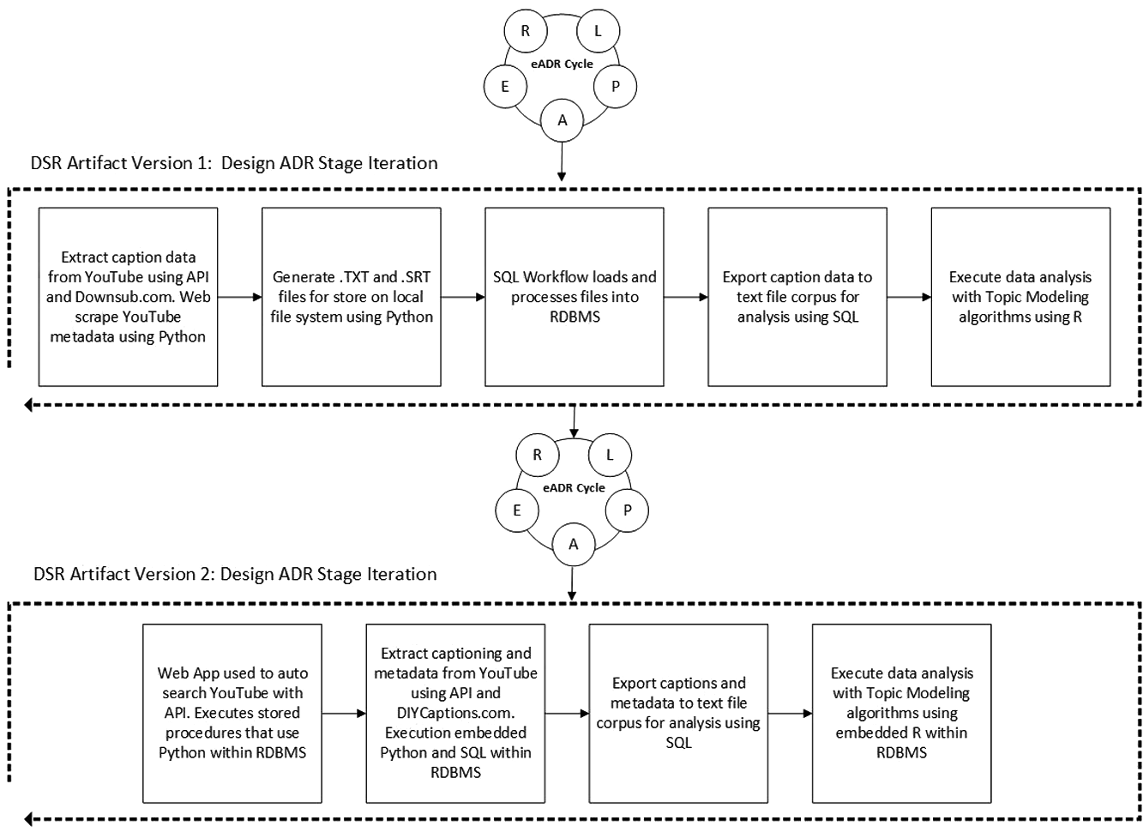
- Phase 1: A Web App provides the interface for search terms.
- Phase 2: Python scripts embedded directly within SQL Server 2017 extract data via the hidden API.
- Phase 3: The system generates a "metadata-enhanced corpus," where captions and metadata (likes, views, categories) are merged into a single analytical unit.
- Phase 4: R code is executed within the RDBMS to run Latent Dirichlet Allocation (LDA), generating topic distributions without data leaving the server.
Experiments & Results: Interpreting the "Tea Leaves"
To evaluate the "goodness" of the artifact, the authors performed Topic Intrusion Tasks. This involves identifying "intruder" topics to see if the LDA algorithm is generating coherent, human-interpretable themes from the video captions.
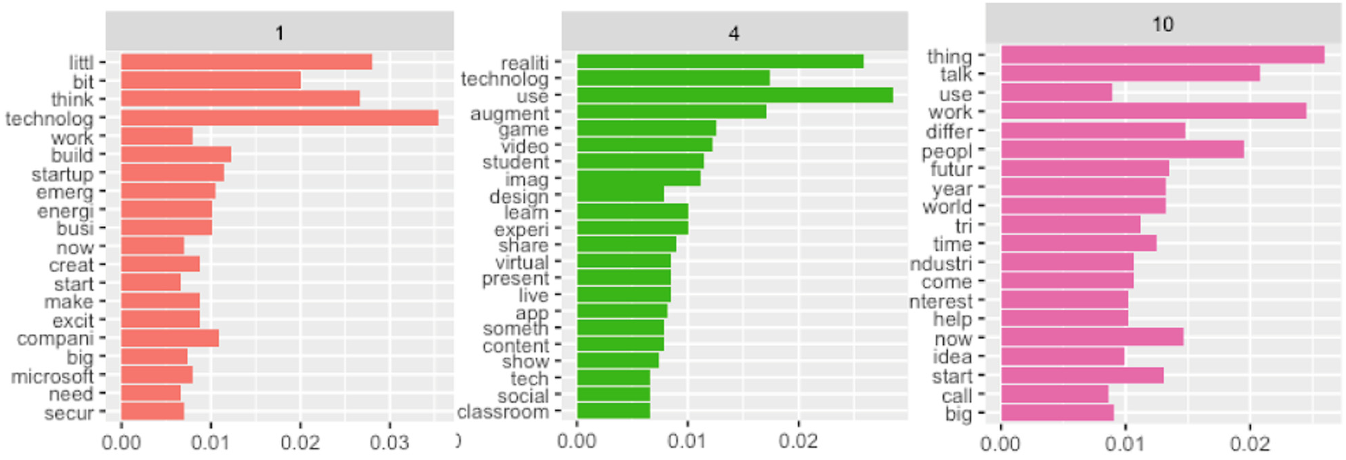
The results confirmed that the automated pipeline could successfully identify emerging technology trends (e.g., "emerging technologies 2016") by analyzing the latent semantic structures of thousands of videos simultaneously.
Critical Insight & Future Outlook
The true value of this paper lies in its methodological rigor. Instead of a "quick hack" to scrape data, the authors provide a blueprint for how academic researchers can work with industry experts to navigate the technical hurdles of "wicked" IT problems.
Limitations: The current artifact is hyper-optimized for YouTube. As social platforms increasingly "wall" their gardens, the "undocumented API" approach may face cat-and-mouse challenges with platform updates.
Conclusion: This research moves us toward a "Total Content Analysis" of social networks, where the spoken word in a video is just as searchable and analyzable as a text post.