
The Scalpel and the Safety Net: How Cardiac Teams Plan to Be Surprised
Getting the right tools for the job: preparatory system configuration and active replanning in cardiac surgery
This ethnographic study investigates the complex interplay between preparatory configuration and active replanning in cardiac surgery using the framework of Distributed Cognition (D-Cog). By analyzing video recordings of OR activities, the authors demonstrate how systemic resilience is maintained through a balance of pre-arranged resources and real-time cognitive adaptation.
TL;DR
Success in the Operating Room (OR) is often viewed as the flawless execution of a pre-set plan. However, this paper argues that true safety stems from Distributed Planning: a combination of "Preparatory Configuration" (setting the stage) and "Active Replanning" (improvising when the script changes). By viewing the entire OR as a cognitive unit, the study reveals how teams use redundant expertise and material cues to catch "minor errors" before they cascade into danger.
Problem & Motivation: The Myth of the Static Plan
In healthcare, "error" is often defined as a deviation from a plan. But anyone who has stepped into a cardiac OR knows that a plan is merely a starting point. The authors suggest that the primary risk to patient safety isn't just the "wrong plan," but a system's inability to adapt.
Existing models fail to capture the situated nature of surgery—how a team negotiates changing intentions and ambiguous tool requests in real-time. The core problem is finding the balance: being prepared enough to be efficient, but flexible enough not to be "trapped" by an initial strategy that the patient's anatomy no longer supports.
Methodology: The OR as a Thinking System
The researchers utilized Distributed Cognition (D-Cog). In this view, the "mind" isn't just inside the surgeon's head; it is distributed across the scrub nurses, the circulators, the medical charts, and the layout of the tool trays.
1. Preparatory Configuration
Before the first incision, the team creates a "configured environment."
- Cheat Sheets: Printed lists that translate a surgeon’s personal preferences into a spatial array of tools.
- Tool Layout: Standardized tables that serve as external memory for the scrub nurse, reducing the need for explicit verbal commands.
2. Active Replanning
When a "re-do" surgery reveals unexpected scar tissue or a surgeon decides to switch from traditional sutures to novel spring clips, the plan must be rebuilt on the fly. This relies on the propagation of representations—moving information from a tactile sensation (the "feel" of a needle) to a verbal clarification (asking for a different size).
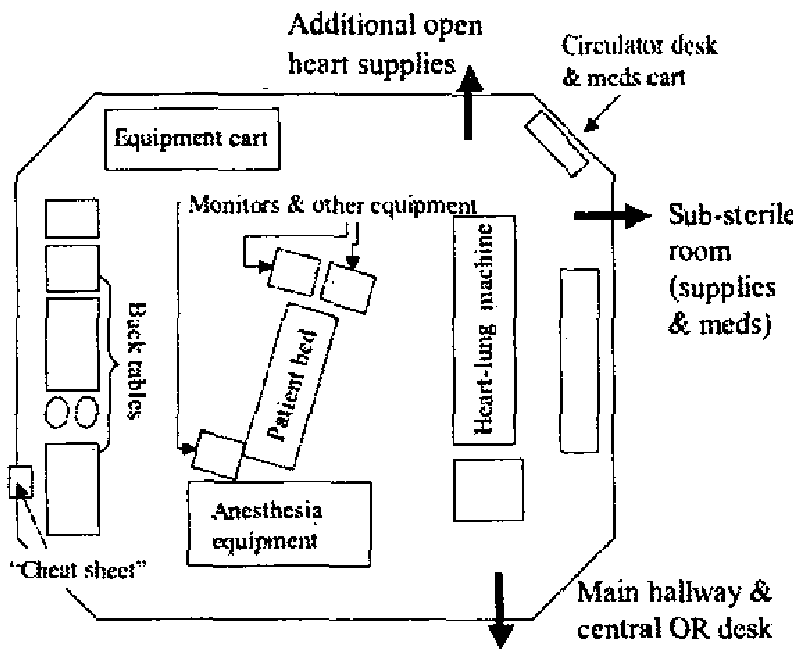 Figure 1: The architecture of the "heart room" is designed to box in a sterile field, concentrating cognitive resources where they are most needed.
A Case Study in Resilience: The Spring Clip Incident
The paper details a specific case where a plan to use radial artery grafts led to an ambiguous tool request. The scrub nurse and circulator mistakenly provided distal (small) clips for a proximal (large) connection.
The error was not caught by the verbal "labels" (which were ambiguous) but by the surgeon’s tactile-kinesthetic feedback. Because the surgeon was wearing magnifying loupes and physically handling the needle, he detected a discrepancy in the needle size that the rest of the team couldn't "see."
| Tool Feature | Cognitive Access | Mode of Detection |
|---|---|---|
| Labeling | Scrub/Circulator | Ambiguous text on box |
| Mental Model | Team | Conflicted due to novelty of tool |
| Tactile/Visual | Surgeon | High-fidelity feedback via loupes/handling |
The "Replan" was successful not because everyone communicated perfectly, but because the system was resilient—it allowed the surgeon to detect the error and pivot to a "Replan 4" without stopping the surgery.
Results: The Power of Redundancy
The study highlights three pillars of system resilience:
- Process Redundancy: Multiple agents (e.g., two scrubs) backing each other up.
- Plan Redundancy: Having "latent plans" (like extra supplies for a crisis) ready to go.
- Cross-Modal Verification: Validating information across different media (verbal commands, spatial orientation, and physical sensation).
The analysis shows that novelty is the greatest enemy of this system. When tools are new or the procedure is a "re-do," the standard "cheat sheets" fail, forcing the team to consume massive amounts of cognitive energy just to align their mental models.
Critical Insight: Redefining Error
The most provocative takeaway from this work is the critique of the standard definition of medical error. If a surgeon discards an intended plan to adapt to a patient’s unique anatomy, is that a "failure of a planned action"? No.
At a system level, following the original plan when circumstances have changed is the real error. Resilience is the ability to recognize when the plan is wrong and to have the configured resources available to change it safely.
Future Outlook
For designers of surgical technology and hospital informatics, the lesson is clear: don't just build systems that enforce compliance with a checklist. Build systems that enhance situation awareness and make it easier for teams to "negotiate" a new plan when the unexpected happens.