
Decoding Cardiometabolic Risk: Transparent AI for Women’s Self-Care Apps
Classification of Cardiometabolic Risk in Early Middle-aged Women for Preventive Self-care Apps
This paper presents an interpretable machine learning approach to classify cardiometabolic risk (CMR) in early middle-aged women for integration into preventive self-care m-Health apps. By evaluating decision trees and rule-based models against the SWAN longitudinal dataset, the authors achieve high predictive performance (PR-AUC up to 0.80 for interpretable models) using non-clinical, user-reported determinants.
TL;DR
Menopause significantly alters a woman’s metabolic profile, yet many remain unaware of their rising risk for heart disease. This research addresses the gap by developing interpretable machine learning models that predict cardiometabolic risk (CMR) using only data a user can provide via a smartphone. By prioritizing transparency over "black-box" complexity, the authors prove that simple decision trees can offer professional-grade risk assessment within the constraints of a mobile app.
Background: The Menopause Blindspot
As women enter middle age, declining estrogen levels are often linked to increased abdominal adiposity and metabolic shifts. Despite the explosion of m-Health apps, most "women’s health" software focuses strictly on fertility or period tracking, leaving the 40-60 age demographic underserved. In a self-care context, we face a dual challenge:
- Data Scarcity: Users don't have blood labs handy during app registration.
- The Trust Gap: If an app tells a user they are "High Risk," they need to know why to feel motivated to change their lifestyle.
Methodology: Human-Centered Feature Selection
The authors didn't just dump data into a model. They used a Participatory Design approach, interviewing women and experts to find 75 tailoring variables. This was eventually whittled down to 13 key predictors that are easy to measure or recall, such as:
- Biometrics: BMI (the most significant predictor).
- Lifestyle: Servings of meat/veg, alcohol intake, and physical activity.
- Symptoms: Frequency of hot flashes (a key indicator of menopausal transition).
Architecture: Choosing Transparency
The study compared "Black-Box" models (Random Forest, SVM) against "Glass-Box" models.
- Decision Trees (DT): Simple flowcharts (If BMI > X and Activity < Y, then Risk = High).
- Rule-Based (RB): Independent if-then statements.
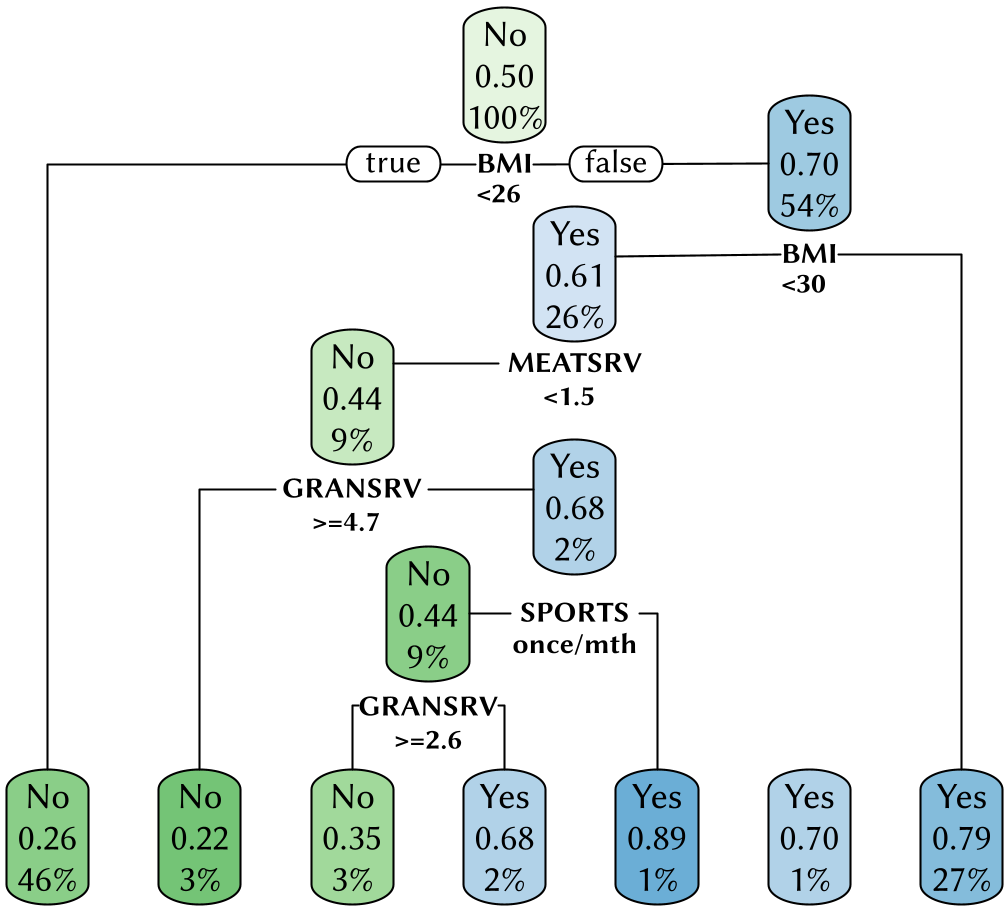 Figure 2: A classification tree (rpart) showing how age, BMI, and lifestyle factors branch into risk categories.
Experiments & Performance
Using the SWAN (Study of Women’s Health Across the Nation) dataset, the authors analyzed data from 1,290 women over 10 years.
Key Findings:
- The Accuracy-Interpretability Trade-off: While Support Vector Machines (svmLinear) achieved a high PR-AUC of 0.92, the interpretable evtree was surprisingly robust at 0.80.
- Outperforming Traditional Scores: The model's F-score (accuracy/recall balance) was superior to traditional clinical scores like the Reynolds Risk Score, which often fail to account for the unique metabolic patterns of the menopausal transition.
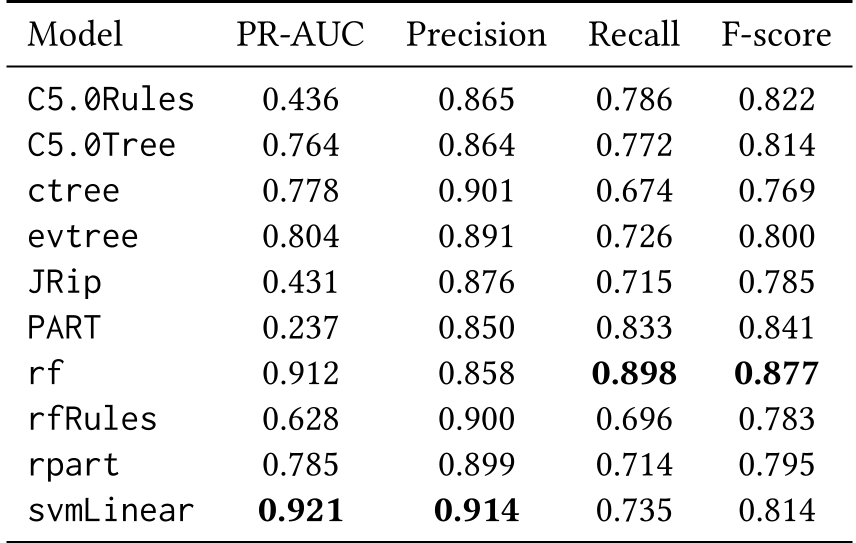 Table 4: Performance metrics comparing black-box (rf, svmLinear) vs. interpretable models (rpart, ctree).
Critical Insight: Why Interpretability Wins
The authors argue that in Preventive Self-care, a "False Positive" is actually acceptable. If the model encourages a woman to exercise more or eat better, the intervention is beneficial regardless of whether a heart attack was imminent. However, an explanation like "Your risk is elevated because your physical activity has dropped while hot flashes increased" is far more persuasive than a raw percentage.
Limitations
- Dataset Age: The SWAN data reflects US women starting in 1996. Lifestyle and dietary habits have shifted globally since then.
- Geographic Bias: The model needs validation across different cultures, especially considering European laws regarding the non-collection of "race" data.
Conclusion
This work serves as a blueprint for the next generation of "Just-in-Time" adaptive health apps. By moving away from inscrutable algorithms and focusing on Explainable AI (XAI), we can empower middle-aged women to take ownership of their cardiometabolic health before chronic conditions set in.