
CareCam: Transforming the Webcam into a Corporate Health Guardian
8592_CareCam Concept of a new tool for Corporate Health Management.
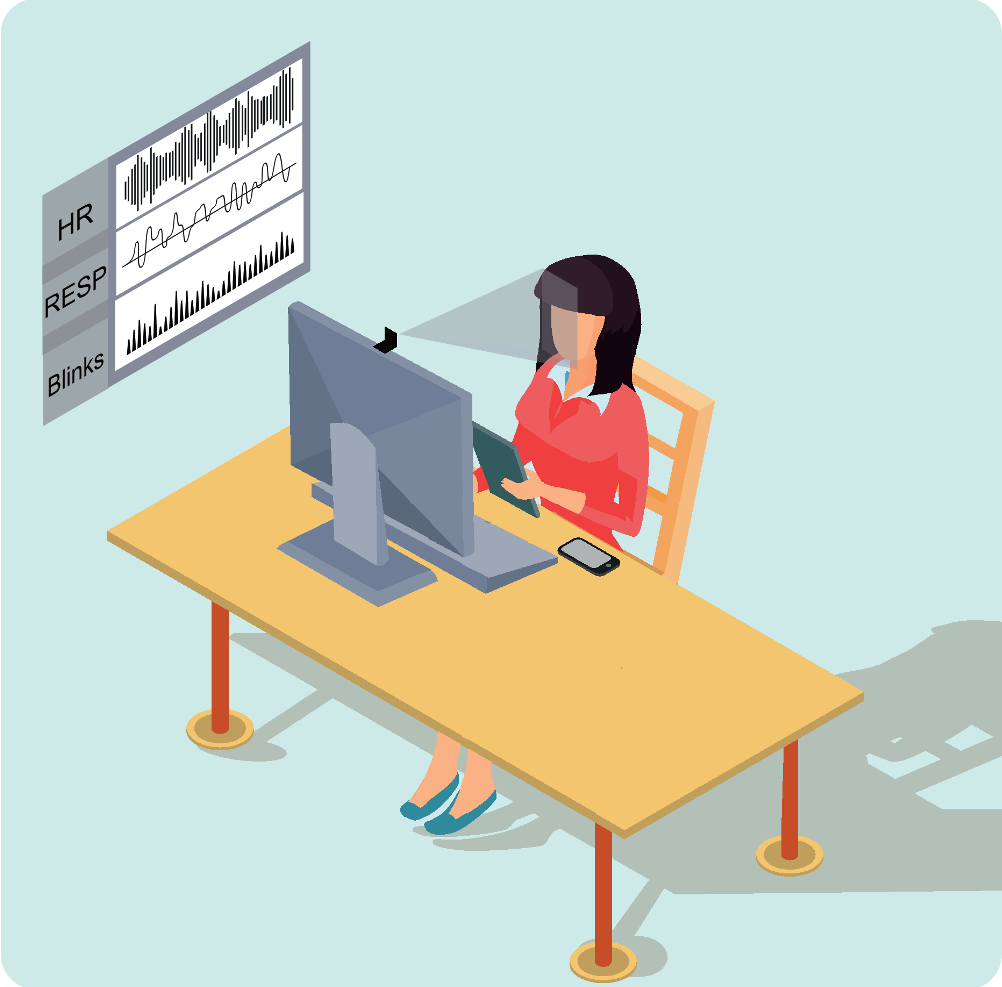
CareCam is a concept and prototypical tool for Corporate Health Management (CHM) that uses a standard webcam to perform contactless, multimodal monitoring of mental and physical stress. By integrating Vital Sign Acquisition (Pulse, Respiration), Eye Blink analysis, and Pose Estimation, it provides real-time intervention recommendations to reduce work-related absenteeism and improve employee well-being.
TL;DR
As mental health disorders become the second leading cause of work disability, the need for objective, unobtrusive monitoring is critical. CareCam is a new concept that repurposes the ubiquitous office webcam into a sophisticated diagnostic tool. By analyzing heart rate, blink frequency, and posture through computer vision, it detects stress at the onset and suggests immediate interventions like deep breathing or stretching.
Background Positioning
In the landscape of Corporate Health Management (CHM), we are seeing a shift from simple fitness trackers to complex affective computing. CareCam sits at the intersection of Ubiquitous Computing and Digital Health, pushing the boundaries of what "passive monitoring" can achieve without requiring the user to wear a single sensor.
Problem & Motivation: The Subjectivity of Stress
Traditional stress assessments are flawed for two reasons:
- Intrusiveness: Wearable ECG sensors or pulse belts are impractical for an 8-hour workday.
- Subjectivity: Stress is highly personal. What "burns out" one employee might be "motivating" for another.
Current CHM tools often use questionnaires (like the START procedure), but these are retrospective and prone to recall bias. The authors argue that we need a system that captures Physiological reactions (heart rate), Behavioral responses (posture), and Affective responses (facial expressions) simultaneously and objectively.
Methodology: The CareCam Multi-Modal Pipeline
The power of CareCam lies in its ability to extract "Invisible Signals" from a standard video stream.
1. The Vital Sign Engine (iPPG)
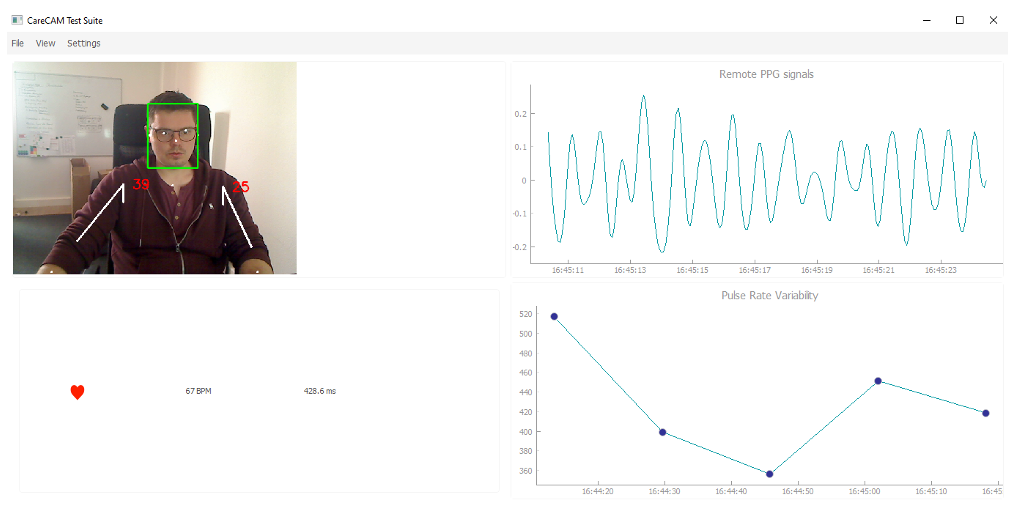
Using Imaging Photoplethysmography (iPPG), the system detects minute changes in skin reflectance caused by blood volume pulses. Even with a compressed webcam stream, the authors use the CHROM method combined with deep learning to denoise motion artifacts, allowing for accurate Heart Rate (HR) and Heart Rate Variability (HRV) tracking.
2. Ergonomics and Eye Health
The system monitors two silent killers of productivity:
- Eye Blink Frequency: Correlated with both stress and "Computer Vision Syndrome."
- Text Neck Syndrome: Captured via 3D head and joint position estimation to prevent chronic neck load (which can be 5x higher than normal during poor posture).
3. Active Learning: Solving the Ground Truth Dilemma
Because stress is subjective, CareCam uses a Calibration phase (deep breathing baseline) and Active Learning. If the system detects a stress spike, it asks the user for a quick validation via a "subtle questionnaire," fine-tuning the underlying Neural Network to that specific individual’s physiological profile.
Prototype and Real-World Implementation
The authors developed a prototype that operates in three modes:
- Daemon Mode: Stealthy background feature extraction.
- Analysis Mode: A dashboard for researchers/users to see real-time vital stats (HR, HRV, Posture).
- Intervention Mode: Provides guided meditation or stretching when stress thresholds are exceeded.
Deep Insights & Future Outlook
While the technical feasibility is clear, the authors strike a note of caution regarding Privacy and Acceptance. For such a tool to succeed, it must operate on the Edge (processing data locally on the PC) rather than the cloud, ensuring video data never leaves the user's machine.
The next frontier for CareCam is Cuff-less Blood Pressure estimation. If blood pressure can be reliably extracted from a webcam, this tool could become a primary defense against "Silent Killer" cardiovascular diseases in the modern workforce.
Conclusion
CareCam represents a logical evolution for the home-office era. By turning a source of stress (the constant "on-camera" meeting culture) into a tool for health, it offers a pathway to sustainable productivity that respects the physiological limits of the human worker.