
CaregiverNet: Digitizing Social Support to Secure Wandering Alzheimer’s Patients
CaregiverNet: A novel social support intervention for locating and securing wandering Alzheimer's patients as soon as possible
CaregiverNet is a novel Information and Communication Technology (ICT) intervention designed to locate and secure wandering Alzheimer’s Disease (AD) patients using a managed social network of family caregivers. By integrating Electronic Geo-Tracking (EGT) with an ad hoc "search and find" protocol, the system aims to reduce the "golden 24 hours" risk and mitigate caregiver psychosocial burden.
TL;DR
CaregiverNet is a sophisticated ICT platform that transforms a passive tracking device into an active, community-driven rescue system. By creating an ad hoc social network of family caregivers, the system ensures that when an Alzheimer’s patient wanders, the nearest available peer-caregiver is mobilized via real-time GPS coordinates, significantly reducing the time until contact and easing the emotional burden on the primary family member.
Background & Motivation: The Loneliness of the Tracker
Wandering is one of the most life-threatening behaviors associated with Alzheimer’s Disease (AD), often leading to physical harm if the patient isn't found within the "Golden 24 Hours." While current Electronic Geo-Tracking (EGT) tools provide coordinates, they place a massive psychological load on caregivers:
- The Reaction Gap: Knowing where a patient is doesn't mean you can reach them quickly.
- Psychosocial Burden: Caregivers face isolation and extreme anxiety during wandering episodes.
- The Monitoring Paradox: Passive tracking requires constant vigilance, which paradoxically increases caregiver distress.
CaregiverNet's core insight is that social support—traditionally a "soft" emotional intervention—can be engineered into a "hard" technical solution to solve the physical problem of retrieval.
Methodology: The Architecture of Active Safety
The system moves beyond simple GPS by implementing a three-tier safety state model: Safe, Unreachable, and Wandering.
1. Personalized Geofence & Call-Based Supervision
Instead of a generic radius, the system creates a "Personalized Geofence" based on the patient's actual mobility habits (e.g., the distance to their farthest regular activity).
The most innovative technical component is the Call-Based Supervision (shown below). This is a periodic "Are you fine?" check. The system places a call; the patient doesn't need to speak but must "respond" by calling back a dedicated number within a specific time (the "I am fine" response). This provides a cognitive "heartbeat" for the system.
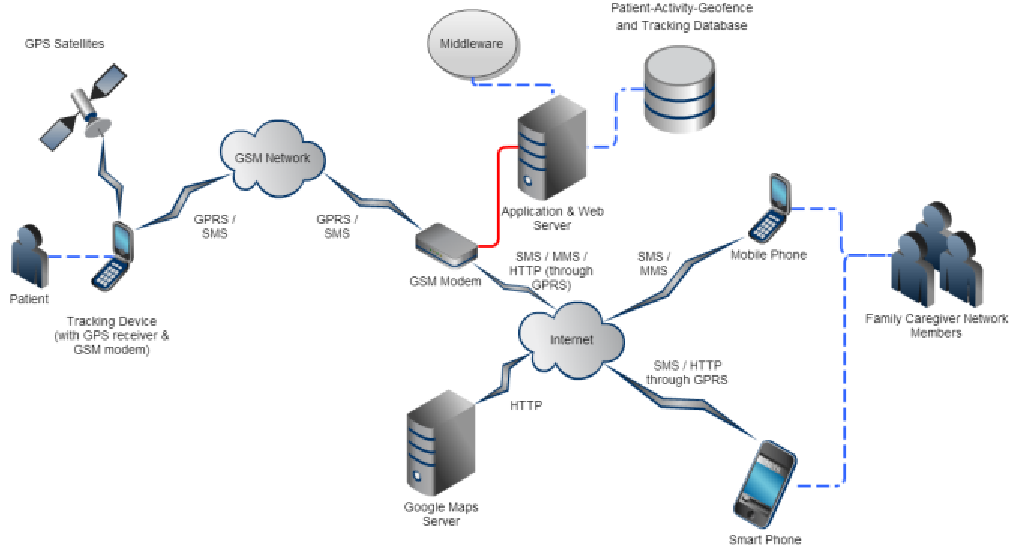 Figure 1: Overall system architecture involving GSM, Satellite, and Application Server components.
2. Ad Hoc Search Network
If safety checks fail, the system doesn't just alert the family; it multicasts a "SUPPORT" request to a network of local Caregiver Network Members (CNMs).
- Voluntary Support: Peers opt-in based on proximity.
- Privacy-First Identification: Volunteers receive a MMS with the patient’s portrait and current address only after confirming availability.
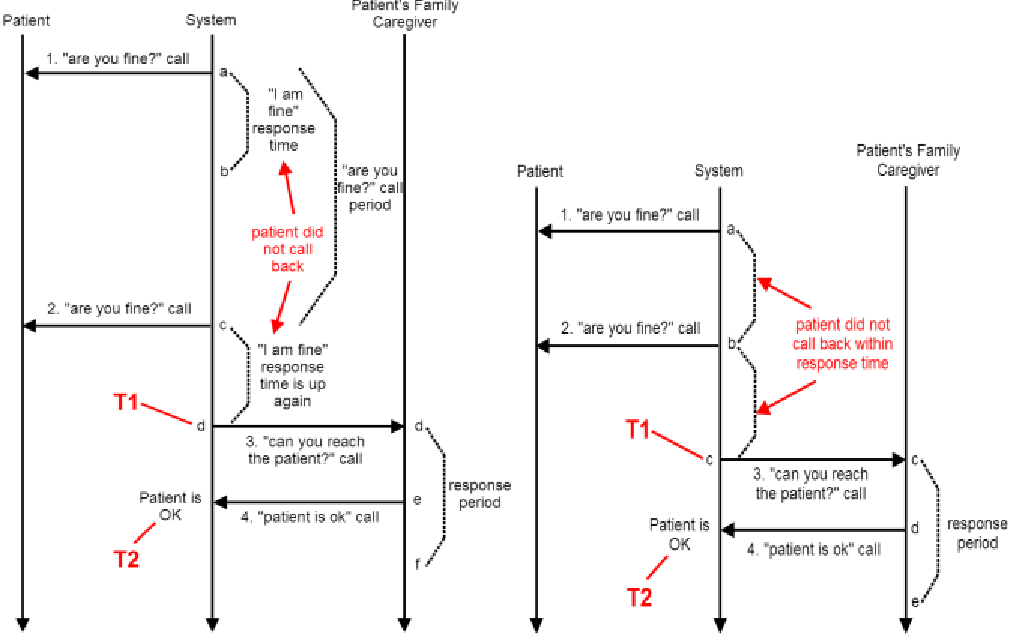 Figure 2: Logic for transitioning from Safe to Wandering state based on geofence location and response times.
Clinical Evaluation & Experimental Design
The authors propose a Randomized Controlled Trial (RCT) to validate two hypotheses:
- Technical Efficacy: Does the social network reduce the "mean time to find"?
- Psychological Impact: Does knowing a network is "watching" reduce the caregiver’s scores on the Zarit Burden Interview and PHQ-9 (Anxiety/Depression scale)?
The protocol uses a "Found" signal loop where the first person to reach the patient triggers a system-wide "secured" notification, closing the ad hoc network.
Critical Insight & Limitations
CaregiverNet is a brilliant application of Inductive Bias in social engineering: it assumes that caregivers of AD patients are uniquely empathetic and motivated to help each other.
Limitations to consider:
- Battery Life: High-frequency GPS updates during "Wandering" state can drain tracking devices quickly.
- SMS Latency: Relying on GSM/SMS in 2026 might be replaced by 5G/LTE-M services for better reliability in dense urban environments.
- Cognitive Load: The "Call-Based Supervision" requires the patient to remember a specific button sequence, which may become impossible as the disease progresses from Phase I to later stages.
Conclusion
CaregiverNet represents a move toward "Cognitive-Social Systems," where technology isn't just a sensor, but a bridge that connects human empathy to urgent physical needs. Future iterations utilizing smartphone apps and real-time map visualization (GPRS/3G) could further reduce the latency of these life-saving interventions.