
Deciphering Social Cascades: The Anatomy of Information Flow in the Digital Age
Cascades on Online Social Networks: A Chronological Account
This paper provides a comprehensive survey of information cascades on Online Social Networks (OSNs), defining them as structural traces of information flow. It categorizes cascade topologies, construction methodologies for platform-defined and generic content, and provides a taxonomic breakdown of structural and temporal features used to quantify diffusion.
TL;DR
Information cascades are the digital "fingerprints" of how ideas, memes, and news travel across social networks. This survey systematically breaks down how we reconstruct these hidden structures from platforms like Twitter, Tumblr, and Facebook, offering a robust toolkit of structural and temporal features to measure influence, trust, and content value.
Background: Why Cascades Matter
While a standard social network (the "Follow" graph) shows us who could listen to whom, a cascade network shows us who is actually listening. As the authors note, these are "implicit networks"—forceful actions of sharing that provide a more accurate reflection of trust and interest than a simple friendship link. Understanding cascades is the key to identifying true influencers and predicting whether a piece of content will go "viral" or die in obscurity.
The Challenge of Construction: One Size Doesn't Fit All
A recurring pain point in diffusion research is that topology depends on content. The paper proposes a critical distinction in how we build these networks:
- Platform-Defined Elements: When you retweet or reblog, the platform tracks the source. These typically form Tree structures (one root, many branches).
- Generic Elements: Links (URLs) or hashtags don't always have a single "parent." These form Forests—multiple independent trees representing the same idea.
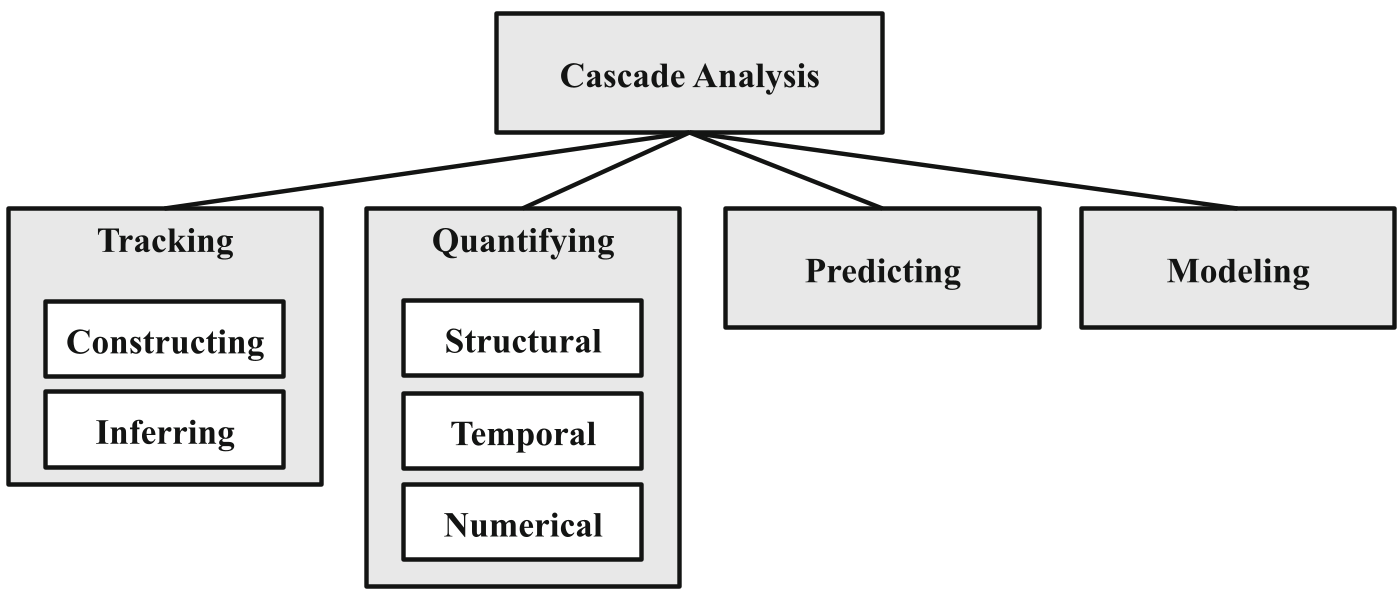 Figure 1: The four perspectives of cascade research: Tracking, Quantifying, Modelling, and Predicting.
Methodology: Quantifying the Invisible
The core contribution of this survey is the taxonomy of features used to measure a cascade's "health" and reach.
Structural Features (The "Where")
How does the cascade look? The authors highlight measures like Structural Virality (via the Wiener Index). A "star" shape (one person shared to millions) is popular but not viral. A truly viral cascade is "deep"—it grows through many generations of people sharing from one another.
- Depth & Range: How far the information traveled from the source.
- Branching Factor: The average number of "children" each node has (a measure of immediate influence).
Temporal Features (The "When")
Time is the crucial second dimension. The paper identifies features like Latency (time between post and first share) and Recurrence (does the cascade spark again after a period of idleness?).
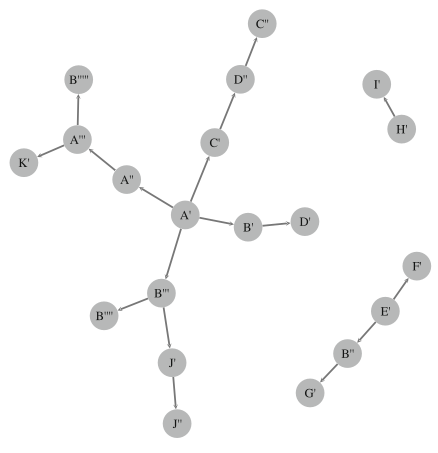 Figure 2: Information cascades visualized as a time-series of events vs. a structural relationship between nodes.
Key Insights from Different Platforms
The survey tracks the evolution of research from early Blogosphere link analysis to modern OSN functionalities.
- Twitter: Focuses on the "Retweet Graph" to distinguish between social media and news media roles.
- Tumblr: Offers unique insights into behavioral patterns through "Reblog" chains.
- Facebook: Highlights the role of "copy-paste" memes and hidden feed interactions.
Critical Analysis & Conclusion
The value of this work lies in its standardization. By categorizing 19 specific features (see Table 1 and 2 in the paper), it provides a "periodic table" for social media researchers.
Limitations: The paper leans heavily on structuralism; it creates a gap by not deeply addressing the semantics of the content—why exactly does one meme recur while another fades? Additionally, as platforms become more "closed" (e.g., Discord, WhatsApp), the construction methods discussed here will face significant data-access hurdles.
Future Outlook: The next frontier for cascade research is likely Multimodal Diffusion, where we must track how an idea jumps from a text post on Twitter to a video on TikTok and back. The features defined here provide the foundational grammar for that future cross-platform analysis.
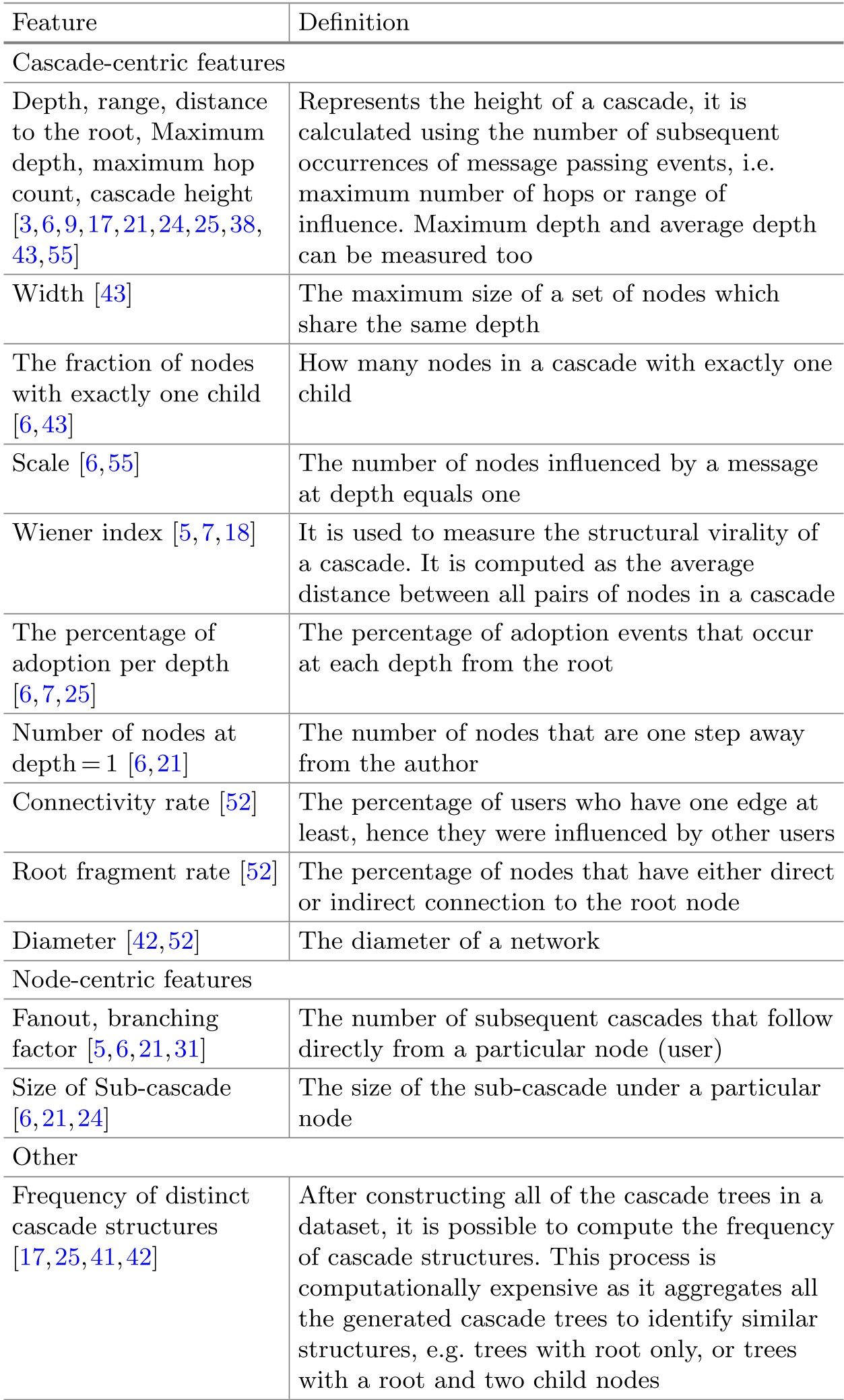 Table 1: A summary of cascade-centric vs. node-centric structural features.