
RCED: Moving Beyond N-k Security to Prevent Cascading Blackouts
Impact of Cascading and Common-Cause Outages on Resilience-Constrained Optimal Economic Operation of Power Systems
This paper introduces a Resilience-Constrained Economic Dispatch (RCED) model and a new Resilience Index (RI) to enhance power system adaptability to extreme weather. The approach utilizes a three-stage outage sampling method to address common-cause and cascading outages, incorporating unique penalty terms based on power flow entropy to homogenize transmission loading.
TL;DR
Power grids are increasingly vulnerable to extreme weather that triggers "common-cause" and "cascading" outages. This paper introduces a Resilience-Constrained Economic Dispatch (RCED) model that proactively adjusts power flows to be more uniform. By introducing penalty terms that minimize power flow entropy and a new Resilience Index (RI), the authors demonstrate a significant reduction in the risk of large-scale blackouts compared to traditional N-k reliability methods.
Context: Why Traditional Reliability Fails in Extreme Weather
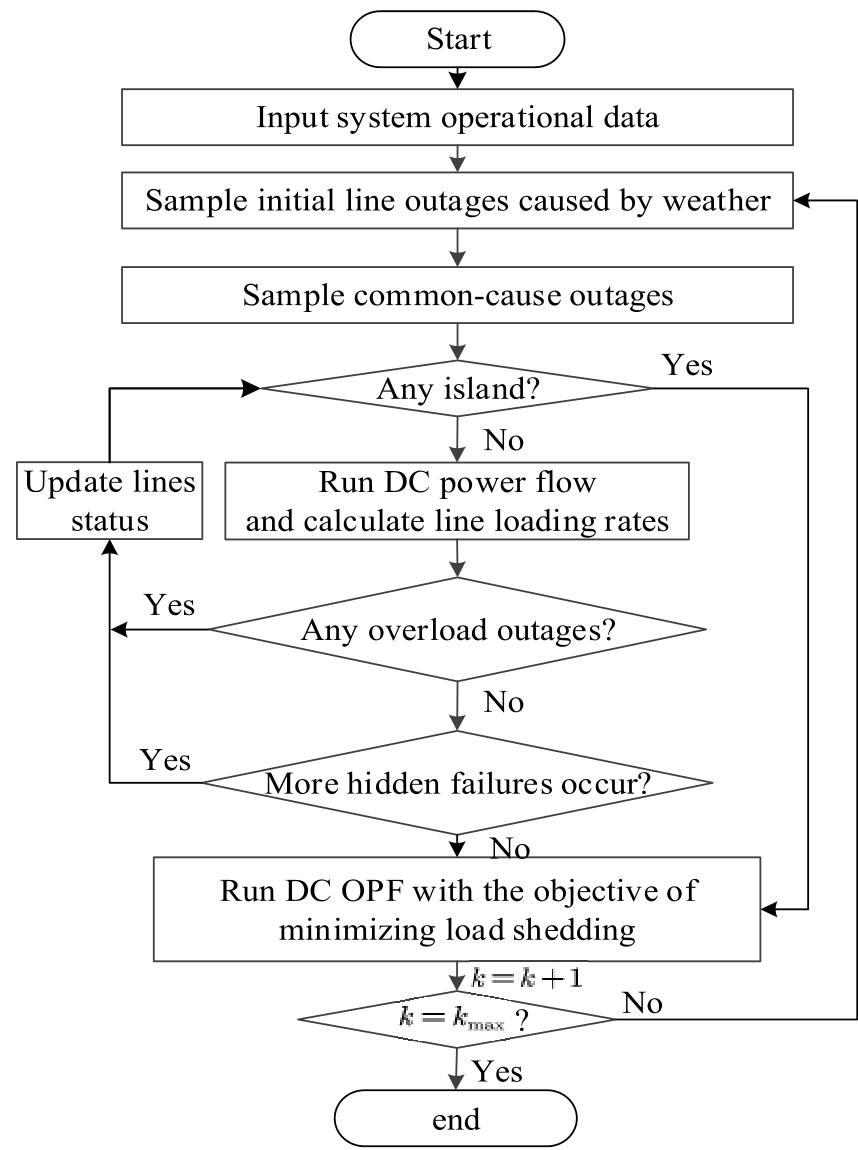
In the world of power systems, the "N-1" or "N-k" criterion has been the gold standard for decades. It ensures that the loss of components won't crash the grid. However, during a tornado, hurricane, or severe icing event, outages are rarely independent. A single lightning strike or tower failure often causes multiple lines to trip simultaneously (common-cause outages). even worse, high loading can expose hidden failures in protective relays, leading to a domino effect (cascading outages).
Traditional metrics like Expected Load Curtailment (ELC) focus on the "average" loss, which masks the catastrophic risk of the "flat tail"—the low-probability, high-impact events that result in total system collapse.
The Core Innovation: Resilience Index and Flow Uniformity
The authors argue that a system's adaptation capability depends on its power flow distribution. If lines are loaded near their limits, any sudden shift in power (due to an outage elsewhere) will likely trigger further trips.
1. The Resilience Index (RI)
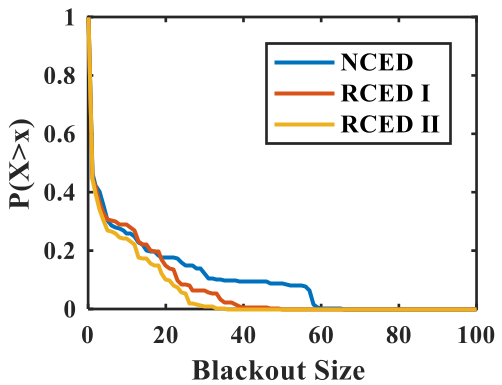
Instead of just looking at average load loss, the authors propose an RI based on the probability that a blackout size exceeds a threshold : This rewards dispatch strategies that "crush" the flat tail of the distribution, even if the average loss remains similar.
2. Taming Power Flow Entropy
The methodology incorporates two clever penalty terms into the objective function:
- Penalty 1 (): Reduces the loading specifically on lines located in weather-affected zones.
- Penalty 2 (): Minimizes the Mean Absolute Deviation (MAD) of loading across the entire network.
The physical intuition is simple: a "flatter" load distribution provides a larger safety margin. If one line fails, the remaining network can absorb the redistributed power without hitting thermal limits.
Methodology: Solving the Non-Convexity
A major technical hurdle in this paper is that the MAD penalty term involves nested absolute value functions, which are notoriously difficult to optimize. The authors provide a rigorous proof (Theorem 1 & 2) that allows these terms to be linearized using auxiliary variables () and a Big-M coordination method. This ensures that the global optimum of the linearized "C-RCED" model is identical to the original complex problem.
Key Results and Evidence
Testing on systems ranging from the IEEE 30-bus to the complex Polish 2383-bus system yielded several "Aha!" moments:
- Blackout Risk Mitigation: As shown in the log-log plots below, the traditional Economic Dispatch (NCED) exhibits a "power-law" tail, meaning large blackouts are surprisingly common. The RCED model transforms this into an exponential decay, effectively eliminating large-scale failures.
- The Reliability Paradox: Interestingly, the authors found that simply adding N-1 contingency constraints (SCED) sometimes decreases resilience. This happens if the constraints force power to be redistributed in a way that creates new "bottlenecks" prone to hidden failures.
- Performance vs. Cost: To achieve this resilience, generation costs increased by roughly 5-8%. In the context of preventing a multi-day blackout, this is a negligible "insurance premium."
Critical Insight: The Limits of Operation
The paper concludes with a vital reality check: operational strategies (like this dispatch model) are highly effective when wind speeds are "moderately extreme" (e.g., 30m/s to 45m/s). However, once weather becomes truly catastrophic (e.g., >60m/s wind), no amount of clever dispatching can save the grid. At that point, infrastructure hardening (physical reinforcement of towers) becomes the only viable path.
Conclusion
This work shifts the focus of power system security from "surviving a list of accidents" to "building a flexible, uniform flow state." For grid operators facing a future of increasingly volatile weather, RCED offers a mathematically sound framework to prioritize adaptation and keep the lights on.