
Cascading Failures in Social Networks: When the Exit of "Super Users" Paralyzes the Web
Cascading failures of social networks under attacks
This paper identifies and models cascading failures in social networks, specifically targeting the impact of "super users" on network stability. By developing a theoretical model based on betweenness centrality and evaluating it on real-world Twitter and Sina Weibo datasets, the study demonstrates how the removal of key nodes can dismantle network connectivity.
TL;DR
Social networks aren't just collections of profiles; they are dynamic systems prone to catastrophic collapse. This paper reveals that the sudden removal of "super users" (high-influence accounts) triggers a cascading failure—a domino effect where information loads redistribute, overwhelm remaining users, and eventually shatter network connectivity. The key discovery? Density is a double-edged sword: Twitter’s dense connectivity makes it far more fragile than the fragmented landscape of Sina Weibo.
Background: The Hidden Fragility of Influence
We often hear about "viral" content, but we rarely discuss "viral failure." In physical systems like power grids, if one substation fails, its electricity load shifts to others. If those neighbors can't handle the extra voltage, they fail too.
The authors argue that social networks follow a similar physical logic. Here, "load" is the flow of information. When a central user disappears, the "shortest paths" for information transmission disappear too, forcing the network to reroute. This paper positions itself as the first to rigorously model this physical-to-social transition.
Methodology: Mapping Information "Load"
The authors move beyond simple follower counts, utilizing Betweenness Centrality to define a user's role.
- Load (): The number of shortest information paths passing through user .
- Capacity (): Defined as , where is a "tolerance parameter." It represents how much extra "noise" or "information pressure" a user can handle before quitting.
- The Trigger: An attack removes nodes.
- The Cascade: Paths are recalculated. If , the node fails. This continues until the network reaches a steady state.
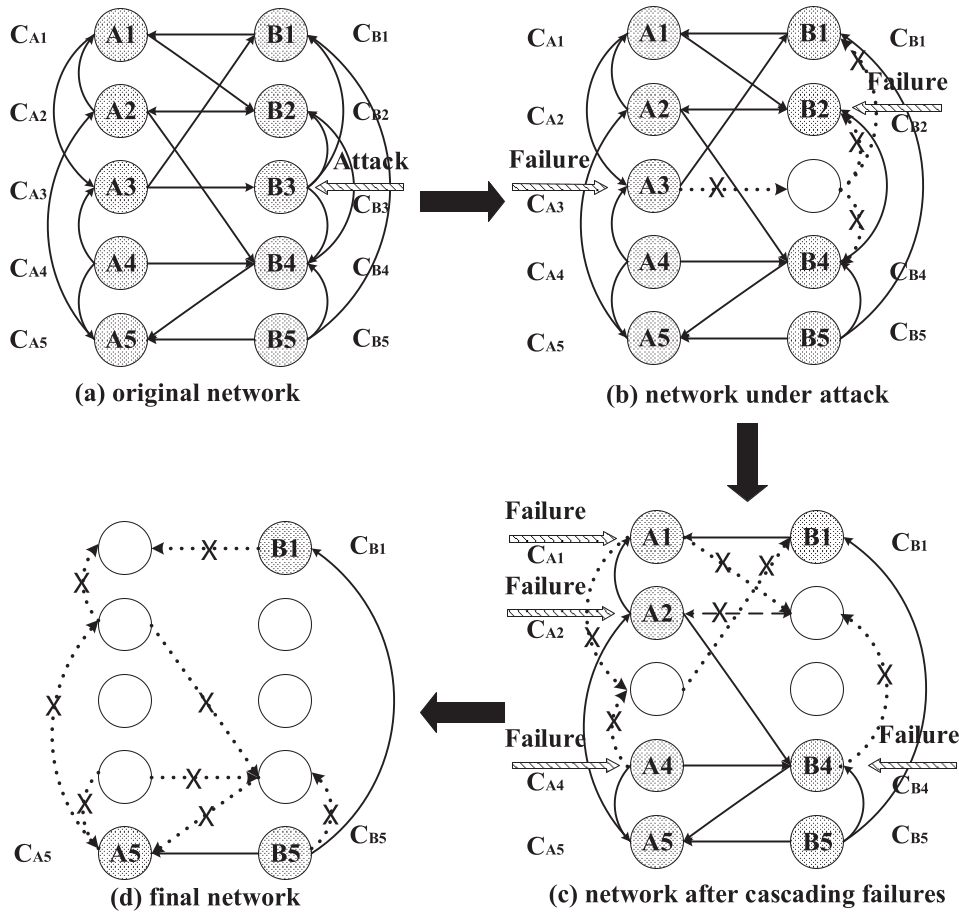 Figure 1: A conceptual view of how the failure of B3 forces a redistribution that eventually kills off most of the local cluster.
Experiments: Twitter vs. Sina Weibo
The study provides a fascinating "stress test" using real data from 2013-2014. They compared two very different topologies:
- Twitter (Chinese Community): Dense and homogeneous (Average degree: 91).
- Sina Weibo: Sparse and inhomogeneous (Average degree: 6.8).
The Resilience Paradox
Counter-intuitively, the "sparsity" of Sina Weibo acted as a protective buffer. Because users are clustered into industry-specific silos (entertainment, IT, finance), a failure in one "silo" rarely jumps to another. Twitter's high "following percentage" (4.55% vs 0.34% for Weibo) allows the "poison" of the cascade to travel faster and wider.
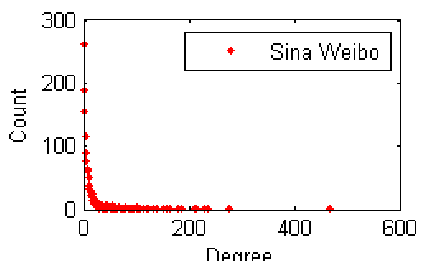 Figure 3: Visualization of a network shrinking from 100 nodes to a mere 36 survivors following a targeted strike.
Critical Results: Persistent Time and Connectivity
The researchers tested four attack strategies: HL (High Load), MPR (Most Path Removal), MD (Max Degree), and RD (Random).
- Persistent Time: The cascade isn't instant. It peaks in duration when the tolerance parameter is around 0.3 to 0.5. If users are too sensitive (), the network dies instantly; if they are ultra-tolerant (), it never breaks.
- Connectivity Collapse: In the Twitter dataset, the connected ratio stays relatively high until it hits a "tipping point" dictated by . For Weibo, the connectivity is fragile from the start, but the scale of the total failure is much smaller.
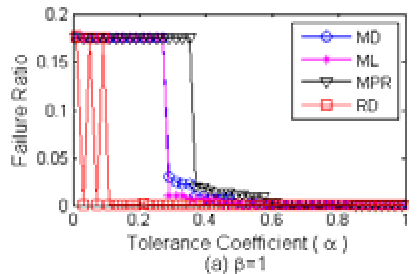 Figure 11/12 Context: The failure ratio shows that targeted attacks on super users (HL strategy) are exponentially more damaging than random user attrition.
Deep Insights & Concluding Thoughts
The takeaway for platform architects is sobering: Super users are the structural steel of the social web.
- Homogeneity is Vulnerability: A platform where everyone follows everyone is a platform that can collapse entirely from a single coordinated attack or "de-platforming" event.
- The "Malicious Information" Interpretation: The authors suggest that "load" can be viewed as malicious information (rumors/spam). High-betweenness users are exposed to more junk; if they reach a breaking point and leave, they take the network's structural integrity with them.
Limitations: The model assumes a linear relationship between initial load and capacity, which might not hold in real psychological behavior. Future work should look at "load-shedding" strategies—how platforms can dynamically reroute information to prevent super-user burnout.
Final Takeaway: Protecting your "Super Users" isn't just a PR strategy; it's a structural necessity for network survival.