
Bridging Meaning and Experience: Enhancing CBR with Ontological Semantic Matrices
Combination of Case-Based Reasoning and Data Mining Through Integration with the Domain Ontology
The paper introduces a hybrid Intelligent System that integrates Case-Based Reasoning (CBR) with Domain Ontologies and Data Mining techniques. By mapping cases to an ontological structure, the authors generate a semantic data matrix that enables the application of fuzzy classification and decision trees for more relevant case retrieval in IT consulting.
TL;DR
This research presents a novel architecture that layers Domain Ontologies over Case-Based Reasoning (CBR) to solve the problem of semantic relevance. By converting case relationships into a numerical Semantic Data Matrix, the authors enable the use of Fuzzy Decision Trees and Data Mining to retrieve solutions that are semantically rather than just mathematically similar.
Context: The Evolution of Knowledge-Based Systems
In the landscape of AI, Knowledge-Based Systems (KBS) have shifted from rigid Rule-Based Reasoning (RBR)—limited by the difficulty of manual rule extraction—to Case-Based Reasoning (CBR). CBR mimics human problem-solving by reusing past experiences. However, traditional CBR is often "blind" to the deeper meaning of the data it processes, relying on surface-level attribute matching.
The Problem: The Semantic Gap in Case Retrieval
The primary challenge identified by Avdeenko et al. is that the "closest" case in a multidimensional feature space isn't always the most "relevant" one logic-wise. Current systems lack a formal conceptualization of the domain, leading to retrieval errors where the context of a problem is misunderstood.
Methodology: Mapping Experience to Concepts
The authors propose a three-tiered integration strategy:
- Ontology Formulation: Using the Protégé editor, they define a hierarchy of concepts (e.g., Accounting, Payroll) and their relationships.
- The Precedent Class: A specific class structure that links case attributes to "Keywords" (Ontological concepts). This creates a bridge between an unstructured case and the formal domain model.
- Semantic Weighting: Weights are propagated from cases through the ontology hierarchy to "terminal concepts." This results in a Semantic Data Matrix—a mathematical representation of how much a case "belongs" to specific domain areas.
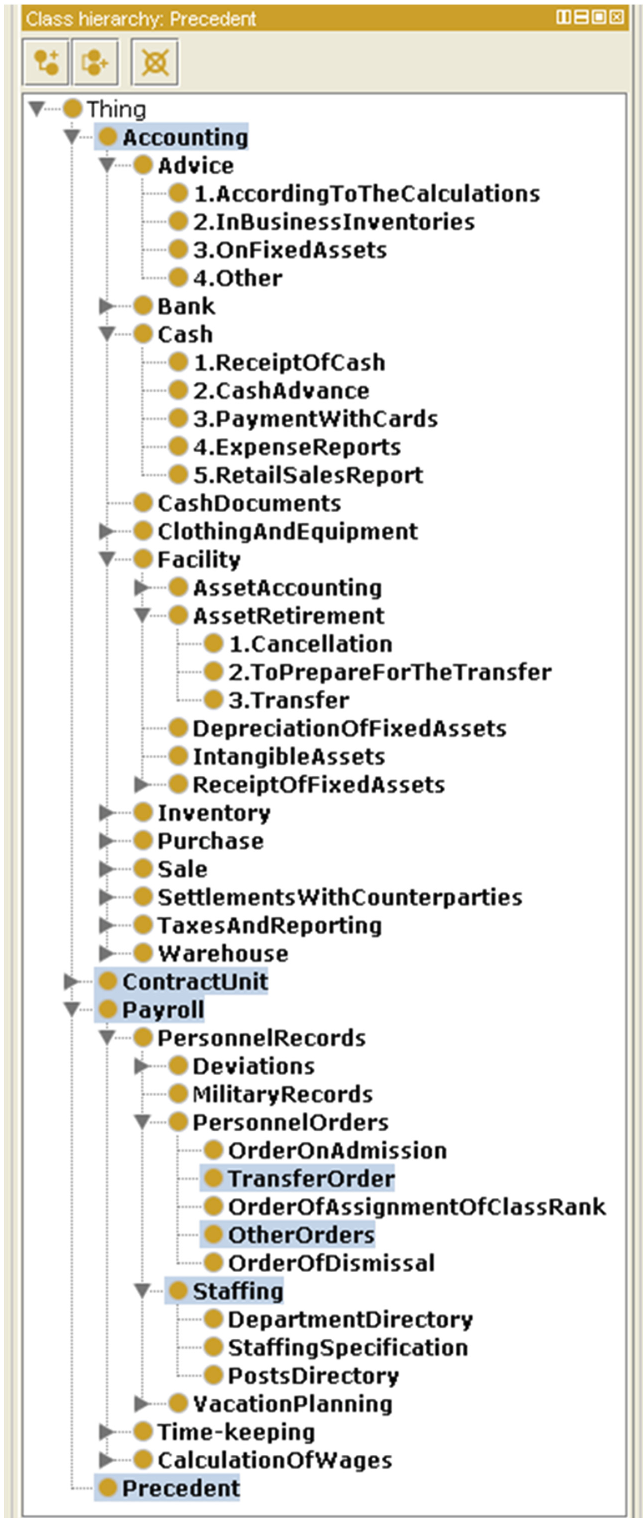 Figure: The hierarchy of IT consulting ontology used to structure terminal concepts.
Experiments: Fuzzy Logic enters the Space
By having a numerical matrix, the researchers could apply Data Mining. They compared two primary methods:
- Direct Fuzzy Rule Generation: High performance on very small datasets.
- Fuzzy Decision Trees (FID): Superior performance as the dataset size and the complexity of linguistic variables (terms) grow.
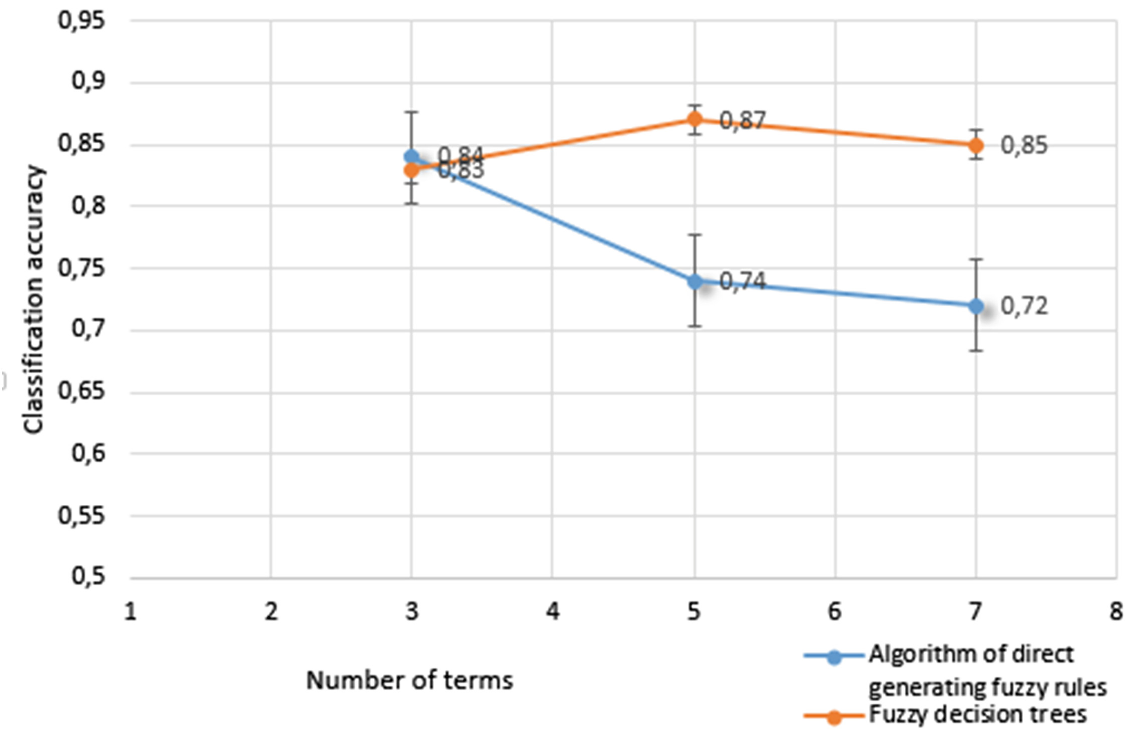 Figure: Classification accuracy across various numbers of linguistic terms, highlighting the robustness of the fuzzy approach.
Critical Insight: Why This Matters
The true value of this work lies in the Semantic Data Matrix. By transforming qualitative "concepts" into quantitative "weights," it allows traditional machine learning algorithms (Cluster analysis, Regression, Classifiers) to operate on top of human-defined knowledge structures. This hybrid approach ensures that the system is not a "black box" but one that follows the logical constraints of the IT consulting domain.
Conclusion & Future Work
The paper successfully demonstrates that integrating CBR with Ontologies significantly increases the relevance of retrieved cases. While currently applied to IT consulting, the methodology is domain-independent. Future research is expected to focus on a unified algorithm that combines the strengths of both fuzzy rules and decision trees to handle varying training sample sizes.
For researchers in Knowledge Engineering, this work provides a blueprint for making case bases "smarter" by anchoring them in a formal semantic reality.