
CASE: Bridging the Semantic Gap in API Search via Twitter Crowdsourcing
CASE: A Platform for Crowdsourcing Based API Search
This paper introduces CASE (Crowdsourcing based API Search Engine), a novel platform that enhances Web API discovery by leveraging Twitter Lists as a crowdsourced semantic resource. By applying Latent Semantic Indexing (LSI) to list metadata and integrating a popularity metric, CASE provides a more context-aware ranking than traditional keyword-based systems.
TL;DR
CASE (Crowdsourcing based API Search Engine) is a research prototype that moves beyond primitive keyword matching for API discovery. By mining Twitter Lists, the system captures how the global developer community categorizes services, using Latent Semantic Indexing (LSI) to match user intent with API functionality based on popularity and human-curated context.
Problem & Motivation: The "Travel" API Paradox
If you search for "travel" on legacy platforms like ProgrammableWeb, the top result might be a webcam directory that happens to have "travel" in its URL, but lacks actual travel-related functionality (like booking or itinerary management). This is the Keyword Matching Limitation.
The authors argue that technical descriptions often fail to capture practical usage context. To solve this, they turn to Crowdsourcing. Specifically, they leverage Twitter Lists—a feature where users manually group accounts (API providers) into thematic categories like "Social Media," "Cloud Computing," or "Finance." This human-in-the-loop categorization provides a goldmine of semantic signals that standard documentation lacks.
Methodology: From Social Signals to Semantic Vectors
The CASE framework operates through a two-pronged scoring system:
1. Semantic Similarity via LSI
Instead of checking if the word "Travel" exists in the API description, CASE processes the names and descriptions of all Twitter Lists an API belongs to.
- Preprocessing: Tokenization, stemming, and stop-word removal.
- LSI (Latent Semantic Indexing): This maps high-dimensional term frequencies into a lower-dimensional "latent space" to find synonyms and related concepts.
- Cosine Similarity: Measures the distance between the query vector and the API’s list-derived vector.
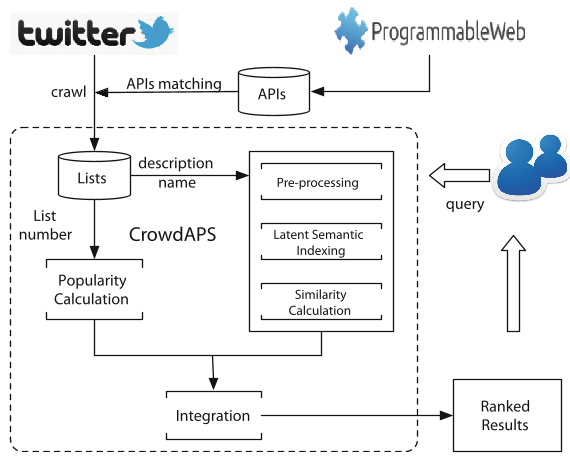 Figure 1: The CASE Framework – Mapping social data to an API ranking.
2. Popularity Calculation
Not all APIs are created equal. CASE uses the log-normalized number of lists an API is included in as a proxy for industry adoption and trust.
3. Integrated Ranking
The final score is a weighted sum: This allows the system to balance niche relevance with general popularity.
Experiments and Interface
The authors validated their approach by crawling 3,877 APIs. A significant finding was the data density: 30.8% of APIs were organized into more than 100 lists, providing a robust statistical foundation for the LSI model.
The user interface (UI) allows users to input queries and view results that display not just the API name, but also its category, description, and "popularity" (list count).
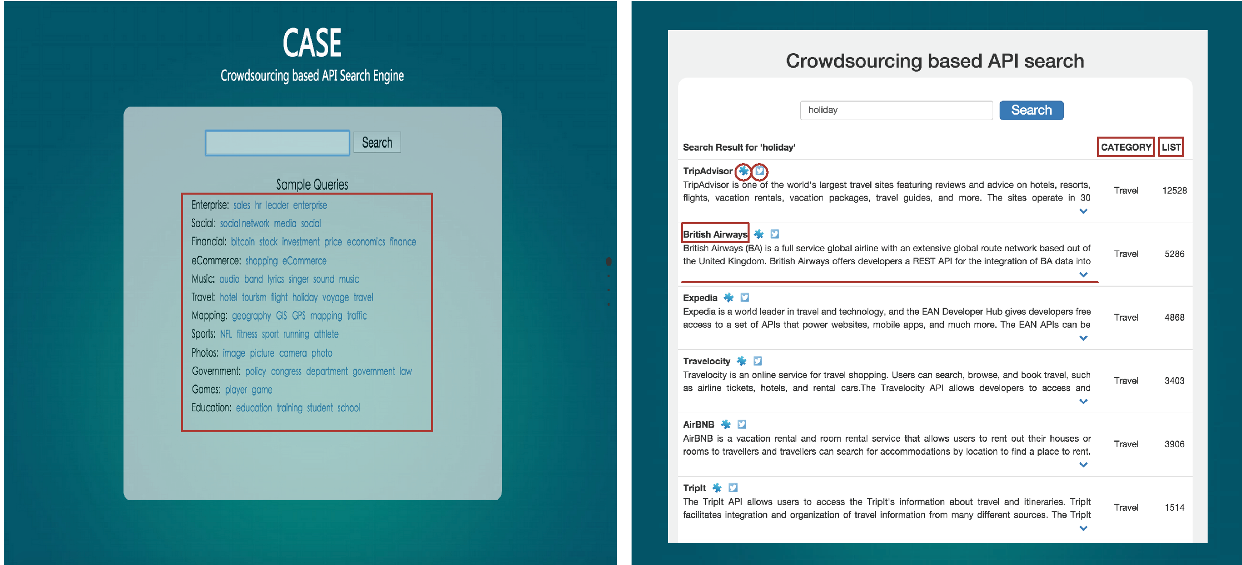 Figure 2: The CASE Search Interface displaying results for the query "holiday".
Critical Analysis & Conclusion
Takeaway
CASE proves that the "wisdom of the crowd" is not just for social trends—it is a viable tool for indexing technical software components. By using Twitter Lists, the authors effectively delegated the task of "categorization" to thousands of humans, creating a dynamic, self-updating taxonomy.
Limitations & Future Work
While innovative for its time, CASE faces two main challenges today:
- Platform Dependency: Relying on Twitter (X) data makes the system vulnerable to API access changes and platform volatility.
- LSI vs. Transformers: Modern LLMs (Large Language Models) might capture these semantics even more effectively than LSI without needing as much external metadata.
The future of CASE involves automatic tag generation and a recommendation engine for "mashups"—suggesting which APIs work best together based on their co-occurrence in user lists.