
Catalyzing Social Support: Bridging the Gap Between Patient Needs and Community Willingness
Catalyzing social support for breast cancer patients
This paper presents a participatory design study to catalyze social support for breast cancer patients through a prototype web application built on Facebook Connect. It introduces mechanisms for explicit help requests, "proxy" and "coordinator" roles, and visual feedback systems to bridge the gap between patient needs and social network willingness.
TL;DR
Breast cancer patients often face a "support paradox": they desperately need help but are too exhausted or guilty to ask for it, while their social networks want to help but don't know how to start. This paper explores a Participatory Design approach to create a Facebook-based system that transforms passive social networks into active support communities through explicit task management, delegated roles, and visual motivation.
The Motivation: Why Desired Help Often Goes Ungiven
In the realm of cancer care, social support is a critical factor for recovery and mental health. However, researchers identified a massive gap in utilization.
- The Patient's Barrier: Patients overestimate the "burden" their requests place on others. During treatment, cognitive load and fatigue make it nearly impossible to "formulate a way to ask."
- The Network's Barrier: Friends and family often fear being pushy or assume someone else is already handling the tasks.
Existing solutions like CaringBridge or CarePages function primarily as digital diaries. They inform the network but don't catalyze action. The authors argue that we need a shift from broadcasting info to coordinating effort.
Methodology: Designing with the Patient, Not Just for Them
The team conducted two series of Participatory Design (PD) sessions with survivors and patients. This collaborative approach ensured the resulting technology reflected real-world nuances, such as the need to say "no thank you" to unwanted help without social awkwardness.
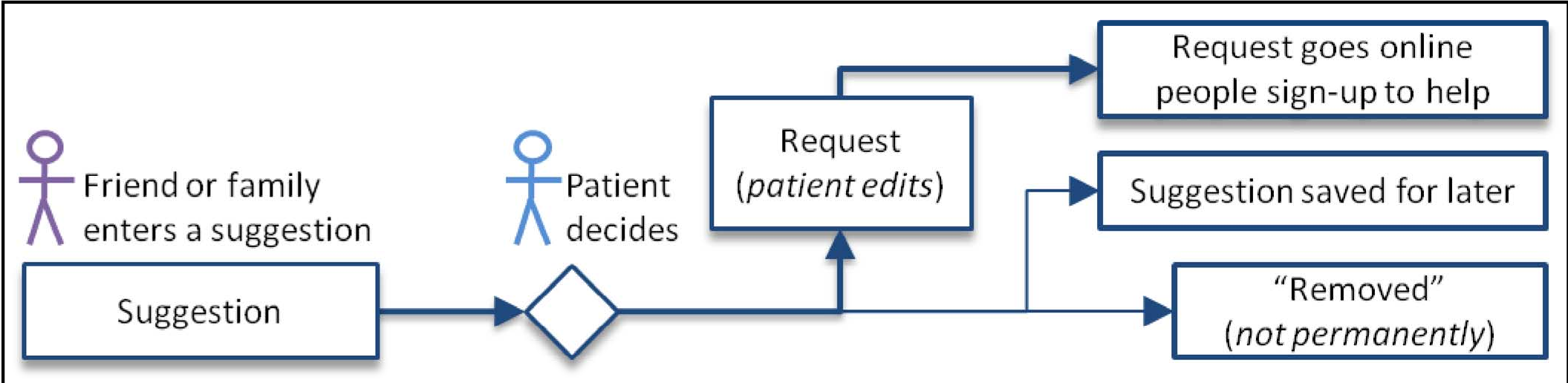 Figure: The proposed workflow where suggestions can come from the network or be initiated by the patient.
The Core Innovation: Proxies, Coordinators, and the "Helping Quilt"
The methodology led to several "Academic SOTA" insights for health-tech design:
- Proxies & Coordinators: To prevent patient burnout, the system allows for a "Proxy" (a trusted person with full access) and a "Coordinator" (someone who manages a specific domain, like all meal-related tasks).
- The structured Help Request: Instead of a blank text box, the system provides categories (Everyday Chores, Medical Tasks, etc.) to prime both the patient and the helper.
- Visual Motivation (The Helping Quilt): To foster a sense of community, the prototype uses the "Helping Quilt" visualization. As tasks are completed, a digital quilt is built with the faces of the helpers.
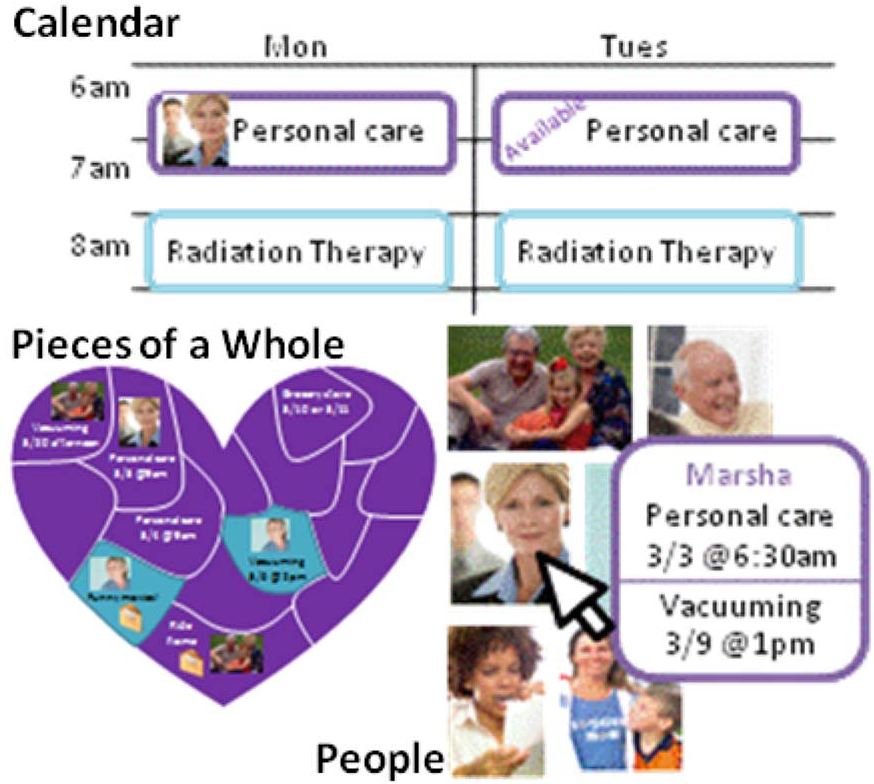 Figure: Three interface concepts—Calendar, Pieces of a Whole, and People-centric—to show active support.
Strategic Implementation on Facebook Connect
By building on Facebook Connect, the researchers leveraged existing social graphs. This lowered the "adoption barrier" because friends and family didn't need to join a new, obscure medical site; the status updates and help requests were integrated into their existing daily digital habits.
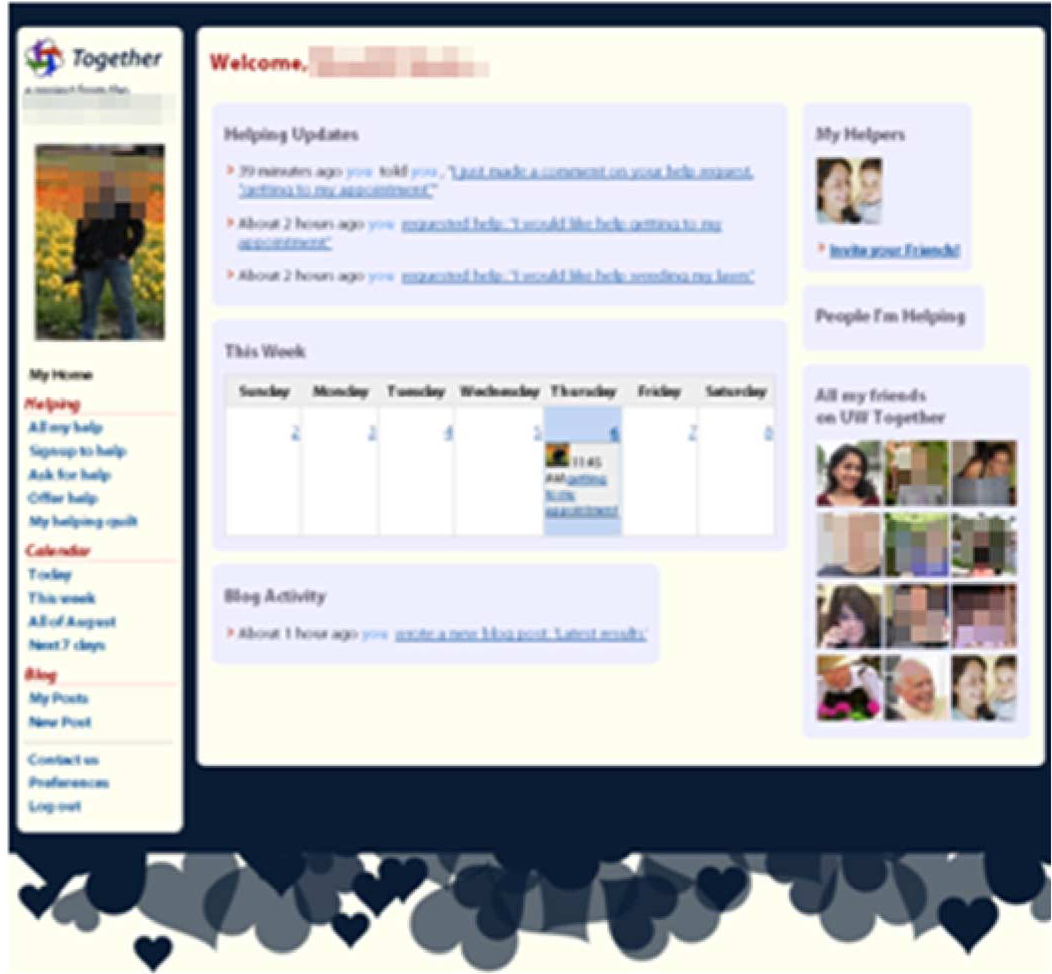 Figure: The final prototype homepage, integrating social networking with structured care coordination.
Critical Analysis & Future Outlook
The value of this paper lies in its Human-Computer Interaction (HCI) insights into the psychology of asking. It recognizes that "privacy" isn't just about data security—it's about control over social dynamics.
Limitations: The study was conducted with a relatively small, tech-savvy group. Future work must address "helper fatigue" (burnout among the network) and how to support those without robust existing social networks.
Takeaway: Effective health systems must move beyond the "patient-doctor" dyad. By designing for the entire social ecosystem, technology can transform a patient’s Facebook feed from a source of FOMO (Fear of Missing Out) into a powerful engine for recovery.