
Catching the Drift: Leveraging Social Initiators for More Responsive Recommendations
Catching Preference Drift with Initiators in Social Network
The paper introduces a trend-based collaborative filtering model that captures user preference drift by identifying "initiators"—influential users who trigger trends in social networks. By combining global trend information from these initiators with local personalization from neighbors, the model achieves superior accuracy over traditional CF and time-weighted methods on the Lastfm dataset.
TL;DR
Recommender systems often struggle to keep up when your tastes change—a phenomenon known as Preference Drift. This paper argues that instead of just looking at time, we should look at who is setting the trends. By identifying Initiators (influential users) via a random walk model and mixing their behavior with your personal history, the authors increased recommendation accuracy and reduced the lag time for discovering new content.
The "Lag" Problem in Current Recommenders
In the world of Collaborative Filtering (CF), we usually assume: "If you liked this in the past, you'll like it now." But humans are fickle. Our music tastes shift, and new trends emerge.
Current methods try to fix this in two ways, both of which have flaws:
- Time-Weighting: Giving more weight to recent actions. The Problem: This often throws away deep, static preferences that are still valid.
- Neighborhood CF: Waiting for your "neighbors" to like something new. The Problem: Influence takes too long to propagate through a standard neighborhood, making the system slow to react to new trends.
The authors' insight? Trends don't just happen; they are started by a minority of influential members. If we can identify these "initiators," we can "short-circuit" the propagation process.
Methodology: Ranking the Trendsetters
The core of the paper is a two-step algorithm:
1. Identifying Initiators via Random Walk
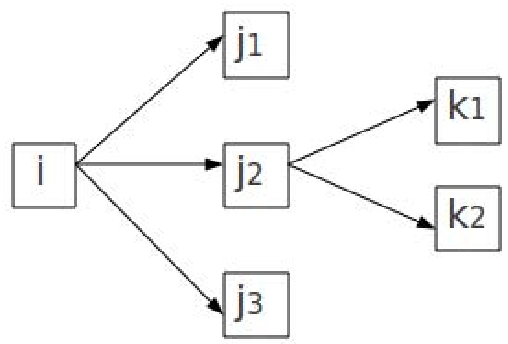
The authors treat the user-item interaction history and social links as a directed graph. A user i is influenced by user j if j rated an item before i. To find the true initiators, they apply a Random Walk on a Markov Chain, similar to Google’s PageRank.
Weights are calculated using a transition probability matrix :
- If user j influences user i, the weight includes a factor based on the number of influenced friends.
- A Teleport Operation () is used to handle users with no friends, ensuring the Markov chain is ergodic and converges to a steady state .
2. The Hybrid Recommendation Model
The authors propose a model that balances Personalization and Trends: Here, acts as the dial. If is low, the system listens to your close friends (Personalization). If is higher, it looks at what the global initiators are doing (Trend Information).
Experimental Insights
Testing on the Lastfm dataset (music recommendation), the researchers found several key results:
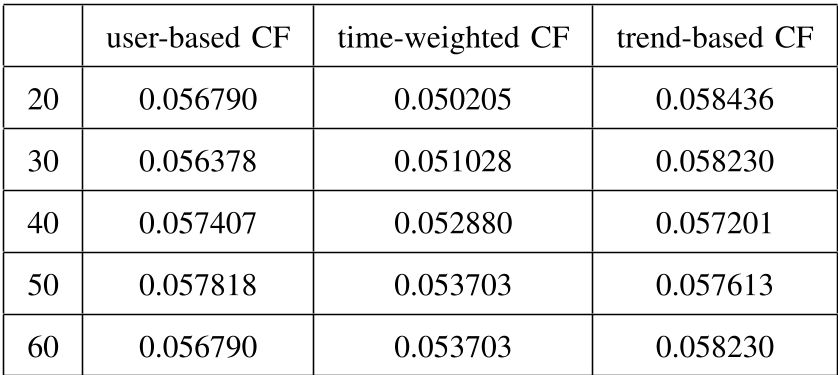
- Accuracy (Hit Ratio): The trend-based model consistently beat classic CF and time-weighted CF. Simple time-decay performed the worst, proving that "newer is not always better" if you lose the user’s core identity.
- Speed of Discovery (Average Age): The model recommended "younger" (newer) items compared to standard CF. By following initiators, the system catches a trend before it becomes mainstream.
- The Sweet Spot: The best performance occurred at and a time window months. This suggests that while trends are important, they should only account for about 20% of the recommendation logic.
Critical Analysis & Conclusion
This paper offers a robust alternative to purely temporal models. Instead of treating time as a linear decay, it treats it as a social propagation phenomenon.
Limitations:
- The model relies heavily on the quality of the social graph. In "dark" social environments where tagging is rare, finding initiators might be difficult.
- The parameter is static; in reality, some users might be "trend-followers" who need a high , while others are "loyalists" who need a low .
Future Work: The industry is moving toward GNNs (Graph Neural Networks). Integrating "initiator" weighting into a GNN embedding space could be the next logical step for SOTA performance in dynamic environments.