
Mining Structural Hole Spanners: The Gatekeepers of Social Information Diffusion
Categories and Subject Descriptors
This paper introduces a principled methodology for mining Top-k Structural Hole (SH) spanners—users who bridge disconnected communities—in large-scale social networks. The authors propose two models, HIS (a mutual recursion importance model) and MaxD (a minimal-cut based model), achieving state-of-the-art performance in identifying influential intermediaries in networks like Twitter and Coauthor.
TL;DR
In the vast web of social networks, certain individuals act as critical bridges between isolated groups—these are known as Structural Hole (SH) Spanners. This paper provides the first systematic algorithmic framework to identify these brokers. By applying two new models, HIS and MaxD, the researchers proved that a tiny fraction of users (1%) can control a massive portion (25%) of information flow across a network.
Background: Brokerage vs. Authority
In sociology, a "structural hole" is a gap between two groups with complementary resources or information. The person who fills this gap gains immense power. However, identifying these people algorithmically is difficult. Most existing algorithms, like PageRank, are designed to find "Opinion Leaders" (authorities within a group). A structural hole spanner, however, might not be the most famous person in any one group, but they are the only link between many.
Problem & Motivation: Why is this hard?
Current social network analysis often conflates "power" with "popularity." The authors argue that:
- Metric Gap: Traditional metrics like degree centrality fail to capture the "bridging" nature of nodes.
- Computational Complexity: Detecting nodes that influence the "Minimal Cut" (the smallest number of edges needed to separate communities) is computationally expensive and, as this paper proves, NP-hard in unweighted graphs.
Methodology: Two Paths to Brokerage
1. The HIS Model (Hierarchical Importance Score)
The HIS model is built on a recursive intuition: a node is an important structural hole spanner if it connects to high-status opinion leaders in different communities. Conversely, an opinion leader gains more influence if they are connected to structural hole spanners who bring in "fresh" information from other domains.

2. The MaxD Model (Minimal Cut Maximization)
MaxD takes a flow-theory approach. It defines SH spanners as the nodes whose removal results in the largest drop in the network's Minimal Cut. Since this is NP-hard, the authors developed MaxD-AL2, an efficient greedy algorithm with provable approximation guarantees.

Experimental Evidence: Controlling the Narrative
The authors tested their models on Coauthor, Twitter, and Inventor networks.
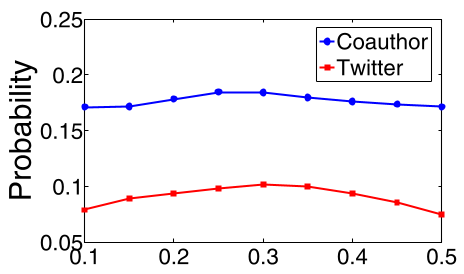
- Information Diffusion: In Twitter, SH spanners are significantly more likely to appear on a "retweet path" between different communities than standard opinion leaders.
- Cross-Domain Influence: In the Coauthor network, people from domain A are more likely to cite an SH spanner when looking for insights from domain B, rather than an opinion leader strictly within domain B.
Deep Insights & Applications
Beyond just finding brokers, the study shows that knowing who the SH spanners are improves other tasks:
- Community Kernel Detection: By weighting SH spanners properly, algorithms can better identify the core "kernels" of communities (+10% improvement).
- Link Prediction: SH spanners provide a "social glue" that helps predict whether two other people are likely to become friends (+3-5% F1-score).
Conclusion
This work formalizes the "Brokerage" advantage in social networks. Whether it's a researcher bridging Artificial Intelligence and Economics, or a Twitter user connecting different political bubbles, these individuals are the key to information diversity. The HIS and MaxD models offer a scalable way to find these individuals in networks with millions of nodes, providing a powerful tool for marketing, innovation research, and social science.
Limitations: The current models rely strictly on network topology. Future iterations that incorporate content analysis (what people are actually saying) could perhaps differentiate between specialized bridges and general "noise" broadcasters.