
QASCA: Bridging the Gap Between Crowdsourcing Task Assignment and Application Metrics
Categories and Subject Descriptors
QASCA is a quality-aware online task assignment system for crowdsourcing (e.g., Amazon Mechanical Turk) that dynamically selects question batches for workers based on application-specific metrics. It primarily focuses on optimizing Accuracy and F-score, achieving over 8% quality improvement over state-of-the-art methods across various real-world applications.
TL;DR
In the world of crowdsourcing (think Amazon Mechanical Turk), not all "answers" are created equal. QASCA (Quality-Aware Task Assignment) is a groundbreaking framework that moves beyond simply asking "which question is most uncertain?" Instead, it asks: "Which question, if answered by this worker, will most improve our final F-score or Accuracy?" By aligning task assignment with the actual metrics used to judge an application, QASCA achieves a significant 8%+ boost in data quality.
The Blind Spot in Current Crowdsourcing
Most crowdsourcing platforms treat task assignment as a generic problem of reducing uncertainty. However, different applications have different "pain tolerances":
- Sentiment Analysis usually cares about Accuracy (the total % of correct labels).
- Entity Resolution (e.g., "Are these two product listings the same?") often cares about the F-score, balancing Precision and Recall.
Existing systems like AskIt! or CDAS are "metric-blind." They might spend your budget perfecting "Neutral" labels in a sentiment task when you actually only care about catching "Positive" ones. QASCA fixes this by making the evaluation metric the "North Star" of the assignment process.
Methodology: The Math of Intuition
The core challenge of QASCA is that you don't know the ground truth when you are assigning questions. The authors solve this through a two-step probabilistic approach:
1. Estimating Quality Without Ground Truth
Since metrics like Accuracy and F-score require knowing the right answer, QASCA uses Accuracy* and F-score*. These are expectations calculated over a Distribution Matrix (Q). This matrix tracks the probability of each label being correct based on previous workers' reputations (modeled via Confusion Matrices).
2. The Efficiency Hurdle
Finding the optimal batch of questions is a combinatorial nightmare. For F-score, this is a 0-1 Fractional Programming problem. To ensure the system doesn't lag when a worker clicks "Request HIT," QASCA employs the Dinkelbach Framework. This iterative approach turns a complex ratio optimization into a series of linear-time sub-problems.
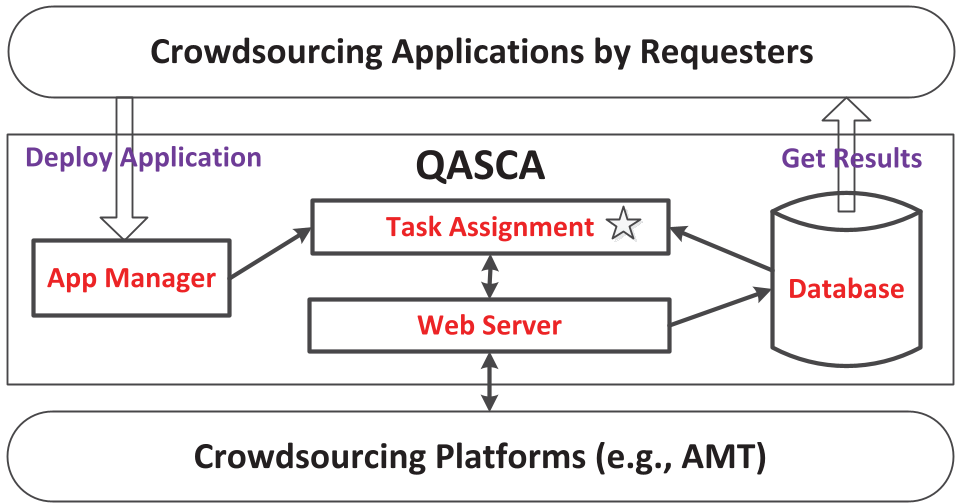 The QASCA system sits atop platforms like AMT, dynamically generating HITs based on real-time worker quality assessment.
Real-World Evidence
The authors tested QASCA against five state-of-the-art baselines. One of the most fascinating takeaways was how QASCA adapts to the parameter in F-scores:
- When is high (emphasizing Precision), the system prioritizes questions that will confirm a label with high confidence.
- When is low (emphasizing Recall), it casts a wider net to find as many target labels as possible.
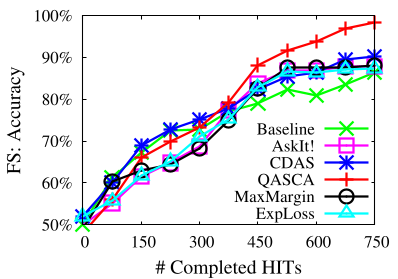 Across multiple datasets, QASCA (solid line) consistently reaches higher quality faster than random (Baseline) or uncertainty-based (AskIt!) methods.
Critical Insights & Takeaways
The brilliance of QASCA lies in its Inductive Bias: it assumes that the requester’s end goal is the only thing that matters.
- Value of the "Confusion Matrix": The paper proves that simple "Worker Reliability" scores are insufficient. Understanding how a worker fails (e.g., a worker who confuses "Positive" with "Neutral" is different from one who confuses "Positive" with "Negative") is crucial for precise quality estimation.
- Scalability: With assignment times under 0.06 seconds for thousands of questions, this is a "production-ready" academic work.
Conclusion
QASCA demonstrates that in the "Human-in-the-loop" AI era, the way we collect data is just as important as the model that eventually consumes it. By being "Quality-Aware," we can get better data for less money.