
Estimating the Scale of Social Networks: A Random Walk Through Triangles and Collisions
Categories and Subject Descriptors: F.2.2 [Theory of Computing]: Analysis of Algorithms and Problem Complexity
The paper presents a unified random walk framework for estimating global and average clustering coefficients and the total number of registered users (network size) in social graphs. Using only public "friends list" interfaces, the authors introduce the first external-access estimator for the global clustering coefficient and a generalized collision estimator that unifies prior node- and edge-collision methods.
TL;DR
How do you measure a network of a billion users when you can only see a user's friends list? This paper provides a mathematically rigorous way to estimate clustering coefficients and network size using nothing but a simple random walk. By introducing a new Generalized Collision Estimator, the authors achieve over 20% better accuracy than previous state-of-the-art methods.
The "Public Interface" Bottleneck
In the world of social network analysis, we rarely have the "God View" of the entire graph. Companies like Facebook or LinkedIn expose only a public interface—a limited API that lets you see who a specific user is friends with.
The challenge is two-fold:
- Structural Analysis: How do we measure "transitivity" (how likely your friends are to be friends with each other) without counting every triangle in the graph?
- Size Estimation: How do we know how many users exist in total if we can only hop from one user to the next?
Methodology: The Power of the Walk
The authors treat the social network as an undirected graph . Their primary tool is the Random Walk—starting at a node and hopping to a random neighbor.
1. The Unified Clustering Approach
The authors observe that while walking, we naturally encounter connected triplets (a sequence of three nodes where exists). By checking if the closing edge () exists in the public interface, we can estimate cliquishness.
They use Conditional Monte Carlo (CMC) to boost efficiency. Instead of just checking the current walk path, they look at the overlap of the entire adjacency lists of visited nodes. This "lookahead" significantly reduces the variance of the estimate.
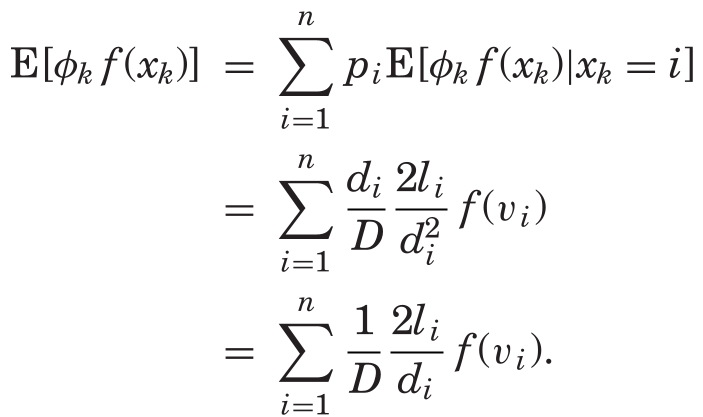
2. Generalizing Collisions for Network Size
The "Birthday Paradox" logic suggests that if we sample enough users, we will eventually "collide" (see the same user twice). The frequency of these collisions tells us how big the "room" (the network) is.
The authors' Generalized Collision Estimator introduces a weight function .
- When , it becomes the "Induced Edges" estimator.
- When , it acts as the "Node Collision" estimator.
- By tuning , they find a "sweet spot" tailored to the specific degree distribution of a network.
Experimental Results: Slicing the Error
The researchers validated their claims on four diverse datasets: DBLP (co-authors), Orkut, Flickr, and LiveJournal.
Performance in Size Estimation
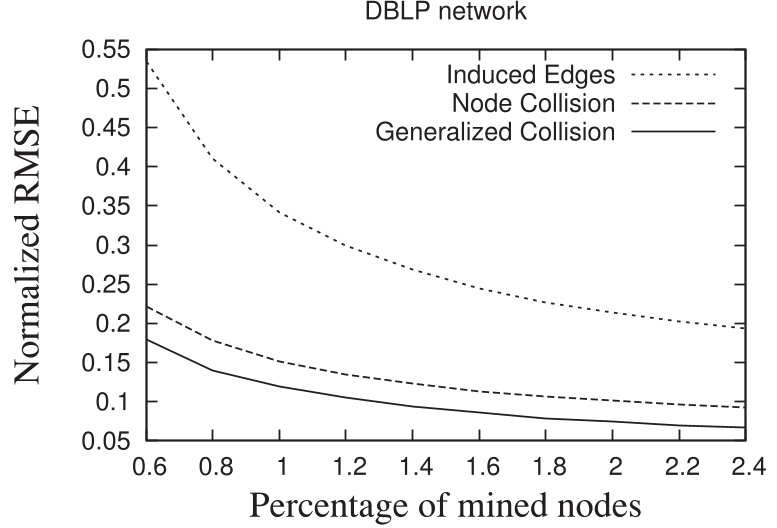
The Generalized Collision estimator (using a blockwise jackknife method to find the optimal ) consistently outperformed predecessors. For the DBLP network, the accuracy improvement was over 20% compared to standard node-collision methods.
Clustering Accuracy
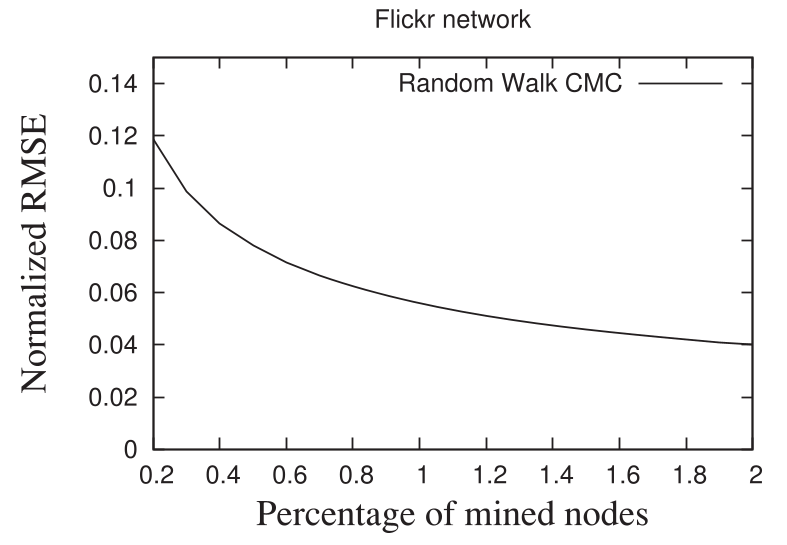
With as little as 1% of the network "mined" (visited), the algorithms produced estimates of the average clustering coefficient with an RMSE of 0.01 to 0.05. This is highly practical for business or sociological research where a 95% confidence interval is sufficient.
Critical Insight: Why Does It Work?
The genius lies in the weighting. Standard random walks are biased toward high-degree nodes (the "popular" people). Most prior works tried to "unbias" this. This paper, however, suggests that we can leverage this bias. By adjusting the parameter, the estimator can favor collisions between nodes that provide the most information about the overall graph density.
Summary and Limitations
This work provides a robust toolkit for "external" graph analysis. However, it assumes a stationary distribution can be reached (i.e., low mixing time). While social networks typically have "small world" properties that allow for fast mixing, highly fragmented or "bottlenecked" networks might require much longer walks.
Takeaway: If you need to estimate the size or density of a sub-community within a massive platform, don't try to crawl it all. Walk it, watch for collisions, and use the degree-weighted generalized estimator.