
Beyond Frequency: Mining Causal Signals in Postmarketing Drug Surveillance
A Potential Causal Association Mining Algorithm for Screening Adverse Drug Reactions in Postmarketing Surveillance
The paper introduces a novel data mining approach for postmarketing drug surveillance using Potential Causal Association Rules (PCARs). The core method utilizes a fuzzy Recognition-Primed Decision (RPD) model to calculate "potential causal leverage," significantly improving the identification of rare Adverse Drug Reactions (ADRs) in electronic health records compared to traditional frequency-based metrics.
Executive Summary
TL;DR: Detecting rare Adverse Drug Reactions (ADRs) is a "needle in a haystack" problem. Researchers have developed a novel algorithm that replaces simple frequency counting with Potential Causal Association Rules (PCARs). By using a fuzzy logic-based decision model to weight the quality of clinical evidence rather than just the quantity, this method identifies life-saving drug safety signals that traditional statistical methods overlook.
Academic Context: This work bridges the gap between traditional association rule mining and clinical causal reasoning. It moves pharmacovigilance from simple "co-occurrence" toward a more nuanced, experience-based "causal signaling."
The Problem: The Inadequacy of Frequency
Postmarketing surveillance (Phase IV) is critical because rare ADRs—those occurring in fewer than 1 in 1,000 patients—are often missed in clinical trials. Current systems like the FDA's MedWatch rely on voluntary reporting, which captures less than 10% of actual cases.
When we turn to Electronic Health Records (EHR) to fill this gap, we face two major hurdles:
- The Infrequency Bias: Rare ADRs are statistically "quiet" and get drowned out by common, unrelated symptoms.
- Confounding by Indication: EHRs use the same ICD-9 codes for the disease being treated and the side effect (e.g., a patient taking a drug for a lung condition might have a cough due to the disease, not the drug).
Methodology: Potential Causal Leverage
The authors suggest that not all drug-symptom occurrences are created equal. They introduce the Potential Causal Leverage measure.
1. The Fuzzy RPD Model
Instead of a binary "Yes/No" for a drug-ADR pair, the system uses a Recognition-Primed Decision (RPD) model. It mimics how a physician thinks by evaluating four cues:
- Temporal Association: Did the drug come before the symptom?
- Dechallenge: Did the symptom stop when the drug was withdrawn?
- Rechallenge: Did the symptom return when the drug was restarted?
- Other Explanation: Could a concurrent disease explain the symptom?
2. Algorithmic Flow
The algorithm classifies every patient case as a "case" or "non-case" and calculates a membership value across four categories: Very Likely, Probable, Possible, and Unlikely.
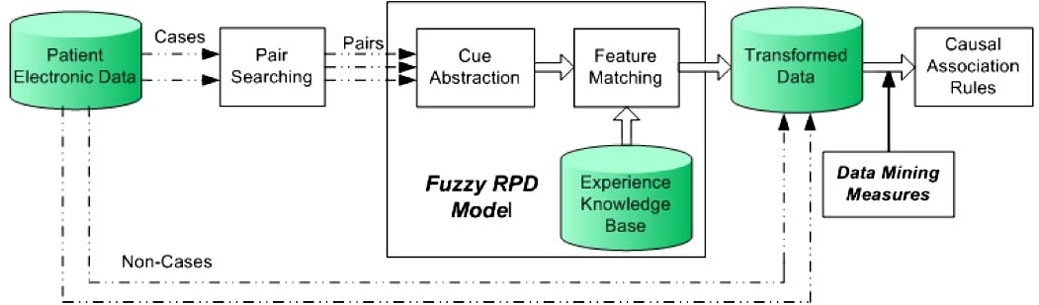
Experiments: Enalapril as a Case Study
The researchers tested their approach on data from over 16,000 patients at the Detroit Veterans Affairs Medical Center, focusing on Enalapril (an ACE inhibitor).
Key Findings
While traditional measures like Risk Ratio and Leverage struggled to find known ADRs like "Cough" (ranking it as low as 1239th), the Potential Causal Leverage measure brought it into the spotlight.
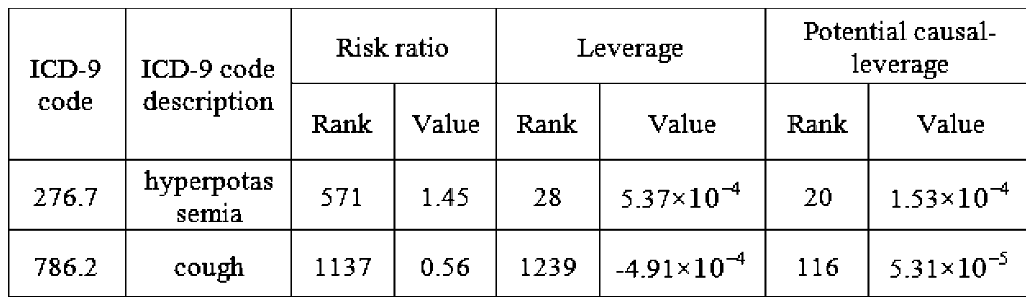
The algorithm identified:
- Hyperpotassemia (High Potassium): Ranked 20th by the new measure.
- Cough: Ranked 116th (massive improvement from traditional methods).
- New Signals: The top 50 ranked pairs contained 8 probable true causal associations.
Critical Insight: Why Fuzzy Logic?
The genius of this approach lies in the weighted sum of causality. Standard mining treats every record as a "1". If a patient has a cough but also has pneumonia, a human doctor knows the drug might not be the cause. The fuzzy RPD model captures this nuance by giving that specific record a lower causality score (e.g., 0.1), preventing it from skewing the data.
Conclusion & Future Outlook
This paper represents a significant shift in postmarketing surveillance. By integrating expert clinical intuition (via fuzzy rules) with large-scale data mining, we can prioritize which drug-symptom pairs deserve expensive epidemiological follow-up.
Limitations: The model is highly dependent on the quality of EHR data. If "rechallenge" or "dechallenge" events aren't documented, the fuzzy model loses its most powerful cues. Future work likely involves using NLP to extract these hidden cues from physician notes.
Final Takeaway: Causal-aware data mining is the future of drug safety. It transforms EHR data from a simple record of "what happened" into a predictive tool for "why it happened."