
Beyond the Type-Box: How Twitter’s Character Limit Change Proves the Power of Affordances
Causal effects of affordance change on communication behavior: Empirical evidence from organizational and leadership social media use
This study provides rare causal evidence on how digital media affordances shape communication behavior by analyzing Twitter's 2017 transition from 140 to 280 characters. Using an instrumental variable (IV) approach on 143,771 tweets from organizational and leadership accounts, the author demonstrates that affordance changes significantly increase post length and multimedia integration.
TL;DR
Is our online behavior a result of technical design or personal choice? By analyzing Twitter’s historic jump from 140 to 280 characters, this study provides rigorous causal evidence that technology "nudges" us, but our past frustrations (perceived constraints) dictate how much we actually change. The research finds a significant increase in both text and—unexpectedly—multimedia use, proving that a simple change in a text limit can overhaul an entire communication protocol.
The "Affordance" Deadlock: Determinism vs. Agency
For years, communication scholars have debated whether the medium is truly the message. Technological Determinism suggests that if Twitter gives us 280 characters, we will use them because the system demands it. Conversely, Social Constructivism argues that users interpret tools as they see fit, often ignoring or subverting original designs.
The author, Alvin Zhou, uses the concept of Affordances—the action possibilities provided by an environment—to bridge this gap. The problem was a lack of data: how do you prove a causal link when platforms rarely change their core rules? Twitter’s 2017 update provided the perfect "quasi-natural experiment."
Methodology: The Encouragement Design
The study focused on 184 high-stakes accounts (Fortune 500 companies and global leaders) because their social media behavior is typically stable and "organization-centric," making them ideal subjects for an Instrumental Variable (IV) approach.
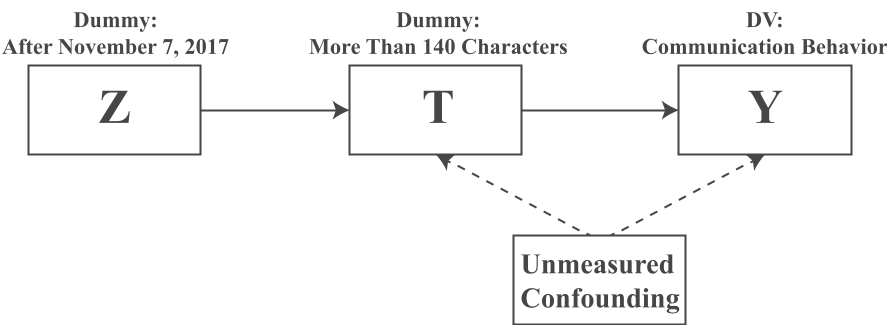
The logic is elegant: The date (Nov 7, 2017) acts as a "nudge." It doesn't force you to write more, but it affords the opportunity. By using a Two-Stage Least Squares (2SLS) model, the author could isolate the specific effect of the character limit while controlling for individual account differences (fixed effects).
Key Findings: The "Spillover" to Multimedia
The results confirm that affordance changes have a population-level impact, but the nuances are fascinating:
- Quantitative Growth: Tweets grew by an average of ~48 characters.
- The Multimedia Paradox: Even though media attachments (images/videos) were never restricted by character counts, their use increased by 0.44 units per tweet. This suggests that when developers expanded the "box," users re-evaluated their entire "communication protocol," moving away from plain text.
- The Agency Factor: Why did some accounts (like Target) embrace the change while others (like Pepsi) became more concise? The answer lies in Communication Constraint.
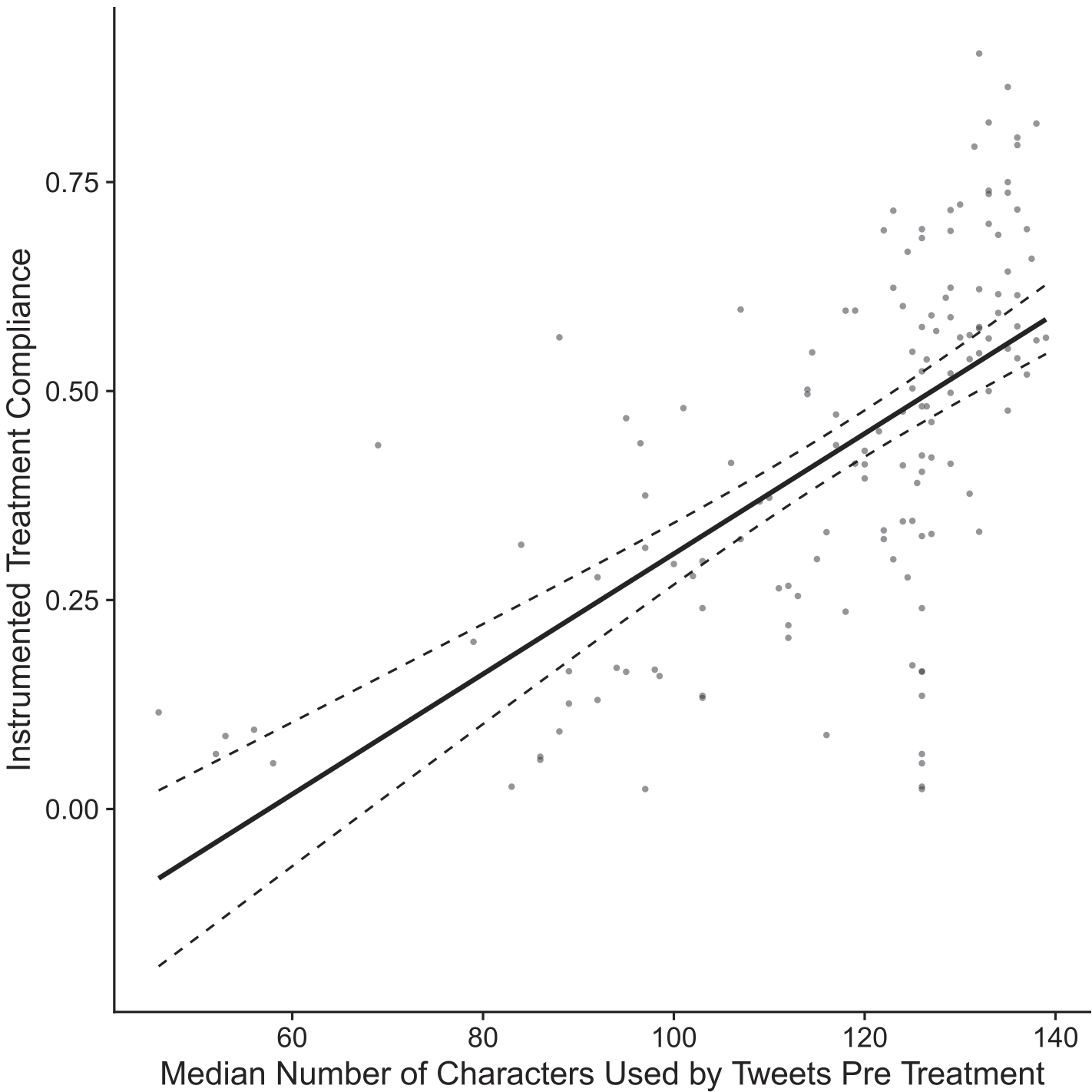
As shown in the figure above, accounts that were "bottlenecked" by the 140-character limit (regularly hitting 130+ characters pre-intervention) showed the highest compliance with the new 280-character limit. Their subjective experience of the old technology predicted their adoption of the new.
Critical Insight: The "Third Way"
This paper serves as a vital reminder for Tech Product Managers and UX Designers: Human agency is not a vacuum.
Users don't just react to features; they react based on the scars of previous technical limitations. The study proves that "perceived affordances" are just as important as "actual affordances." When you change a feature, you aren't just changing a tool; you are altering the relational dynamic between a human's intent and the machine's constraints.
Conclusion & Limitations
While the study successfully identifies causality, it focuses on high-profile organizations. Whether "personal" accounts follow the same logic of perceived constraint remains a question for future research. However, the takeaway is clear: ICT (Information Communication Technology) development isn't just about adding capacity—it's about understanding the "imagined affordances" that users carry with them.
For those interested in the raw data or replicating the econometric models, the author has made the dataset and R scripts available via the Open Science Framework.